
Imagine trying to write a narrative history of the United States in the mid-2020s. The entire process is fraught with standard issues of historiography, such as where to start and end, what to include and leave out, and so on. Furthermore, no matter what route the historian takes, he or she writes across a political minefield. Partisan and ideological biases tempt the writer and reader at every turn. On the one hand, we may encounter hagiographical accounts, often on the Right, animated by an ideological nationalism and an arrogant patriotism that refuses to acknowledge anything broken or scarred. America’s sins are either ignored, explained away, or even embraced as virtues. The story of the United States is one of good and evil, heroes and villains. On the other extreme, to the Left, are those who cannot decide if they hate to love America or love to hate it. Here, America’s story is primarily one of hypocrisy, oppression, inequality, superstition, and violence. American history becomes something to apologize for, overcome, and resent, rather than something to celebrate. Like the extremes on the Right, this history is also one of good and evil, heroes and villains; the only difference is how the characters are classified. While such extreme histories are rare, many modern history textbooks evince a temptation toward one or the other. A more nuanced story of the United States may be more challenging to write, but it is deeply needed for an informed citizenry.
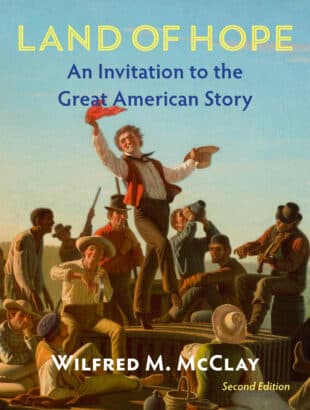
Wilfred M. McClay’s Land of Hope meets this challenge brilliantly. For those of us who want to transmit to our children knowledge of American history untainted by ideology, this is undeniably the best volume to use. It is a history animated throughout with honesty and humility toward the past, and with gratitude for the generations to which we are indebted. It’s as if he set out to write the biography of a parent from the perspective of a loving child whose affection for mom and dad only increases with knowledge of their flaws.
McClay’s account is especially distinguished by its emphasis on hope. His explanation here is worth quoting in full:
In fact, nothing about America better defines its distinctive character than the ubiquity of hope, a sense that the way things are initially given to us cannot be the final word about them, that we can never settle for that. Even those who are bitterly critical of America, and find its hopes to be delusions, cannot deny the enduring energy of those hopes and are not immune to their pull. Of course, hope and opportunity are not synonymous with success. Being a land of hope will also sometimes mean being a land of dashed hopes, or disappointment. That is unavoidable. A nation that professes high ideals makes itself vulnerable to searing criticism when it falls short of them—sometimes far short indeed, as America often has.
Throughout the book, that hope and that aspiration can take varying forms. It may simply be the aspiration toward freedom, peace, and justice rooted in reality and human nature. Other moments in the story show utopian aspirations to overcome human nature or economic reality. Still other moments showcase an individual or group’s aspiration for power, privilege, or simply the right to be treated equally. The hopes and dreams of Americans move McClay’s narrative along and help us see the past through the eyes of people whose aspirations often look and feel more familiar than we might expect.
By putting hope at the center of his historical narrative, McClay is also placing the person—the whole human condition: material, physical, social and otherwise—at the forefront. The American story is not some march of abstract ideas or a seemingly inevitable unfolding toward greatness or failure. It is, rather, an inspiring drama of individuals and groups searching for meaning, liberty, prosperity, and justice. It’s a story readers will want to be a part of, but which carries no small number of cautionary tales.
The Importance of Insight
Content-wise, it would be difficult to improve on McClay’s text, given the size. A more detailed narrative account has been provided by the multi-volume Oxford History of the United States, but this is impractical for the modern classroom prior to graduate school. McClay’s exceptional discernment for what to include and leave out is worth a study on its own.
“History always begins in the middle of things,” McClay writes, and so the book roots the American story in a broader context of human history and within Western history generally. The themes of hope appear early, then, in the exploits of explorers like Columbus and those fleeing religious persecution.
McClay pays refreshingly careful and respectful attention to the role of religion in all its competing currents, and the hopes of many in the search to practice their faith freely. He takes seriously the theological and ecclesiological context and subtly showcases his interdisciplinary character throughout the narrative. Themes of race, class, gender, and sexuality are not absent, but in no way does McClay stray toward cultural Marxism, nor does he reduce history to the struggle between narrowly conceived demographic categories. The role of faith, economic aspirations, and the simple desires for peace and liberty are more compelling explanations for historical currents anyway, and the “players” in the American story seem to have seen it that way too.
The book noticeably “slows” when McClay gets to the Civil War. His attention to slavery is particularly nuanced and thorough. He obviously never endorses the practice but tries to understand why there was such an intense and violent debate about an issue that is essentially decided today. On the one hand, it is a sign of progress that we can’t imagine endorsing slavery in our own time. On the other hand, it may be a failure of imagination to conceive why the same people that signed and celebrated the Declaration of Independence could allow such grievous injustice.
Historical accounts are not just dumps of empirical “data,” but are most compelling when colored by deeper insights into the meaning and importance of key moments. They help connect abstractions with concrete reality. A great example of McClay’s mastery in this regard comes in his description of the two-day Grand Review of the Union Armies, several weeks after the Civil War. Starting on May 18, 1865, 200,000 men in a twenty-five-mile-long line marched through Washington, D.C. in front of thousands of spectators who traveled for miles to witness it. To McClay, this was a moment where the antebellum attitude of states resisting unity had given way to a more unified, national spirit. “The army,” he writes, “visibly represented the welding together of inconsequential individuals into a grand and powerful unit, with great and lofty objectives.” Until I read McClay’s book, I was not even aware this event took place. But it brilliantly captures a moment fraught with fear, exhaustion, pain, and, somehow, hope. This move toward a more united America was cause for concern among some and celebration among others. But that post-Civil War tension and spirit would be crucial as American hopes and dreams began to shape greater industrialization and urbanization, not to mention its implications for the coming waves of immigrants.
Insightful moments like this occur throughout the book. McClay’s observation that Americans of the late nineteenth century lacked an “urban ideal” is an observation worth exploring, for example. What is the quintessentially American city? Do we still lack an answer? His description of the Spanish-American War is more detailed than one typically encounters in similar books, and his treatment of progressivism’s tension between its religious and scientific sides will be excellent for classroom discussion. The same can be said of his concluding chapter on “The World Since the Cold War.” “If history teaches us anything,” he writes, “it is that we only rarely have the power to grasp the meaning of events as they are occurring. Live long enough, and you will find out how true that is.” Indeed, one could argue that Americans are still in search of a post-Cold War order.
The book overall is simply great storytelling, saturated by Americans’ hopes, dreams, and failures. The soon-to-be-published second edition also provides a much needed upgrade and expansion with more headings, images, primary sources, timelines, maps, pull quotes, and more attention to the text’s usefulness for teachers. It is a history written for Americans, not in a way to pander or chastise, but in a way that invites us to become part of that hope—the hope of our ancestors and the hopes of our children.
Provocations
McClay’s book does provoke two troubling questions, however. First, what happens when a nation has lost hope? It’s one thing to be honest about flaws and failures; it’s quite another to despair of any improvement or means by which to affect positive change. To say that Americans have “lost hope” en masse seems like quite the overstatement, and it’s unclear how one would even measure hopefulness well. But reflect for a moment on what we see so often, not only online but in contemporary film and literature, and especially with younger generations. Where is the hope?
In Seth Kaplan’s recent book, Fragile Neighborhoods, he observes, with supporting data, the following about the United States:
Our families and communities suffer from social problems that shock the rest of the world, and ought to shock us: family disintegration, homelessness, school shootings, racial animosity, skyrocketing rates of loneliness and depression, and deaths of despair—alcoholism, drug abuse, and suicide. No country in history has had such material wealth alongside such unprecedented social decay. … [Furthermore,] we don’t feel obligated to help our neighbors, give back to our community, or even (in many cases) care for members of our own family—and we resist joining any group or association that might create such obligations.
America, despite its overwhelming economic prosperity, has cultivated a disturbing amount of social poverty that is poorly understood. McClay’s book is an invitation to hope again and to see ourselves in the story of a great nation that aspires to be much more. Yet cynicism, distrust, and demoralization can be seen in classrooms across the country and in the mental health crises sweeping through campuses. One might argue that this loss of hope is precisely what postliberal movements on the Left and Right are feeding off of. Still, Land of Hope illustrates well Americans’ penchant for turning dark times into triumphs, but the War on Terror, COVID-19, the AI Revolution, the Iran War, and the widespread breakdown of key institutions has challenged all of that. Will we meet the moment?
The second provocative question then is whether there will be McClay-like figures in the twenty-second century willing and able to write that story. Will they see us clearly? Do we see ourselves clearly? There is a deep, urgent need to recover the historical consciousness, hope, patriotism, and responsibility that Wilfred McClay has exemplified in this book and throughout his career. Perhaps it is in his kind of storytelling that we can make America hope again.
—
Joshua J. Bowman (Ph.D., Catholic University of America) is the executive director of the Ciceronian Society, which encourages and equips Christian scholars who serve the Church as a center of cultural and civic renewal. His scholarly research focuses on the history of political philosophy and the intersection of Christianity and imagination with politics and thought, and especially with regard to education and the environment.