
“I didn’t, like many people who come to faith, see big banging lights,” Ayaan Hirsi Ali remarks during her June 3, 2024, debate with Richard Dawkins. What led to her conversion to Christianity was not a dramatic experience. Instead, as she puts it, “I had a personal crisis.” Ali speaks candidly with Dawkins about her struggles with depression and anxiety, along with her many attempts to manage the turmoil within. Eventually, she turned to prayer—a simple, humble acknowledgment of a reality greater than herself. No bright lights, no spectacle—just the quiet bending of the head and hands toward the God of all creation. Her experience of conversion, she explains to Dawkins, rekindled her “zest for life” and gave her a renewed sense of purpose and mission.
Dawkins, the renowned leader of the New Atheist movement, had mentored Ali, and in the video, he is visibly stunned by her admission. By his own admission, he came to the debate to persuade her that she was, in fact, not a Christian and did not believe in all the silly stuff like the Virgin Birth and the resurrection of Jesus. She acknowledges that for years she agreed with him. “But,” she tells him, “if you come around to the idea that there might be something much more powerful than we are—something that caused everything else—then something like Jesus rising from the dead and these other miracles, Jesus being born of a virgin, for that higher power is not a big deal.” Dawkins throws up his hands and concedes, “I came here prepared to persuade you, Ayaan, that you’re not a Christian. But I think you are a Christian.”
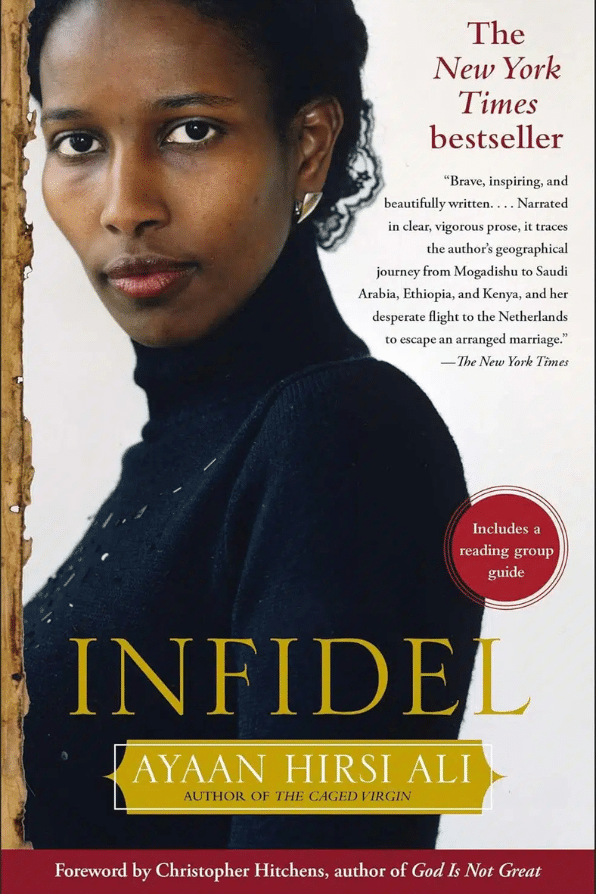
Before her conversion, Ali’s life had been marked by a persistent struggle for freedom. In her 2006 autobiography, Infidel, the Somali-Dutch activist and politician recounts the traumatic experiences of her youth in a Muslim-majority country, her eventual escape and political asylum in the Netherlands, and her global advocacy for women’s rights. Her encounter with the West taught her that, among many things, “life on earth is valued in the here and now, and individuals enjoy rights and freedoms that are recognized and protected by the state.” Now, however, she recognizes that true freedom is found not in radical autonomy but in submission to something greater than ourselves: a benevolent God who created the world and providentially reigns over it.
Ali is not alone in her turn toward Christianity; many intellectual elites are rediscovering God. Peter Savodnik has written about these “new theists” in The Free Press, surveying influential contemporary thinkers—including Matthew Crawford and Jordan Peterson—who are, as he puts it, “getting religion.”
Why are so many intellectuals giving faith a serious hearing? In my view, the answer lies in a complex interplay of “looking around” and “looking within.” Many intelligent and introspective people are looking around at the chaos of society and asking fundamental questions about citizenship and the good life. When these questions arise among them, they often begin looking within, searching their own hearts, and considering their standing before God. It is not easy to disentangle these dynamics, nor do I think we should. They are connected; each illuminates and reinforces the other.
When Ali first announced in a 2023 essay that she had become a Christian, she pointed to civilizational concerns as part of what drew her to Christ. “So, what changed? Why do I call myself a Christian now? Part of the answer is global,” she writes. For anyone shaped by an Evangelical context, this may sound unusual. Not many people who walk an aisle at a revival service explain to the pastor that they are converting to Christianity for “global” reasons. But the global reasons are the important signifier of a civilizational crisis, and the Christian culture that even made revivals possible is waning.
Those who are “looking around” are recognizing that the situation has deteriorated: civilization is shifting, even collapsing. The great revivals of the nineteenth and twentieth centuries aimed to reclaim wandering souls and to shore up a fading Christian culture. Today, however, after decades of mounting secular pressures, the major institutions of Western civilization, governments, universities, businesses, even churches, are buckling under the weight of a culture no longer sustained by Christian convictions.
“Western civilisation is under threat from three different but related forces,” Ali warns. These include the authoritarian expansion of regimes such as the Chinese Communist Party and Vladimir Putin’s Russia; the rise of global Islamism that is steadily advancing in Western societies; and the viral spread of woke ideology that is reshaping the next generation. For those who are “looking around,” the convergence of these forces is destabilizing the historic synergy between Christ and culture that undergirded Western civilization.
Ali observes that Western nations have attempted to confront these cultural challenges with “modern, secular tools,” including the military, economic development, diplomatic procedures, and technological strategies. Yet all of them, she argues, are ultimately inadequate. They cannot address the deeper need for a shared moral framework and social cohesion. The West cannot withstand these formidable pressures, she insists, “unless we can answer the question: what is it that unites us?” And unless the core mores of our civilization remain rooted in the “legacy of the Judeo-Christian tradition,” our prospects are dim.
Those looking around will also see that the state of the church is dire. In his recent book, The Vanishing Church, sociologist and former pastor Ryan Burge puts things bluntly: “The share of Americans who say that they never attended church service grew from forty-five million in 2008 to eighty-five million in 2022.” As a result, “thousands of churches are going to close across the United States over the next several decades.” The ripple effect of the vanishing church is not just shuttered buildings but the transformation of society. “The decline of the church is a problem not just for religiously inclined people—it’s a problem for us all,” Burge observes. We are no longer debating Niebuhr’s categories of Christ and culture; the very framework has collapsed, because the Christ in culture is fading.
This turn toward the fundamental assumptions of society, or the mores that bind us, marks a shift from “looking around” to “looking within.” Looking around and looking within are tethered together because the Christian spiritual life is not an idealist retreat, but the calling, as the apostle Peter tells us, to live “such good lives among the pagans that, though they accuse you of doing wrong, they may see your good deeds and glorify God on the day he visits us.” The Christian spiritual life is embedded in the world and lived among others, like leaven working through a lump of dough.
By looking within, some are finding that their own sinful persuasions have contributed to the web of depraved society surrounding us, and they find themselves groping for something better. Philosopher and author Matthew Crawford notes that, in the recent past, “very thoughtful people who once believed reason and science could explain everything—why we’re here, what comes after we’re gone, what it all means—are now feeling a genuine hunger for something more.” The “God-shaped void” many are rediscovering can only be filled by the Christian beliefs and convictions that flow from the Creator of all things. Many who spent years railing against the Christian establishment are discovering that the grass is not greener on the other side; in fact, the essential theological commitments of Christianity and the Christian vision of life are true and good.
Through Christ and a commitment to the church, those looking within find a renewed sense of purpose, a reason to live, and a hope for building, or even rebuilding, the beautiful goods of Western civilization. As Tom Holland explains in his celebrated book, Dominion—a book that Ali notes was influential in her own conversion—this legacy of the Christian tradition is far from the horrid tale often told in modern historical works. Instead, the true legacy “consists of an elaborate set of ideas and institutions designed to safeguard human life, freedom, and dignity, from the nation-state and the rule of law to the institutions of science, health, and learning.” If we cannot offer something substantial, something that recovers the convictions that animated the birth of Western civilization, the erosion of civilization will continue. But by perhaps looking within they will see, as Ali concludes, “Christianity has it all.”
I hope that more people continue looking around, because in doing so perhaps we might begin looking within and asking the fundamental questions of first principles: What truly unites us? What does it mean to uphold the values of life, liberty, and the pursuit of happiness? How do we build a civilization in which love of God and neighbor can flourish?
When we take a good long look inside ourselves with these questions, I hope we find that salvation is found only in Christ, and that the good life comes from that truth. Those who convert may encounter “big banging lights,” or they may not. Either way, those who are looking within, like Ali, will find the Lord there to receive his prodigal sons and daughters, welcoming them home to feast at his table and to enjoy the blessings that flow from life with God.
Stephen O. Presley (Ph.D., University of St. Andrews) is senior fellow for religion and public life and director of education and engagement at the CRCD, as well as associate professor of church history at The Southern Baptist Theological Seminary in Louisville, Kentucky. He is the author of several books, including Cultural Sanctification: Engaging the World Like the Early Church and Biblical Theology in the Life of the Early Church.