
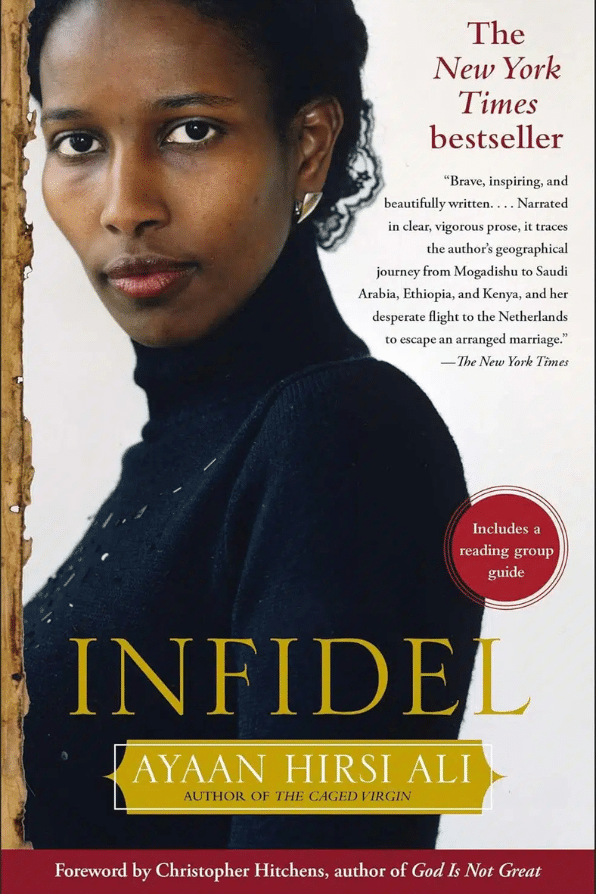
American theologian J. Gresham Machen was describing the impact of the encroachment of revisionist ideas in orthodox Christianity when he famously wrote, “What is today a matter of academic speculation begins tomorrow to move armies and pull down empires.” But this quote could just as easily have come from the pen of Ayaan Hirsi Ali when she first entered public life sounding the alarm regarding the encroachment of unassimilated Muslim migrants into the West. Westerners approached the issue with optimistic naivete—assimilation would happen naturally as migrants saw all the benefits of the free and open society that had emerged from the rich soil of the Judeo-Chrisitan moral tradition.
Within just a few years of her entry into public life in the Netherlands, Theo Van Gogh, Ayaan’s partner in a film project that revealed how women are treated in many Islamic communities, was assassinated in Amsterdam. His murderers left a dire warning: Ayaan was next.
Unfortunately, the West did not recognize this political assassination as Ayaan’s vindication, so the years following have seen scores of terror attacks perpetrated by Muslims who have been welcomed into the West with open arms. Last month we observed the tenth anniversary of a series of coordinated attacks in Paris that took the lives of nearly 200 people. And in July 2026, we’ll remember the martyrdom of Fr. Jacques Hamel, an elderly French priest who was decapitated while celebrating mass in a Normandy church.
As a non-Christian immigrant to the West, Ayaan has an advantage that those of us who have been immersed in the West often miss. The things that make the West unique have unequivocally been shaped by the Jewish and Christian faiths. Ideas like human dignity, individual rights, and the rule of law have Judeo-Chrisitan provenance even as the practice of faith is in decline. As such, these are not intuitive to most who come from outside of the West. And they are becoming less and less intuitive to many who were born here.
In my first conversation with her, Ayaan explained her frustration with the way that her life has been understood by those in the West. It is, in her words, the “Disney version” of her life: a child born into one of the poorest nations on earth who then dramatically ascends against all odds to global prominence. This version attributes her rise to equal parts luck and pluck, a framing particularly resonant with an American audience that believes that all things are attainable through hard work, determination, and moxy.
But from Ayaan’s perspective, especially now that she has become a Christian, she understands her story much more in terms of Providence and an increasingly refined worldview. The “Disney version” glosses over the fact that she was born into a tribalistic culture marked by a culturally rigid but intellectually underdeveloped form of Islam. This was followed by a period immersed in a more institutionalized form of Islam that led to her radicalization. After September 11, Ayaan famously left Islam. But in 2023, she shocked the world by announcing at a conference in London that one of the world’s most ardent atheists had, in fact, become a Christian. She had, in her words, finally embraced the system that provides the “only credible answer” for opposition to the enemies of Western civilization.
No matter the phase of Ayaan’s intellectual and spiritual journey, it is remarkable that she has always grasped something that is so often overlooked: the powerful effect of religious beliefs as a force for shaping the world and motivating action. The concept of secularism emerged to guarantee that the public square was neither Catholic nor Protestant. Despite a murderous fixation on the differences between the two that drove wars for generations, the differences between even the most disparate expressions of Christianity amount to very little once dramatically different systems of belief—like Islam—enter into the public square. Ayaan was one of the first to take note of the fundamental incompatibilities between aspects of Islam and the Judeo-Christian roots of the West. And she understood that these incompatibilities would have dire consequences for women, girls, and liberty because they would ultimately animate the way that non-Western migrants would order their lives in their adopted homes.
We live in a world today in which New York synagogues are surrounded by antisemitic mobs, hordes of migrant men sexually assault German women with impunity, hundreds of girls are trafficked by Pakistani gangs in the United Kingdom, and Holocaust survivors are burned alive in Colorado. It is also true that we can also find Muslims quietly living their lives, raising their children, and contributing to their communities; it is not as if Muslims can’t be productive Western citizens. But the very real problem of Islamic terror requires serious attention and reflection.
The obligations of citizenship precede the privileges of citizenship, and it is clear that when Ayaan warned the West, she knew that the obligations that have been clear for generations would not be adopted by Muslim migrants unless explicitly imposed on every person seeking Western citizenship. This is the only explanation for the uncurbed practice of female genital mutilation in Europe, the ban on Israeli sports teams in the Netherlands after their fans were the victims of antisemitic violence, and the skyrocketing rates of Islamist-driven antisemitism in France.
The Machen quote I opened with first appeared in a 1913 essay, “Christianity and Culture.” The next less famous and unheeded sentence prescribes Machen’s solution and a dire warning: “[Once armies have moved and empires have begun to be pulled down], it has gone too far to be combatted; the time to stop it was when it was still a matter of impassionate debate.” It is a tragedy that the West did not listen to Ayaan when the debate about the place of non-Western immigrants could be a matter of “impassionate debate.” We’re now at the point when we must combat the rise of antisemitism, Islamism, and antiwesternism from a position of disadvantage. But it is worth combatting, and civilization is worth saving. And one thing is for sure: Ayaan Hirsi Ali is and will remain at the forefront of the fight.
Trey Dimsdale (J.D., University of Missouri-Kansas City) was the founding executive director of First Liberty’s Center for Religion, Culture & Democracy and is now the president of the Ayaan Hirsi Ali Foundation.