
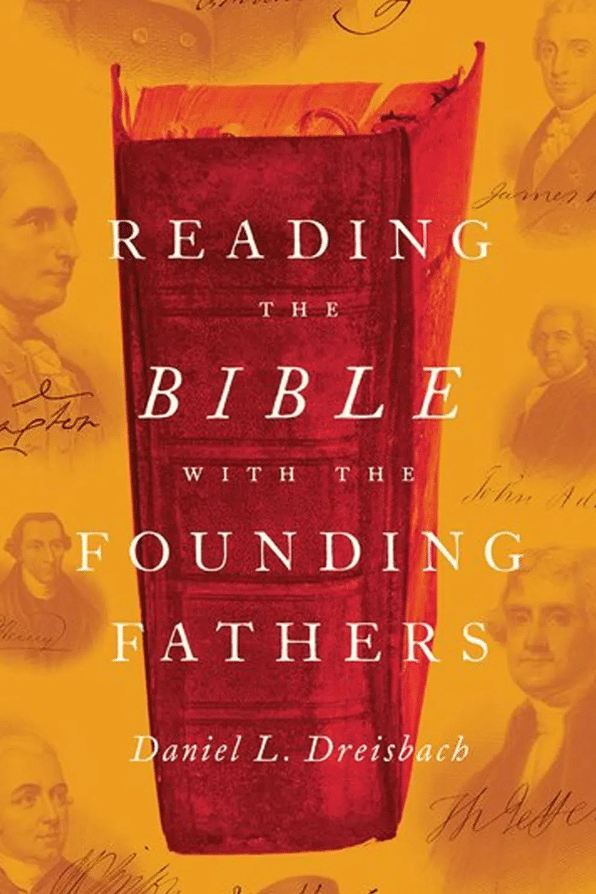
In 2017 Daniel L. Dreisbach, the author of several groundbreaking articles concerning the American founders’ relationship with the Bible, wove this material together with new research to form a superb book called Reading the Bible with the Founding Fathers. Dreisbach’s extensive research, judicious analysis, and lucid writing made this volume a landmark contribution to the study of the American founding.
Dreisbach exploded the myth that most of the founders were secularists who either ignored or assaulted the Bible. Even the few biblically unorthodox founders were steeped in Scripture from an early age, spent their lifetimes studying it, and frequently referred to their favorite verses in private correspondence as well as in public speeches and debates. Thomas Jefferson relished the Psalms. Raised by devout Bostonians descended from Puritans, Benjamin Franklin quoted Scripture casually and familiarly throughout his life. His citation of Psalm 127:1, “Except the Lord build the house, they labour in vain that build it,” and other verses in an emotional appeal for daily prayer at the Constitutional Convention was a sincere expression of his fervent, lifelong belief in the biblical concept of an intervening deity. Living in a society in which the Bible was the principal text employed to teach small children to read and a continuing focus of study thereafter, even the unorthodox founders could hardly have escaped biblical influence had they desired to do so. Because the Bible was the most widely read book in America, the only volume found in nearly every home and the only book that was the subject of lengthy sermons heard by most Americans, political rhetoric was suffused with biblical language and themes throughout the colonial, revolutionary, and early republican eras. It was inevitable that the biblical conditioning the founders received at school, church, and home should shape their mental habits and modes of expression.
Some of the more orthodox founders, such as Charles Thomson, Elias Boudinot, John Dickinson, and Roger Sherman, devoted a portion of their retirement years to the composition of biblical commentaries and theological discourses. Boudinot also established the American Bible Society, which distributed free copies of Scripture to the poor. Its officers included John Jay, John Marshall, and Charles Cotesworth Pinckney.
Contrary to the deists of the era, all of the founders believed in an intervening God who endowed and defended natural rights. Thus, they saw the hand of God in the United States’ astonishing victory over Great Britain, the greatest power on earth, in the Revolutionary War. Most considered the United States the new Israel, God’s chosen nation, bound to him by a sacred covenant of liberty. As a result, many of the founders warned that the national sin of slavery was such a gross violation of that covenant that it might result in a divine punishment as great as the divine favor previously bestowed on the nation for its defense of freedom.
All of the founders except Thomas Paine expressed the belief that Jesus’s moral teachings constituted the greatest ethical system in history, greater even than the classical morality they studied in their grammar schools and colleges. No one loved the Greek philosophers more than Jefferson, and none of the founders except Paine was more biblically unorthodox than he, yet Jefferson wrote passionately and extensively about the superiority of Christian ethics. It was Jefferson’s love of Jesus’s moral teachings that led him to call himself a Christian and to donate the then-hefty sum of fifty dollars to the American Bible Society.
Nearly all of the founders regarded widespread popular belief in an omniscient God and adherence to the moral principles contained in the Bible as essential to the new republic’s survival and success. George Washington famously emphasized the indispensability of religious belief to republican government in his farewell address.
Most of the founders accepted the core element of the biblical doctrine of original sin, the belief in innate human selfishness. As a result, they established checks and balances in their state and federal constitutions. The founders believed that political power must be dispersed because history confirmed the biblical conception of human nature and the resultant conclusion that no one could be trusted with excessive power.
In addition to relating the general influences the Bible wielded and the general functions it served in the founders’ discourse, Dreisbach examined individual founders’ use of specific scriptures. His discussion of Washington’s favorite verse, Micah 4:4 (“They shall sit every man under his vine and fig tree, and none shall make him afraid”), a scripture to which the Virginian referred almost fifty times across many years, was a tour de force that plumbed the depths of the verse’s rich collection of personal, social, and political meanings for the warrior-statesman.
As Dreisbach himself readily conceded, Reading the Bible with the Founding Fathers was far from comprehensive in its treatment of the founders’ relationship with the Bible. Indeed, it is doubtful that any single volume could fully elucidate all of the biblical influences on the founders.
In The Founders and the Bible, I discuss some additional influences, such as the various heroes and villains the founders discovered in the Bible’s pages. Jesus was, of course, their chief role model, the only person to whom most of them ascribed perfection. Satan was the principal villain, Judas the runner-up. But other influential heroes and villains abounded, each exemplifying a lesson of some kind. The prophet Samuel called to mind God’s curse on the Israelites for demanding a king. In Common Sense, Paine used 1 Samuel 8 to convince many Americans that the Almighty abhorred monarchy and favored republics, a conviction that was instrumental in bringing about American independence.
The founders encountered distinctive virtues in the New Testament that led them to assert Christianity’s ethical superiority. These virtues included humility, benevolence, and forgiveness. Even Paine, who published an attack on the Bible (The Age of Reason, 1794-5), possessed a conception of virtue that was profoundly Christian, stemming from his Quaker background. He characterized the chief ethical obligations as duty to God and duty to one’s neighbor, yet refused to cite the obvious biblical source for this conception of morality. Even so zealous an enemy of the Bible as Paine could not escape its pervasive influence.
The founders derived from the Bible a belief in spiritual equality, the principle that all people are equal in God’s eyes. By convincing them that they possessed equal rights with the inhabitants of Great Britain, this belief spurred them to rebel against the mother country. By assuring many of them that African American slaves possessed equal rights, it also led them to abolish slavery throughout the North, which eventually led to civil war and the eradication of slavery in the whole nation.
The founders also derived from the Bible a belief in an afterlife characterized by rewards and punishments. This belief provided them with priceless comfort in an age of high mortality rates and motivated them to risk their lives and to make staggering sacrifices in time, labor, and money in order to secure American independence and establish the new republic on solid ground.
Finally, the founders employed biblical principles and Jesus’s own example in advocating religious freedom. Their most frequent argument for this form of liberty was the contention that no government had the authority to interpose itself between an individual and an omniscient Creator who cared deeply about the inner beliefs of his creatures. The individual possessed both the right and the duty to define his relationship to God in the manner of his own choosing, free from all compulsion. The founders called this “the right of conscience” and held it to be the most sacred of all God-given rights. To bolster the biblical basis of their argument, the founders often noted that Jesus himself never compelled anyone to express any belief but relied solely on the Holy Spirit to attract souls to the faith.
Reading the Bible with the Founding Fathers is not the last word on the founders’ relationship with the Bible. But it is an excellent starting point for any reader who is curious about this important subject, as well as an essential volume for all historians of the early American republic.
Carl Richard (Ph.D., Vanderbilt University) is a professor of U.S. intellectual history at the University of Louisiana at Lafayette. He is the author of many books, including The Founders and the Bible (Rowman & Littlefield, 2016) and So Help Us, God: American Presidents and the Bible (Rowman & Littlefield, 2025). This essay is adapted from his 2017 review of Reading the Bible with the Founding Fathers in the American Historical Review (Vol. 122, no. 4).