
At least since the 1980s, Americans have included the Christian beliefs (or lack thereof) of their founding generation among the set pieces of rhetorical disputation in popular culture. Whenever the news got a little slow, we could count on some publication like Time or Newsweek to run a ready-made evergreen piece on the argument over whether the founders were deists or Christians. But to what end are these battles fought? One doubts the popular debate is centered so much on the question itself as it is on making a claim about the place of Christianity in America.
Beneath that popular debate, there has been a more serious academic one. A number of scholars have argued that the American founding was far more influenced by Enlightenment thinkers such as Locke or Montesquieu than by the Bible. Such a case is highly intuitive when one reads a seminal document such as the Declaration of Independence. Though Jefferson claimed its authorship on his headstone (while making no mention that he’d been the third U.S. president), anyone who’s read Locke recognizes the Declaration should drop a citation to his work. There is also little question that some members of the founding generation were highly influenced by classical thinkers like Cicero, who recommended the kind of mixed regime the United States clearly adopted with its president (like a monarch), its senate (like an aristocracy), and its lower house (like a democracy). The mixed regime was an answer to the instability Plato observed in the different types of governments as one cycled into the other over time.
But while some have promoted the idea of the more secular founding, others, like Richard Niebuhr, made the argument that although the leading philosophers of the founding were influenced by the Enlightenment, there were far more in the rank and file driven primarily by their Christian faith. Patricia Bonomi pointed out that it would be strange, indeed, if the founding generation, sandwiched between the two Great Awakenings, happened to be uniquely secular in its orientation.
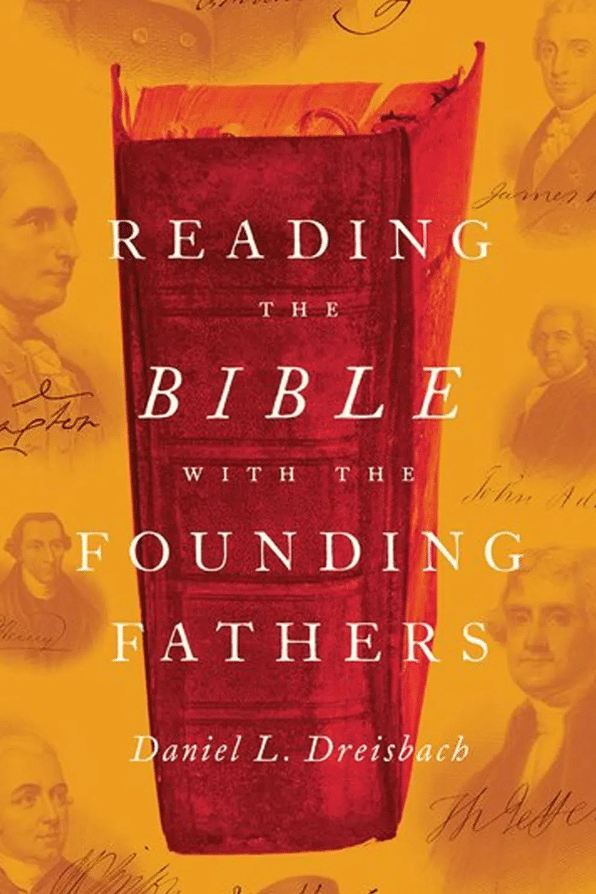
Daniel Dreisbach has spent a career making a careful case for understanding the founders and the culture in which they lived. Building on the work of Donald Lutz, he believes the record demonstrates the strong influence of the Bible on political thought in the founding era. Lutz did a tremendous amount of empirical research sampling the literature of the time. His work showed the heavy degree to which biblical and Christian thought leavened the speech and writing of political thinkers during the period. In Reading the Bible with the Founding Fathers, Dresibach makes excellent use of primary documents to display the Bible’s great influence as Americans argued for the right to resist what they saw as British tyranny and to cast a vision for Christian morality undergirding the virtue necessary for people who would govern themselves. It would be truly difficult to ignore the degree to which many thoughtful Americans wrestled with the text of Romans 13 as they sought to justify their determination to break with the English crown.
It is actually somewhat surprising that a case such as Dreisbach’s should be necessary. The cultural background of the people who immigrated to the English colonies was clearly a Christian one. Most Americans are aware of the stories of the Pilgrims and Puritans. It should take little to imagine that culture taking deep root in the communities that grew up in the colonial period and then weaving together the tapestry of the new nation.
Dreisbach, however, is aware of the extent of biblical illiteracy among scholars who study the matter and how easily they might miss much of the clear biblical influence in speeches and writings from the founding. In addition, it is important to recognize that we have long had a kind of emancipation thesis at work, which leads secular scholars to assume that increasingly sophisticated human beings have had less and less need of religion. Such scholars would likely see a fulfillment of their view in Jefferson’s Virginia statute on religious freedom, the religion clauses of the First Amendment, and the incremental move away from religious establishment in the states. That view overlooks realities such as the highly devout Baptists who worked in alliance with Jefferson and shared his opposition to establishment—but out of the most pious motives rather than some sense of secular liberation.
One of Dreisbach’s great virtues is that he is no more ambitious in his claims than the evidence permits him to be. He is careful to acknowledge the significant skeptics in the founding, such as Jefferson and Franklin, while also noting their use of biblical language and imagery because of its value in reaching the public. Thomas Paine would be another excellent example who effectively employed scripture despite being far from Christian. His Common Sense relies heavily upon 1 Samuel 8 in encouraging Americans to reject a king. In addition, Dreisbach makes clear that he is not making a case about the personal faith of the founders so much as he is demonstrating that the Bible and Christian thought were simply part of the common and publicly understood language of the time.
Why does it matter? If biblical language was obviously and absolutely employed during the time of the creation of the republic, then wouldn’t it be strange to argue that it is somehow alien or inaccessible in such a way as to demand it be rigorously policed in the public square? Dreisbach’s argument, I believe, helps support the critical distinction between the separation of church and state, which should be seen as fundamentally institutional in nature, and secularism, which goes much further and seeks to segregate religious acts and thoughts in our public lives.
Dreisbach’s case is also important simply for the sake of understanding America. The root Latin word of culture (colere, with translations including “to farm,” “to cultivate,” and “to worship”) also gives us the word “cult.” In other words, religion is at the core of who a people are. The United States was not grown in a test tube in a lab. It has an organic culture that certainly includes the Christian faith, which has deeply informed its law and politics. It is clearly wrong to argue Christianity has somehow become alien to the American fabric. Certainly, pluralism creates certain challenges, but it seems reasonable to give some pride of place to Christianity in terms of its founding influence upon the nation. To say as much is not to argue for something like Christian nationalism, but rather to say that the tenets of the Christian faith deserve at least some of the credit for the successes of the United States when it comes to democracy and human rights. While there is much to criticize in terms of the treatment of slaves and native Americans, it can also be acknowledged that reformers such as Martin Luther King, Jr. were able to effectively appeal to the Bible and Christian thought and belief in order to upend oppressive structures.
The strong influence of the Christian faith upon the founding doesn’t create any kind of ownership or lease for Christians on the U.S. as though it had been deeded to them. Christians do not own the United States, but we can help our fellow citizens to remember and from time to time to seek renewal in our deepest sources. Dreisbach helps us to see what those sources were.
Hunter Baker, (J.D., University of Houston, Ph.D. Baylor University) is the author most recently of Postliberal Protestants: Baptists between Obergefell and Christian Nationalism, a senior fellow at First Liberty’s Center for Religion, Culture & Democracy, and the provost of North Greenville University.