
A glorious October moon still lit up the sky long after dusk, and under it a grand curve of the Potomac River lay silver in the valley below. The pillars of the portico were illuminated by candles on the laden table. Next to me, speaking in eighteenth-century turns of phrase, was a tall white-haired actor, the spitting image of a Gilbert Stuart portrait of George Washington. He was, as Washington is reputed to have been, an amiable, reserved, and kindly man, slow and sober and yet quite warm in his responses to my questions. Across the table, at its head, sat James Rees, the careful, scholarly, yet bold leader of Mount Vernon. He had said earlier he had a question for me at the end of our elegant dinner, which was attended by just over a dozen guests. Meanwhile, the conversation was lively, the Virginia wine light and tasty, and the October air balmy, fresh, and exceedingly soft upon our faces. One felt a little of the thankfulness George Washington must have felt as he sat on this very patio with his friends, two hundred years before, a glass of port in his hand.
Inside, each of the brilliantly painted walls of the walls of the mansion had been meticulously matched with the colors found on bits of ancient paint carefully uncovered during the recent restoration. As we walked through, admiringly, the question Mr. Rees at last put to me was this: He had been looking for an author to write a book on the religious life of George Washington, and having read On Two Wings: Humble Faith and Common Sense at the American Founding (Encounter Books, 2002), he wondered if I might do it. He pointed out the resources that Mount Vernon offered and asked me to contact Mary Thompson, a researcher in the archives there, who was assiduously digging into the background of this very subject.
I promised Mr. Rees to think the project over but told him I was already committed to several years of work on other books; so the answer would probably be no, but I would consider it. Nearly a week later, I felt differently. My daughter Jana promised to help me with the research and writing. If I could postpone the project for two years or so, enough to assign summer interns and my regular assistant, in his free time, to begin gathering materials, maybe it could be done. The more I thought about the debt my family and I owed to George Washington for the freedoms we enjoy, and the high national standard he set for us, the more the task seemed like an obligation, not simply a pleasure. So Jana and I began the buying of books and the building of files, based upon our systematic reading plan. And I telephoned in our willingness.
Mr. Rees told me that Mount Vernon receives more than a million visitors a year and, with its new Visitors Center already under construction, was making ready for many more. One of the most frequent requests he received from visitors, he said, was for a book on George Washington’s religion. The subject is a delicate one, for there has been a great deal of controversy about that subject, much of it quite passionate. Some claim that Washington asked for, and received, baptism by immersion in the Delaware River at the hands of a Baptist preacher; a few even claim improbably that, due to his closeness to the Catholic Carroll family of Maryland, Washington came to admire Catholicism and asked to be baptized by a priest from Georgetown in his last days. There are untrustworthy stories about Washington in prayer at Valley Forge, as well as one about his leaving behind hand-written copies of prayers for each day of the week, taken from an official-sounding Christian prayer book. Meanwhile, as a whole, most historians of the twentieth century appeared to be rather uninterested in religion and had more-or-less exhausted the subject by putting Washington down as a deist, at best a tepid Anglican, and little more than a practical eighteenth-century rationalist.
In fact, those who were most insistent on this last interpretation—and it was the preponderant view—maintained three distinct theses:
1. Washington was a deist.
2. In a lukewarm fashion, he kept up the appearances of being a Christian, more for public consumption than out of conviction. Essentially, he was not a Christian, or was only barely so.
3. Although he spoke often of “Providence,” he meant something more like fate or destiny—an impersonal force—than like the biblical God of the Hebrews and Christians, whose Providence might act in history both in ordinary and in miraculous ways.
In short, they posited, Washington was more like a modern secular believer than like an authentic Christian.
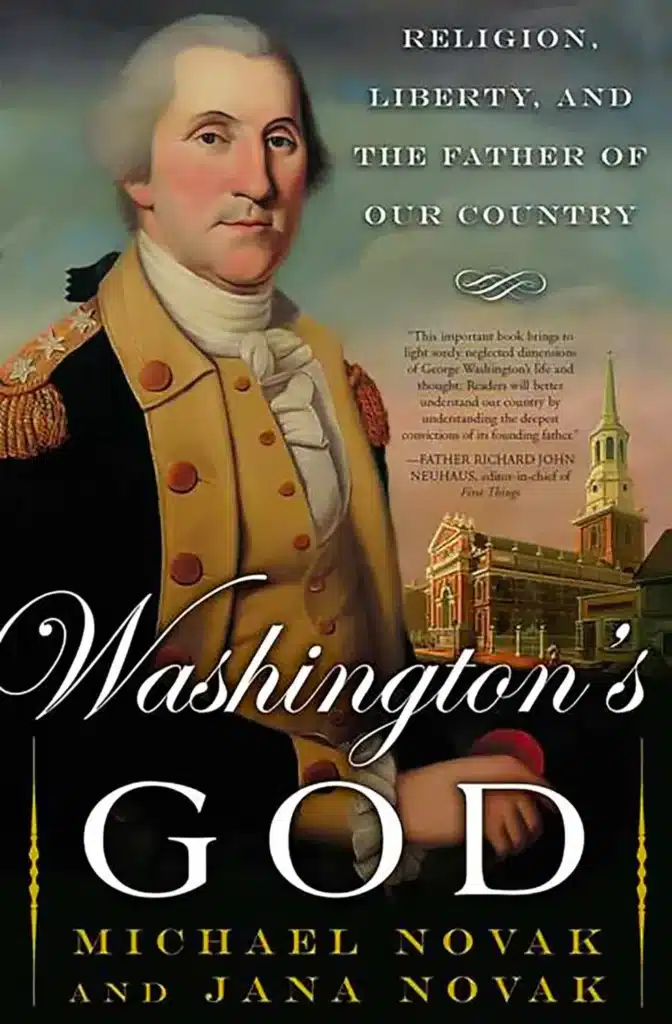
In this book, my daughter Jana and I try to take Washington’s words about God seriously. We try to understand just who Washington’s God is. Our findings on all three points, we will admit, are almost the reverse of the conventional wisdom. Washington cannot be said to be a deist. He was a serious Christian, perceived to be so by many quite close to him, less clearly so in the documentary record. And as he explained to the Hebrew Congregation in Savannah after he became president, his idea of Providence was the God Jehovah, who had so often guided and blessed Israel of old.
We have written this book for the average visitor to Mount Vernon, who comes physically by the million or so every year, to enjoy the beautiful home and grounds left to posterity. (Nowadays, we must add, under the protection of the incredibly dynamic and visionary Mount Vernon Ladies Association—which was founded in 1853 by a woman distraught over the condition of the mansion, and which originally saved the crumbling estate by purchasing it in 1858—Mount Vernon has been wonderfully restored to its original appearance, and its amenities are being constantly improved.) But we write also for those who can journey only in thought, to learn more about the man who more than any other won the independence of the United States and taught the American people by his example and leadership how one lives, if one would contribute to the vitality of a free republic.
Read more in Washington’s God: Religion, Liberty, and the Father of Our Country (Basic Books, 2006).