

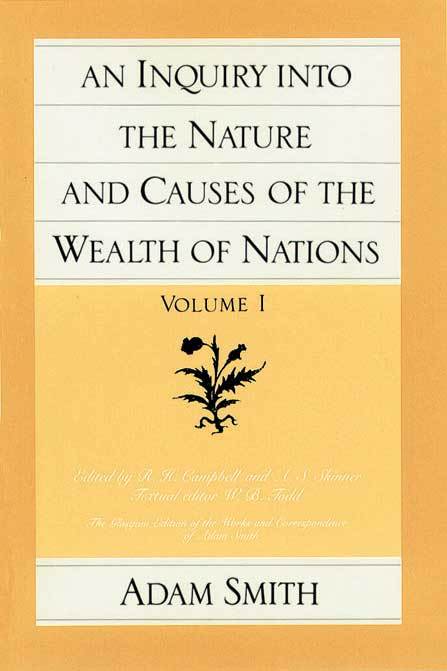
Adam Smith (1723–1790) was an important moral philosopher, political economist, and member of the Scottish Enlightenment who Christians should read. This year marks the 250th anniversary of what many people view as his most important work: An Inquiry into the Nature and Causes of the Wealth of Nations. But Smith’s impact on the world extends far beyond The Wealth of Nations.
Christians should also read Smith’s other book, The Theory of Moral Sentiments. The book doesn’t draw explicitly on Christian doctrine and theology, but it is deeply compatible with and informed by it. In The Theory of Moral Sentiments, Smith develops the virtue ethics of a modern commercial society, in contrast with the ethics of a medieval or ancient society. Smith recognizes the primacy of trade and the division of labor and technological and industrial progress to the human condition.
Smith’s moral theory builds on the idea of our sociability and the natural sympathy that we have for one another. Out of this sympathy, we develop the idea of the impartial spectator. The impartial spectator then provides a kind of subjective or contextual framing of moral issues underneath a more objective or universal ethical standard.
Virtues such as respect, courage, or prudence are true across time and for all people. However, what it means to be courageous, or to be prudent, will vary dramatically by situation. Is a certain act courageous or foolhardy? Well, it depends on a variety of contextual issues: the options, the danger, the intentions of the actor, and so on. Or consider how one shows respect in Japan today. It’s very different from how one showed respect in Japan 150 years ago, or the way one showed respect in medieval courts.
Smith gives us a practical way of approaching moral questions by imagining ourselves in other people’s shoes. Moral judgement, then, is not simply a matter of following rules but an act of imagination and embodied perspective. But the perspective that has authority must be impartial.
Smith also emphasizes the importance of justice in The Theory of Moral Sentiments. Although there are many virtues, only one should be enforced by government coercion: justice. This is the case both because of the importance of justice to society and because of the nature of justice whose rules are clear, “grammatical,” and therefore relatively easy to determine. Smith writes: “Beneficence, therefore, is less essential to the existence of society than justice. Society may subsist, though not in the most comfortable state, without beneficence; but the prevalence of injustice must utterly destroy it.”
The other virtues, however, depend on the motives and thoughts of the actor. Therefore they cannot be easily observed or enforced.
The Theory of Moral Sentiments complements The Wealth of Nations. Nobel Laureate Ronald Coase argued that Smith’s view of man’s nature beyond self-interest strengthens his political economy. Smith’s views on the economy, self-interested production, and spontaneous order should be understood in light of his moral theory and human sociability. While The Theory of Moral Sentiments is profound, The Wealth of Nations provides the blueprint for how the economy, society, and politics ought to work.
By the mid-1700s, the medieval ties of land, guild, and church were dissolving. Smith explores new kinds of ties that developed between people in modern commercial societies. Smith begins with the fundamental drivers of prosperity: division of labor, specialization, and exchange. Increasingly, people were moving physically, changing professions, and embedding in extensive impersonal networks of commercial transactions. With greater division of labor came greater specialization.
Instead of households growing their own food, making their own clothes, and building their own houses, people within households increasingly entered into labor contracts paid in money. Smith describes how this process rapidly raises productivity and how it leads to every man becoming a merchant. This new set of specialization and impersonal exchanges were accompanied by the accumulation of wealth and increasingly sophisticated property rights.
He explains how larger markets and broader trade networks increase specialization, and thereby productivity. In a commercial society, he writes, “Every man thus lives by exchanging, or becomes in some measure a merchant, and the society itself grows to be what is properly a commercial society.”
Money allows people to trade their surplus specialized production for everything else they want. The institution of money, as well as the complex system of production and exchange (and also of laws and institutions), emerged over time as “the result of human action but not of human design,” as put by Smith’s contemporary Adam Ferguson (1723–1816). These institutions emerge because of man’s nature and his historical context.
Self-interested behavior largely causes these orders and institutions to emerge. Markets develop a complex, oftentimes anonymous, system of exchange. Smith famously said, “It is not from the benevolence of the butcher, the brewer, or the baker that we expect our dinner, but from their own regard to their self-interest.” And while this may sound sterile or cold, this system of exchange has the great advantage that, as Coase put it, even “those who are unknown, unattractive, or unimportant will have their wants served.”
Smith’s famous description of people being led by “an invisible hand” represents the core of his project. In an important essay on the history of astronomy, Smith talks about how for much of human history people appealed to divinities or spirits to explain the irregular: lightning, earthquakes, storms, and so on. But in the enlightened (and Christian) world, the task of the moral philosopher or scientist was to show God’s hand in the regularity and the beauty that can emerge in systems beyond the intent or knowledge of any person or group of people.
Smith’s work reconciles man’s self-interested behavior with his natural sympathy for his fellow man. In markets, self-interest rules, but not without etiquette and virtue. In informal affairs, sympathy and regard for others dominate—yet these affairs exist within broader formal systems of exchange, production, and property.
Nobel Laureate Friedrich Hayek explained this duality well in The Fatal Conceit. If we were to apply our family norms of benevolence and sympathy to the broader social order “as our instincts and sentimental yearnings often make us wish to do, we would destroy it. Yet if we were always to apply the rules of the extended order to our more intimate groupings, we would crush them. So we must learn to live in two sorts of world at once.”
Smith’s brilliance is apparent in how he reconciles and connects how people operate in these two worlds—and how social institutions develop to help us do this. And yet Smith’s writing is not all optimism. He warns about avarice, weakness, stupidity, and selfishness. But these problems are generally limited until they enlist the power of the state. Greed, unkindness, rudeness—these can all be disciplined through competition. But governments can ban competition, as with the British East India Company and the poor laws that restricted laborers’ ability to move.
Smith gives us some rousing warnings about abuse of government power: “What is the species of domestic industry which his capital can employ, and of which the produce is likely to be of the greatest value, every individual, it is evident, can, in his local situation, judge much better than any statesman or lawgiver can do for him.”
Smith also says that “folly” and “presumption” characterize the “man of system” who abuses his office and political authority:
The statesman, who should attempt to direct private people in what manner they ought to employ their capitals, would not only load himself with a most unnecessary attention, but assume an authority which could safely be trusted to no single person whatever, and which would nowhere be so dangerous as in the hands of a man who had folly and presumption enough to fancy himself fit to exercise it.
Smith criticizes those who use political power to direct the lives, businesses, and fortunes of everyone else. In our current political moment, we see a movement away from restraint allowing decentralized market activity to a strong-man approach, despite Republicans controlling the executive branch and the legislative branch. President Trump governs to reshape the world through the strength of his will and the apparatus of the state.
But in doing so, he runs the risk of being a “man of system,” who
is apt to be very wise in his own conceit; and is often so enamoured with the supposed beauty of his own ideal plan of government, that he cannot suffer the smallest deviation from any part of it…. He seems to imagine that he can arrange the different members of a great society with as much ease as the hand arranges the different pieces upon the chess-board. He does not consider that the pieces upon the chess-board have no other principle of motion besides that which the hand impresses upon them; but that, in the great chess-board of human society, every single piece has a principle of motion of its own, altogether different from that which the legislature might chuse to impress upon it… If they are opposite or different, the game will go on miserably, and the society must be at all times in the highest degree of disorder.
Adam Smith championed the “liberal system” of “natural liberty” where the “chess pieces” remain free to order their own affairs. He argued that when governments limit themselves to enforcing justice, maintaining national defense, and providing clear rules, society will take care of the rest. Politicians don’t need to plan or fix the economy. The invisible hand, which brings order beyond any person’s plan or intention, will see to that.
Paul D. Mueller (Ph.D., George Mason University) is a research fellow and associate director of the Religious Liberty in the States project at First Liberty’s Center for Religion, Culture & Democracy and a senior research fellow at the American Institute for Economic Research. He taught economics at The King’s College in New York City and academic work has appeared in various journals and publications. He is author of Ten Years Later: Why the Conventional Wisdom about the 2008 Financial Crisis Is Still Wrong.