
I confess to a soft-spot for losers. Perhaps that results from a lifetime of following the Detroit Lions, or perhaps it arose from being a conservative on a college campus where others expected me to play the part of the Washington Generals (the team that lost to the Harlem Globetrotters more than 16,000 times). I learned there that having good arguments meant very little when confronted with a combination of ideology, power, and coordinated effort. Still, someone has to remind people of the fundamental purposes of any social institution and how easily those institutions can drift away from animating principles.
History may be written by the winners, but the spoils of war don’t always go to the righteous. The machines may have defeated the Luddites, but I’d happily take up a hammer in their cause. Too often we count the Anti-Federalists among the benighted losers setting up shop on history’s wrong side, perhaps giving them some credit for selling the winners the Bill of Rights. Certainly, the U.S. Constitution’s endurance for 239 years speaks to the quality of its design, but its increasingly ramshackle structure invites inspection of its foundations. While Federalist and Anti-Federalist agreed widely on the material for the foundations—popular sovereignty, representative government, checks and balances, protecting liberty—they cast those materials in different ways. Revisiting their arguments may help us strengthen the Constitution’s foundations once again.
Our historiography of “the Founding” often toggles between Beardian cynicism and “Miracle at Philadelphia” hagiography. The truth is always more complex and more interesting. The debates at both the Constitutional Convention and the state ratifying conventions indicate robust and roiling disagreement concerning what it takes to build and sustain a republic. Many of our contemporary political debates echo those that took place in 1787.
The term “Anti-Federalist” suggests part of the problem, for that was not how they referred to themselves. They claimed the Federalist mantle, which those who advocated for national consolidation subsequently stole. Scholars wrote books asking whether the Anti-Federalists were for anything, or simply obstreperous. Cecelia Kenyon in a famous essay referred to them as “men of little faith,” even though she acknowledged they were “like all men of their age, great constitutionalists.” Their lack of faith, however, appeared only when brought into relief against the progressive optimism of the Constitution’s supporters.
Not that anyone shared later progressive confidence in the perfectibility of human nature. The seeds of dissension, Madison reminded us in Federalist No. 10, “are sown into the nature of man.” Since men “are not angels,” governments operate as a necessary restraint on the vicious tendencies of human beings, Madison said in Federalist No. 51, observing further that since we are not governed by angels, “auxiliary precautions” were necessary. Constitutions not only constitute governments but also the essential measures of restraint, without which government soon becomes tyrannical.
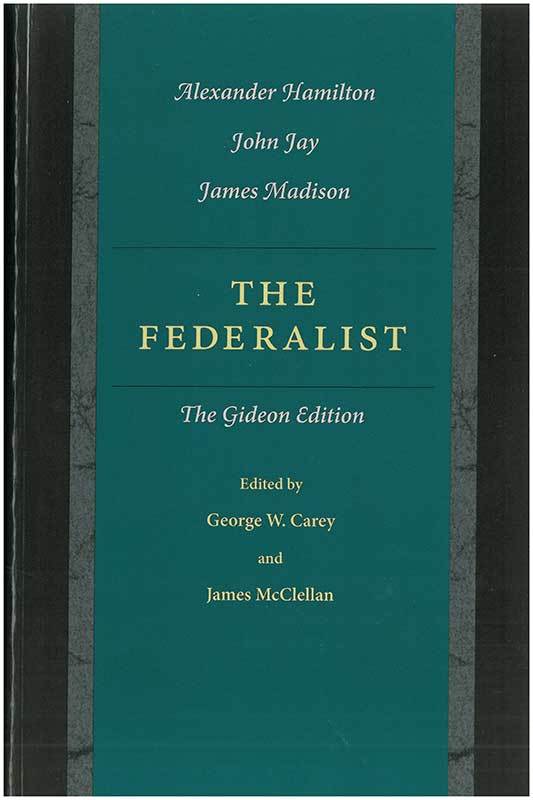
The framing of the Constitution occurred with a great deal of nervousness about the prospects of republican government itself. Already in Federalist No. 1, Hamilton admonished readers that the Americans had to decide for once and for all “whether societies of men are really capable or not of establishing good government from reflection and choice, or whether they are forever destined to depend for their political constitutions on accident and force.” In Federalist No. 9, he meditated on the “petty republics” that filled him with “sensations of horror and disgust” as he contemplated “the rapid succession of revolutions by which they were kept in a state of perpetual vibration between the extremes of tyranny and anarchy.” Madison in Federalist No. 10 observed that past republics had been “as short in their lives as they have been violent in their deaths.” Securing a republic that could become the Novus Ordo Seclorum (“A New Order of the Ages”) was the desideratum, and that required setting it on sound principles derived from the newly improved “science of politics.”
Critics of the Constitution, too, worried about creating an enduring republic, but they tended to think more in terms of patterns and cycles of history. Hard-earned liberties carved out of the stone-on-stone friction of political conflict gradually eroded as political power stabilized. The great “revolutions” of the past occurred when intrepid rebels sought to reclaim those ancient rights and privileges from those who had in piecemeal fashion robbed them of their inheritance. The Magna Carta was once such instance, as was the Glorious Revolution, as was 1776. Now, they feared, ambitious men were undercutting the Spirit of ’76.
The opening salvo was the Philadelphia Convention itself. Convened for the purpose of revising or amending the Articles of Confederation, the delegates instead produced a whole new government. Luther Martin, the most dipsomaniacal and vituperative Anti-Federalist at the convention, warned that “if we, contrary to the purpose for which we were intrusted, considering ourselves as master-builders, too proud to amend our original government, should demolish it entirely, and erect a new system of our own, a short time might show the new system as defective as the old, perhaps more so.” Madison himself had conceded “the novelty of the enterprise,” which critics interpreted as experimenting with their ancient liberties.
Liberty, once given up, proves difficult to recover. Publius vigorously argued for a more energetic government than that provided for under the Articles of Confederation, and while the Philadelphia document produced a government still too weak for his tastes, he also realized that it was the best he was going to get. Skeptics such as the author of the Brutus essays, however, cautioned patience in creating a whole new system. “It is a truth confirmed by the unerring experience of ages,” he wrote, “that every man, and every body of men, invested with power, are ever disposed to increase it, and to acquire a superiority over every thing that stands in their way.” Better to protect liberty zealously at the outset than to trust it can be reclaimed later.
The central strategy for protecting those liberties had been frequent elections and rotation in office. Both parties believed in representative government, but Hamilton worried that too much turnover would destabilize the government and render it as “imbecilic” as the one under the Articles of Confederation. Never one to understate his case, Hamilton believed that having reached “the last stage of national humiliation,” the Anti-Federalists were prepared to double-down: having “conducted us to the brink of a precipice,” he sighed, they now seemed intent on plunging the nation “into the abyss that awaits us below.” He feared more than anything a weak and enfeebled America.
The solution for Publius lay in three key features of the new constitutional system: the federal government had to operate its powers directly on citizens without the states as intermediaries; energetic executive power; and the sharing of power among the different branches. To be sure, everyone agreed that the blending of power would lead to tyranny, but the convention had carefully blended executive and legislative powers into a mix that made the Anti-Federalists extremely nervous. Ambition might counteract ambition, but only if politicians acted on the basis of protecting their turf; interest and partisan passions could operate as a catalyst to ignite that blended mix into either crude majoritarianism or aristocratic privilege.
The carefully calibrated machinery of checks and balances, Publius believed, could remain well-oiled by the presumed virtue of elected officials. Yes, Madison had observed in Federalist No. 10 “enlightened statesmen [would] not always be at the helm,” but in the same essay he also observed that the system of representation would “refine and enlarge the public views,” resulting in better leaders.
Publius affirmed this confidence in Federalist No. 55 when he noted that “republican government presupposes the existence of [esteemed] qualities in a higher degree than any other form,” pointedly singling out the Constitution’s critics for their dark portrait of human character. Continuing on those lines, in Federalist No. 57 Publius claimed that “The aim of every political constitution is, or ought to be, first to obtain for rulers men who possess most wisdom to discern, and most virtue to pursue, the common good of the society; and in the next place, to take the most effectual precautions for keeping them virtuous whilst they continue to hold their public trust.” The House might have been susceptible to being populated by the rabble, but the Senate would be populated by the best and the brightest, dignified persons who commanded public respect and confidence (Federalist No. 65, for example).
Likewise, the mode of presidential selection afforded “a moral certainty” that the office would never fall into the hands of someone “who is not in an eminent degree endowed with the requisite qualifications.” Only those persons of high character could survive the gauntlet, prompting Publius to predict that “It will not be too strong to say, that there will be a constant probability of seeing the station filled by characters pre-eminent for ability and virtue.” (No. 68) Judges, too, would only ascend to the bench if they combined knowledge of the law with “sufficient skill” in adjudicating and “the requisite integrity” that marked their character. (No. 78) The Federalists at the convention had hoped for longer terms for all elected officials, judges already having lifetime appointments, but took their half loaf on term length in order to eliminate term limits.
When Kenyon called the Anti-Federalists “men of little faith,” she meant they did not share Publius’s optimism that only the best and the brightest would hold federal offices. Unless elected officials returned regularly to their constituents, forced to share their fates and concerns, those officials would soon fall captive to the corruptions of a capital city, substituting a new and foreign set of interests in place of the interests of those who had voted for them. The steadily growing power of a capital city with its courtesans and hangers-on, its sycophants and ambitious ideologues, exploiting the countryside for its wealth of resources and people, all-too-often in the service of imperial ambitions and a lust for glory, had always been the instrument of republican demise. The combination of centralizing power, taxation authority, and a standing army threatened to undo liberty’s blessings.
Most Anti-Federalists acknowledged the need for a stronger central government than that under the Articles of Confederation, but not at the expense of sacrificing liberty, which found its true expression in the face-to-face interactions of citizens with one another. Even Publius admitted to the audacity of a continental republic but believed that the benefits would far outweigh the dangers. Among those benefits they counted clipping Europe’s wings, making America a consequential and indeed a great nation, endless economic growth, and a stage befitting those possessed of “bright talents and exalted endowments” unsatisfied with their state under the flaccid Articles.
We labor still under the divisions of those who want America to be a great nation and those content with it being a good one. American exceptionalism, expressed already in Federalist No. 1, arose from the belief that commerce and union and military strength could free us from the usual cycle of decline and fall that would inevitably lead to revolution. Publius counted on “the vigilant and manly spirit which actuates the people of America, a spirit which nourishes freedom, and in return is nourished by it,” (No. 57) but didn’t fully appreciate how an overweening government might attenuate that spirit. Perhaps the fledgling nation didn’t enjoy enough security under the Articles of Confederation, but too much concern with security makes us less free.
As Tocqueville put it some fifty years later: “Because the civilization of ancient Rome perished in consequence of the invasion of the barbarians, we are perhaps too apt to think that civilization cannot perish in any other manner. If the light by which we are guided is ever extinguished, it will dwindle by degrees, and expire of itself.” Both Federalist and Anti-Federalist sought to keep that flame lit; they simply couldn’t agree on who should be the keeper of the flame.
Jeff Polet (Ph.D., The Catholic University of America) is the director of the Ford Leadership Forum at the Gerald R. Ford Presidential Foundation.