
As the United States approaches its semiquincentennial celebration, Americans would do well to examine how we talk and, indeed, how we think about our national heritage. Any honest reflection must begin with an uncomfortable admission: we have largely failed to inspire young Americans with a durable sense of civic pride or even national gratitude. The great challenge of our time is therefore not political but pedagogical—it consists in educating future Americans as to what makes our nation both unique and uniquely laudable. Across the political landscape, one encounters a troubling disillusionment with American ideals, coupled with a profound ignorance of our institutions. Worse still, young Americans possess little sense of our history—except perhaps its failings—and even less appreciation for the costs of freedom. Like heirs to an unearned fortune, we have grown weary, and even embarrassed, of our riches, with no sense of duty to preserve them into the future.
Much of the blame rests with the university. Too often, institutions of higher education inculcate in students a reflexive skepticism toward our inherited moral and civic order, rather than equip them to understand and evaluate that order on its own merits. In response, many reformers have sought to cultivate a civic renaissance through renewed collaboration between state legislatures and universities. These developments reflect a growing recognition that an indoctrination in what Roger Scruton called the “culture of repudiation” is no education at all. Policymakers have accordingly begun to question whether such an education truly serves the public good—and, consequently, whether it merits public support. Increasingly, state funding has therefore been conditioned on the establishment of schools, departments, and initiatives around civic education and civil discourse.
This renewed focus on civic education and civil discourse is undoubtedly beneficial; yet it risks misunderstanding the crisis it seeks to address. Civic attachment is not formed primarily in the abstract, nor can students meaningfully deliberate about a political order they have not first come to see as worthy of reflection and attachment. Civil discourse, in turn, is of dubious value when participants have little knowledge or experience to bring into discussion. Students today are not short on political opinions; what they lack is the kind of political knowledge that proceeds from deep and sustained reflection. The problem, in short, is not a lack of opportunity for civic instruction or discussion. Rather, the problem is that we have neither formed citizens capable of moral and political judgment nor instilled in them a gratitude for their civilizational inheritance—failures civics itself cannot remedy.
The Need to Inspire Real Attachment
The heart of the problem is that civics is not enough. Human beings are not moved primarily by abstractions, but by concrete attachments. We are moved by what we love. That love includes rational assent, to be sure, but it is also formed through narrative, moral imagination, and aesthetic experience. Civic reformers have largely succeeded in winning the rational argument, yet we must be honest enough to admit that the argument has proved wholly incapable of inspiring any real attachment.
I was reminded of this fact a few years ago at a conference in Nashville, Tennessee, where a number of thoughtful speakers discussed and dissected ideas of patriotism and nationalism. The discussion was clarifying, even impressive, but this sort of detached and abstract analysis failed to accomplish the most important thing—it didn’t actually inspire patriotism. Just down the road at the Johnny Cash Museum, I stumbled upon a projector screen on which looped a short, grainy video of the Man in Black reciting an original poem, “Ragged Old Flag.” More genuine national affection was contained in this short poem than in an entire conference of America’s most accomplished scholars. In the span of a few minutes, this poem accomplished what days of analysis could not. This moment settled in me a conviction: people cannot be argued into attachment to their country. We deceive ourselves if we suppose that another concept, course, or conference will remedy what is, in reality, a crisis of cultural formation. What C. S. Lewis said of the modern educator could be said of the civic reformer: our task is not to cut down jungles but to irrigate deserts.
Part of the difficulty of fostering national attachment lies in the fact that we do not know how to think of ourselves as a national entity. Are we primarily a “creedal nation,” whose identity consists in abstract propositions to which any individual can subscribe? If so, from where do those ideals arise and how are they to be given concrete form in political reality? Moreover, why should those ideals bind us together as a people rather than remain matters of private conviction? Alternatively, is it our constitutional structure and institutional design that constitutes our national identity? If so, what animates those institutions and what historical precedents have proved their worth? Why, moreover, should these institutions demand our faith and loyalty rather than mere obedience? No one ever fought and died for a bicameral legislature.
If neither principles nor institutions suffice, perhaps it is the unprecedented degree of liberty afforded to American citizens that defines us as a distinct people—that is, our doctrine of natural rights. If so, then we must ask, liberty to what end and rights ordered to what conception of the good? Liberty doesn’t interpret itself, nor are rights self-justifying. Absent a deeper moral framework, liberty dissolves into license and rights claims become destructive rather than constructive.
The Federalist Papers and National Identity
Each of these accounts captures something real, yet they all fail for the same reason: they treat as comprehensive what is, in fact, only partial. A nation is not first encountered as a set of propositions, a blueprint of institutions, or even a regime of rights, but rather a living civilizational inheritance. Its political principles and institutional arrangement—important as those may be—are bound up with a people’s shared history, moral imagination, aesthetic judgment, and deeper philosophical and theological commitments. Only when one considers America at this deeper level can we truly come to have a grasp on American national identity.
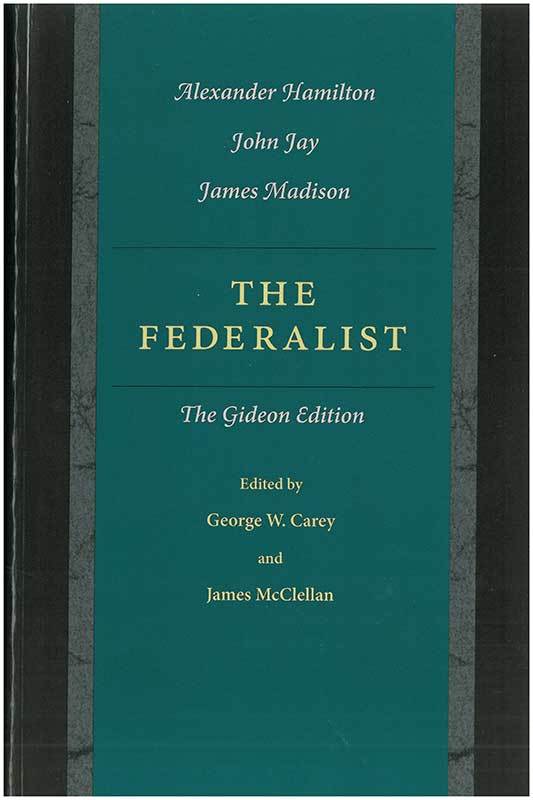
In the Federalist Papers, we find a veritable model for understanding civic nationhood. Publius (the pseudonymous author of the papers) doesn’t merely present a theory of government or an institutional blueprint. Rather, he speaks to a union founded on both reflection and inheritance.
In Federalist No. 1, Publius (in this case, Alexander Hamilton) frames the choice of constitution as a moment of world-historical significance. With unusual self-awareness, he presents America as uniquely positioned to settle an age-old question: whether societies are capable of establishing good government from “reflection and choice” or whether they must eternally be slaves to “accident and force.” Whereas other nations were wholly subject to the vicissitudes of fortune, America is afforded the rare opportunity to reflect upon its principles and to choose institutions suitable to those ends.
Publius thus emphasizes rational self-determination and the centrality of ideals and institutions. Yet, he also recognizes the limits of reason, acknowledging that “passions” and “prejudices” threaten the entire endeavor. More telling still, he addresses his readers as “citizens” and “people of this country” prior to ratification. In other words, Publius’ appeal to “reflection and choice” presupposes what it cannot itself produce: a people already formed whose shared attachments render such reflection possible in the first place.
In Federalist No. 2, we turn from a language of “reflection and choice” to that of “inheritance.” Here, Publius (in this case, John Jay) makes explicit what the previous argument only presupposed: that the Americans he addresses are no mere aggregation of individuals, but a people already formed. They can “be one nation, under one federal government” precisely because they already are, in the most important respects, one people.
He begins by pointing to the providential geography of the American continent, which, he argues, “binds [the people] together,” by facilitating “easy communication” and “mutual transportation and exchange.” Unlike the fragmented terrain of the Swiss cantons—divided by impassable mountain ranges—the “one connected, fertile, wide spreading country” of America encourages social and political cohesion. Geography, in Jay’s account, is not incidental but formative of national unity.
More decisive still is the fact that Americans shared a common culture. As Publius observes,
With equal pleasure I have as often taken notice, that Providence has been pleased to give this one connected country, to one united people; a people descended from the same ancestors, speaking the same language, professing the same religion, attached to the same principles of government, very similar in their manners and customs, and who, by their joint counsels, arms and efforts, fighting side by side throughout a long and bloody war, have nobly established their general liberty and independence.
In other words, America is a nation by virtue of its heritage, language, religious inheritance, and its political principles—in short, by its culture. This unity was forged and deepened through the crucible of the American Revolution, binding the people together through a shared history of sacrifice. Political unity, in this light, does not create a people; it presupposes one.
Taken together, these opening essays reveal a deeper understanding of the American experiment—one that transcends the false dichotomies that dominate contemporary discourse. The United States is neither merely a creedal nation nor reducible to its institutional arrangements. Rather, it is a people forged through a shared history, animated by common ideals, and upheld by a living culture.
Hamilton’s appeal to “reflection and choice” presupposes the underlying unity that Jay makes explicit. Indeed, such reflection is only possible for a people already bound together by moral inheritance, habits of self-government, and shared historical experience. Ideals and institutions, in this light, are neither self-generating nor self-sustaining. They arise from, and depend upon, a prior civilizational framework that renders them intelligible and worthy of attachment.
American Civilization: Ideals, Institutions, and Culture
For this reason, civics must give way to something more comprehensive: the study of American civilization. Civics, as it is commonly taught, focuses on the principles of American government and its institutional design. While important, this leaves a whole realm of human experience out of consideration because it neglects the means by which we develop civic attachment in the first place. At best, civics offers a schematic understanding of politics; at worst, it reduces national identity to a series of abstract propositions. What it lacks is formative power to shape the imagination and affections.
A proper study of American civilization must attend not only to ideals and institutions, but also to culture—the moral, imaginative, and aesthetic world in which those ideals are lived and those institutions take root. Through art and literature, for example, students come to identify with their nation and its story. Through theology and philosophy, they come to understand the deeper foundations of its principles. Through history, they come to see themselves as participants in an unfolding civilizational drama. Such an education would include not only the Federalist Papers and the speeches of Abraham Lincoln, but also the sermons of Jonathan Edwards, the novels of Nathaniel Hawthorne, the landscape paintings of Thomas Cole, the essays of Ralph Waldo Emerson, the poetry of Robert Frost, and the short stories of Flannery O’Connor. It is within this broader conversation—spanning politics, statesmanship, philosophy, theology, literature, and art—that a people comes to know and sustain itself as a people.
One often hears the objection that such an account of national identity is no longer possible in a diverse society. Yet greater diversity does not eliminate the need for a shared sense of culture; if anything, it intensifies it. A political order composed of individuals with different backgrounds and experiences cannot be held together by procedure alone. It requires a common reservoir of meaning, a shared set of cultural touchstones, and a unifying narrative capable of sustaining civic life across differences. To avoid culture merely because it is difficult or uncomfortable is not to transcend culture, but to abandon the very conditions under which common life can be maintained.
What is required, in the end, is not counter-indoctrination, but initiation into American civilization. To study American civilization is to imaginatively enter into an ongoing conversation—one carried forward not only by statesmen but by novelists, poets, theologians, and artists. Students must not be told what to think or be handed a pre-digested narrative. Rather they must be invited to wrestle with primary sources, to imagine themselves at decisive historical crossroads, and to grapple with the tensions that have always defined the American experiment. The goal here is not to impose conclusions, but to cultivate judgment grounded in real knowledge and sustained reflection.
A true education in civic life is therefore not the transmission of ideas, but the formation of a citizenry capable of sustaining common life. It is, to use the language of Publius, equal parts “reflection and choice” and “inheritance.” These may appear to stand in tension, yet it is precisely within that beneficial tension that civilization comes to be realized. In truth, each is unintelligible without the other: inheritance without reflection degenerates into stagnation, while reflection without inheritance becomes abstract and bloodless—incapable of moving a real people. Only in their union is civic life possible.
The grateful reception of our past—understood in the fullest sense of ideals, institutions, and culture—makes for a shared identity in the present, and from that shared identity emerges the possibility of a sound and enduring common future.
Jacob Wolf (Ph.D., Boston College) is director of the Program in American Civilization and assistant professor of politics at the University of Austin (UATX) and a research fellow at First Liberty’s Center for Religion, Culture & Democracy.