
I am not sure when it was exactly that I fell in love with my country. We each have our own story. I was raised in a small farming community in rural Central California. It was a great place to grow up, though there was not much that connected us directly to America’s history beyond the Gold Rush and then the interstate highway system. I remember saying the Pledge of Allegiance every morning, and I remember a flag hanging in every classroom. My sense of history gravitated to the heroic, as befits many a young boy. The first challenging book I remember reading cover to cover was J. R.R. Tolkien’s The Hobbit, followed by The Lord of the Rings trilogy.
When I was in seventh grade, America celebrated its bicentennial. The Freedom Train passed through, and I remember watching the tall ships on television. Mom gave me a newly issued $2 bill with a bicentennial stamp that the local post office dated July 4, 1976. There was a big parade, and my older brother was in the high-school marching band.
It was after the bicentennial that I first became drawn to American history. My grandfather had served in World War I, and our family lived briefly on a military base in the late 1960s when my dad was a doctor in the Army. I had a great history teacher in middle school, and another in high school, who connected our history to our freedoms and me to both.
The country was preparing for another bicentennial, that of the Constitution, when I entered college. A few excellent professors there would change my life. We read serious works-Aristotle, Cicero, Aquinas, Shakespeare, and morebut also the words of Washington, Jefferson, Madison, Adams, and especially Lincoln. There I first seriously encountered the writings and documents that brought our history to life, and I began to understand their deeper meaning. The year after the bicentennial of the Constitution, I went to graduate school for my Ph.D. and began a lifelong study of this history and these ideas. Now I teach them to my students.
Somewhere along the way, at first instinctively and then based on reflection, I realized that America is a good country, even a great country, perhaps the greatest, not because it is perfect—it is made up of imperfect human beings with original sin and their share of reoccurring wrongs—but because it is dedicated to, and constantly aspires to uphold, permanent principles about human liberty that are true. Through its noble efforts to achieve its highest ends, this country has done more to advance those principles than any other. America is beautiful not only for its spacious skies and amber waves of grain, as the patriotic hymn goes, but also for its “glory-tale of liberating strife.” And the cause of all these good things, the source of America’s true greatness, is the Declaration.
We are now in the 250th year of our country’s life. As a nation, we should take this rare opportunity not only to celebrate but also to relearn our history, the history of “the good People of these Colonies” who struggled and resisted, dreamed and created, fought and died, to found this country.
We must also rediscover those truths that are self-evident. The Declaration of Independence draws us to things that are beyond the material, allowing us to see a world imbued with meaning and to grasp the transcendent truth that sets us free. In our history guided by that truth, we may even be surprised joyfully to find a fleeting glimpse of the eternal.
I invite you to join me in falling in love with America again, or perhaps for the first time.
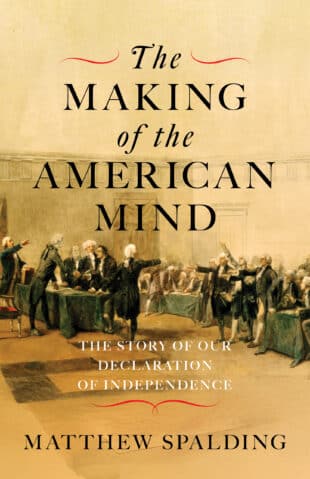
Read more in The Making of the American Mind: The Story of Our Declaration of Independence (Encounter, 2025).