

I have the privilege of teaching political theory to undergraduate students. The thinkers that pose the greatest challenge to these young people tend to be not the ancient Greeks, nor the likes of Machiavelli or Hobbes, but the American Founders. This is not to say that my students find the Founders the most difficult to read. Rather, my students struggle to reconcile the Founders’ ideas with the realities of American politics, both as they exist today and as they existed in the Founders’ own historical moment. They are frustrated by the Founders; they agonize over them.
I think this tension arises from a variety of different factors, the most important of which is the American tendency to mythologize the founding. I begin my freshman Introduction to American Politics with a lecture entitled “Foundings: Fact and Myth.” I walk my students through two founding myths of Rome (Romulus and Remus and the Aeneid), as well as the British founding myths involving Arthur’s acquisition of Excalibur (both by way of the stone and the being described in a Monty Python film as a “watery tart”). Then I turn to the American founding.
Because the United States is a comparatively young nation, I tell my students, we often believe we understand its founding mostly in terms of historical fact. I show them John Trumbull’s The Declaration of Independence, a portrait they all, without exception, know by heart. Fact or myth? I ask them. Fact, they respond, usually also without exception. Then, I ask them what date this painting depicts. July 4? No, June 28. I point out that there are people depicted in the painting that weren’t in attendance that day, and there’s an extra door that Trumbull added for symmetry. The whole room is, in fact, wrong; Trumbull had never been to Independence Hall and was working from Thomas Jefferson’s hand-drawn map. Perhaps Trumbull presents us with mostly fact, but there is a little myth, too.
I conclude by showing them The Apotheosis of Washington, the fresco that crowns the U.S. Capitol Building rotunda. In it, Washington is deified, sitting among the clouds and surrounded by the classical muses. I let them admire it for some minutes, and then ask again if there is any mythology to be found in the way we think about the American founding. What do these potential myths tell us about what it means to be an American?
In the middle of the twentieth century, political theologian Reinhold Niebuhr described one type of American mythology by identifying in the American mind a perception of innocence regarding the American project—a certainty that American aims were always noble, American motives always pure, and American origins unambiguously heroic. Niebuhr rightly asserted that this understanding was reductive, and that, as the United States reached national maturity (especially in a post-WWII world order), it would cause political problems both within the nation and on the international stage. How could the nation with the world’s most fearsome military—the dropper of the only atomic bombs that have ever been deployed—balance its self-identity as the protector of the huddled masses and the defender of freedom and justice in the world? The contradiction, Niebuhr offered, could not be reconciled. The center could not hold, and indeed it did not. In the postmodern era, certainty in the innocence of the American project has given way to certainty in its culpability. From the postliberals of the far right to the deconstructionists of the far left, there is no shortage of voices denouncing the American founding as the original sin for which modern American politics still suffers. This swing of the pendulum, while perhaps predictable, is as much mythology of the American founding as the previous myths of its purity and goodness.
My students are caught in this crossfire. On the one hand, most of them have some sense for the value of the American founding and the uprightness of certain theoretical elements presented therein. They have some sense for the dignity and morality of certain American Founders. Many of them believe, on a deep level, that the United States is the greatest nation on earth. They feel a pull toward the certainty of American innocence that Niebuhr described. On the other hand, they are bombarded with broadside critiques of the United States that hold its founding responsible for every shortcoming of modern political culture. These critical mythologies, with their cultural cache and moral superiority, have a pull all their own. By the time students land in my classroom, they have largely oscillated between these competing mythologies. It is my work to reintroduce curiosity about the American founding, a lack of certainty about specific people and events, an eye for nuance, and a desire to seek truth rather than convenient ideological maxims.
There is perhaps no Founder who suffers more by way of these competing founding mythologies than Thomas Jefferson. Indeed, it is Jefferson with whom my students quibble most. Is he the author of American liberty or a hypocritical intellectual sellout? Should he be seriously studied as one of the most important Founders or dismissed as just another enslaver of his fellow men? Was he crossing his fingers behind his back when he wrote that “all men are created equal, and are endowed by their creator with certain unalienable rights, among these life, liberty, and pursuit of happiness”? Instead of trafficking in myths, I like to suggest to my students that the Jefferson most true to life is the one we cannot reduce to a narrative—that the most interesting Jefferson is the one who both held slaves and actually meant what he said when he wrote that “all men are created equal.” Of course, this version of Jefferson requires further examination, because we cannot end with the contradiction—we must attempt to solve it. This requires effort, and more than a superficial reading of Jefferson, and indeed the founding at large. But this work rewards those willing to do it, and it leads away from Jefferson toward an unsung voice of the founding, and toward the enduring importance of moral education for right thinking.
Buried deep in the middle chapters of his Notes on the State of Virginia, Thomas Jefferson dismissed, seemingly in passing, the Bostonian poet Phillis Wheatley. He wrote:
Religion indeed has produced a Phyllis Whately [sic]; but it could not produce a poet. The compositions published under her name are below the dignity of criticism. The heroes of the Dunciad are to her, as Hercules to the author of that poem.
This denunciation, offered in service of Jefferson’s broader, infamous argument in Query 14 that race determines intellectual and artistic capacity, condemns Wheatley’s religiosity as irrational, her poems as farcically self-important (as Alexander Pope is to Hercules, Wheatley is to Pope’s satirical goddess Dulness), and her fame as a passing novelty. All of this was, for Jefferson, downstream of the fact that Phillis Wheatley had been a Black woman, enslaved for most of her life (she died in 1784, one year prior to the publication of Notes on the State of Virginia). Wheatley, Jefferson averred, was simply case in point for his egregious assertion that Black individuals sat at the bottom of the racial hierarchy, and were, in fact, incapable of being liberally educated in any real way.
Query 14 is perhaps the most shocking slice of Jefferson’s oeuvre to twenty-first-century ears; these passages are among those most frequently invoked (alongside Jefferson’s practical reality of slaveholding) when contemporary readers critique as hollow or hypocritical his aspirations toward American political liberty. Amid all of this, it is perhaps unsurprising that most readers fail to note Jefferson’s brief but specific mention of Wheatley. And yet, it is this passing mention that holds the key to understanding much of Jefferson’s epistemology of human nature—and as such, his politics.
To understand Jefferson’s denunciation of Wheatley, though, one must understand Query 14 as a meta-practice in Jefferson’s epistemological framework. He was, among the Founders, perhaps the most indebted to Enlightenment rationalism and empiricism. Eschewing faith, tradition, morality, and metaphysics as sources of real knowledge, Jefferson’s preferred way of understanding truth privileged the observable. A generation later, Alexis de Tocqueville would note that nowhere in the world was Descartes’s “I think, therefore I am,” more central to the mode of life than in America. Jefferson is perhaps the origin point of this phenomenon. Jefferson’s commitment to the rational as the source of all wisdom was clear and consistent. It explains his ardent support for the French Revolution as well as his sense for the “self-evident” truth of natural rights, his defense of religious liberty, and his excision of Christ’s miracles from his own personal bible. He maintained that there was a science to human life and that understanding this science would yield more and more perfect politics. His objectionable claims about race here are an attempt to construct an empirical anthropological account of human capacities; he was a man on the cutting edge of the science of his day in this regard. To wit, Query 14 should alert readers to the pitfalls of Jefferson’s epistemology.
Further, the ontology that emerged from Jefferson’s epistemology was one relatively new in the world. While man could recognize man in part due to their shared moral consciousness, per Jefferson, this moral consciousness contained no appeal to ultimate objective truth. Instead, morality only hinted at an empirically observable mutual sociability; any specific moral tenets were subjective and socially contrived. As Jefferson wrote to Peter Carr in 1787:
Man was destined for society. His morality, therefore, was to be formed to this object. He was endowed with a sense of right & wrong, merely relative to this. This sense is as much a part of his nature, as the sense of hearing, seeing, feeling; it is the true foundation of morality, & not the to kalon, [sic] truth, &c. as fanciful writers have imagined. The moral sense, or conscience, is as much a part of man as his leg or arm.
First principles of morality, then, can be of no assistance in seeking truth; in fact, they potentially obscure the truth by constructing artificial taboos. Only the moral sense, not any specific moral directive, is natural to man. Thus, when Jefferson wrote of “natural rights,” he did not situate them within some kind of enduring moral hierarchy. Instead, he developed his understanding of the rights of man from what he could observe about men. Rights, then, were not granted by way of a final metaphysical authority, but by demonstrable natural traits of human beings.
This should color our reading of the Declaration, insofar as we believe Jefferson’s authorship of the document to be meaningful. Given Jefferson’s understanding of the origin of rights, liberty—chief among the natural rights Jefferson articulated in the Declaration—is part and parcel of what it means to be a human being; it is not an achievement or an aspiration. The end of Jefferson’s Enlightenment-flavored liberty is wholly contained within the freedom of an individual to do what that individual wills, beginning at birth and ending at death. Humans do not have a teleological or collective destiny for Jefferson. Rather, each life is an end unto itself. This rationalist view of human rights and human nature runs counter to the way these things were traditionally conceived within the canon of Western philosophy prior to the Enlightenment. The Western tradition, from Plato through Aquinas and beyond, generally held that there is such a thing as objective good, that objective good is linked to objective truth, and that the knowledge of such things is worthy of pursuit. Within this tradition, rights are downstream of an overarching moral and metaphysical authority (God, perhaps, or capital-T Truth), and human nature fits into a broader natural order, aiming (and perhaps even arcing historically) toward some ultimate good. Jefferson was a well-educated and erudite man—he had been steeped in this tradition. It was this educational grounding that allowed him to attempt to overthrow it and assert that no metaphysical authority was necessary to justify the existence of rights, and that human nature was individual and not part of some greater narrative. Jefferson was an “innovator,” the likes of which C.S. Lewis described in his educational treatise The Abolition of Man, writing that:
The Innovator attacks traditional values … in defence of what he at first supposes to be (in some special sense “rational” or “biological” values … If he had really started from scratch, from right outside the human tradition of value, no jugglery could have advanced him an inch toward the conception that a man should die for the community or work for posterity.
Because of his epistemological approach to the world, Jefferson’s theories would always rest upon an incomplete and time-bound “scientific” understanding of human nature, which might be disproven by the presentation of some new information in the future. This much is clearly evident in his “empirical” anthropological investigation of race in Query 14; the same is true of his thoughts on liberty and from whence it comes.
Jefferson’s epistemological vantage point illuminates his critique of Phillis Wheatley, who otherwise ought not to have commanded his attention at all. Wheatley was poor, enslaved, Black, and a woman. Any power she might have accrued as a literary figure paled in comparison to that of Jefferson, future president, author of the Declaration, and chief among the American Founders. Jefferson might not have bothered to mention her at all, were it not for the fact that she was his epistemological rival. Where Jefferson sought to overthrow the presuppositions of the Western philosophical tradition, an enslaved Black woman used that same tradition to make a case for her own liberty. Wheatley’s conception of liberty, unlike Jefferson’s, was a liberty derived from her moral and metaphysical education, not conceived in opposition to it. And, in turn, it was a vision of liberty that insisted, contra Jefferson, that the abolition of slavery was imminently necessary to realize the promise of the new nation.
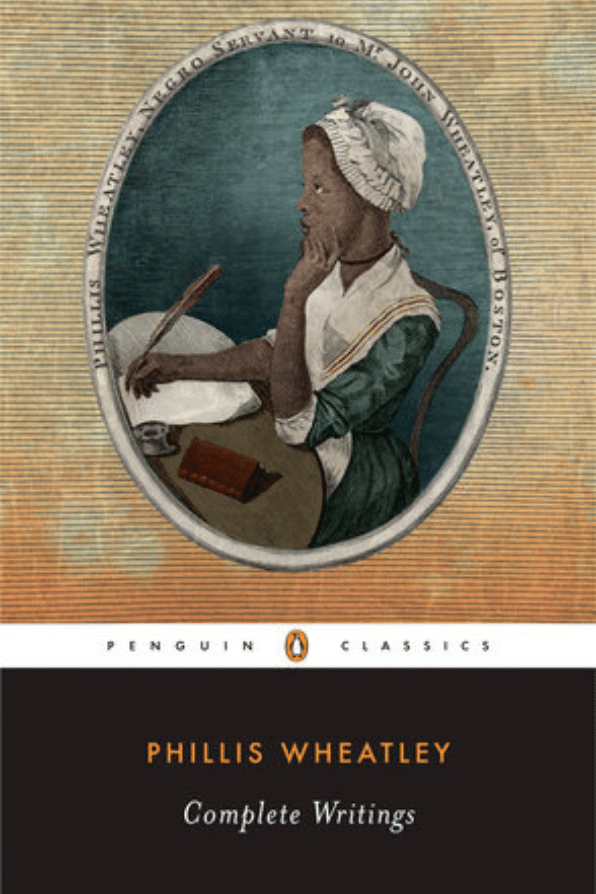
Phillis Wheatley arrived in Boston on a slave ship in 1761, when she was about seven. She was purchased by the Bostonite Wheatley family, who provided her an education within their household, first issued by their daughter, Mary. Though Wheatley spoke no English upon her arrival in the United States, she proved adept at learning in all the typical subjects of a liberal education of that day: English, Latin, astronomy, geography, and history, among others. In short, Wheatley received a liberal education—no common thing for an enslaved person. In turn, she fell in love with classical and neoclassical works of literature, and also explored the world of theology as a serious Christian. By 1765, she took up the pen for herself and began to write poetry, much of it in the classical and neoclassical styles. Wheatley became a respected poet on both sides of the Atlantic and was the first published Black American poet. Her poetry reflected the events of the Revolution, and she often wrote with political undercurrents. Liberty is a recurring theme in her work, and it emerges in her writing in a way that separates her from the likes of Jefferson and aligns her with the broader tradition of western philosophy.
Wheatley’s education and faith led her to that fundamental assumption of the great tradition: that there is such a thing as objective good, that objective good is linked to objective truth, and that the knowledge of such things is worthy of pursuit. Wheatley’s favorite classical writers, including Homer and Ovid, wrote teleologically—that is, on the premise that the purpose of each thing aligns with the ultimate end of all things. Such reading was reinforced by the Christian theology to which Wheatley cleaved. Wheatley located the purpose of human life outside of individual experiences. This bore out in her writing, as she handled the question of her own enslavement while the burgeoning United States hoisted the banner of freedom. In her poem “To Maecenas,” for example, Wheatley draws a clever parallel between herself and the ancient Roman playwright Terence. Superficially, this reference demonstrates Wheatley’s fluency with the classical canon; less obviously, it situates Wheatley herself within that canon, as she notes that Terence, too, was once an enslaved person from Africa (and perhaps even Black to boot); still more surreptitiously, it critiques American chattel slavery by comparison to Roman slavery. While Terence was freed for his rhetorical brilliance and allowed full citizenship in Rome despite his race, Wheatley remained enslaved despite her own literary merits because of her race.
The poem works as a critique of the anthropological theories of race (including Jefferson’s, though he had not yet penned Notes on the State of Virginia) that suggested the intellectual inferiority of Black people, and as a teleological argument for Wheatley’s own freedom. This poem is one of longing for an artistic greatness, like that of Terence, that Wheatley cannot achieve because she remains enslaved. In a word, Wheatley articulates that her enslavement keeps her from flourishing—from reaching that highest peak of human life through self-mastery. Indeed, self-mastery (the definition of liberty throughout the Western philosophical tradition), not merely autonomy, is what is denied the enslaved person. The egregious evil of her own enslavement, per Wheatley, was bound up not only in that she was not free to do as she wished, but that she could not do what she should, in pursuit of goodness and of God. “To Maecenas” expresses Wheatley’s desire for her own freedom—a freedom that is for something, toward something. Wheatley wanted a freedom that was not for freedom’s sake, but for the sake of a grander telos in which she had a specific role to play.
Wheatley advocated for this vision of freedom for other enslaved Black Americans on these grounds as well. Poems like “To the Right Honorable William, Earl of Dartmouth,” and her letter to Samson Occum underscore the theory of liberty that Wheatley suggested in “To Maecenas.” In the latter, Wheatley wrote:
I have this Day received your obliging kind Epistle, and am greatly satisfied with your Reasons respecting the Negroes, and think highly reasonable what you offer in Vindication of their natural Rights: Those that invade them cannot be insensible that the divine Light is chasing away the thick Darkness which broods over the Land of Africa; and the Chaos which has reign’d so long, is converting into beautiful Order, and reveals more and more clearly, the glorious Dispensation of civil and religious Liberty, which are so inseparably Limited, that there is little or no Enjoyment of one Without the other: Otherwise, perhaps, the Israelites had been less solicitous for their Freedom from Egyptian slavery; I do not say they would have been contented without it, by no means, for in every human Breast, God has implanted a Principle, which we call Love of Freedom; it is impatient of Oppression, and pants for Deliverance; and by the Leave of our modern Egyptians I will assert, that the same Principle lives in us. God grant Deliverance in his own Way and Time, and get him honour upon all those whose Avarice impels them to countenance and help forward the Calamities of their fellow Creatures. This I desire not for their Hurt, but to convince them of the strange Absurdity of their Conduct whose Words and Actions are so diametrically, opposite. How well the Cry for Liberty, and the reverse Disposition for the exercise of oppressive Power over others agree, I humbly think it does not require the Penetration of a Philosopher to determine.
The “natural right” to liberty, for Wheatley, did not emerge from empirical observation or anthropological analysis, but instead through a capacity for flourishing exhibited by enslaved Black American people. While some scholars have critiqued Wheatley’s description of Africa and the “thick Darkness which broods over” it in this letter, the darkness she refers to is not a darkness inherent to the people of the African continent; it is the darkness of a world without Christian “light.” The steady advancement of Christianity throughout Africa, Wheatley implies, proves even further that Black people have a teleological destiny—an important role to play in the history of the world as image-bearers of God with unique individual gifts and talents. It is not only she—“Afric’s muse,” as she called herself on occasion—who deserves liberation based on her own, individual merit, but all enslaved Black Americans, of whose potential for flourishing her literary talents were but one example. If genius can be found in even one enslaved Black person, all enslaved Black people must be entitled to freedom. Natural rights, for Wheatley, are not anthropological, they are teleological. What gives the human a right to liberty is not the scientifically observable, but the metaphysically undeniable. Individuals have purposes—talents, capacities, gifts—that serve a greater narrative of human existence. They can flourish in these purposes only so long as they have the freedom to pursue such ends. As such, the abolition of slavery was not an inconvenient inevitability, a can to be kicked down the road, as Jefferson believed, but rather a desperate and urgent necessity. Those in bondage did not hypothesize about liberty, or desire it—they panted for it.
Jefferson and Wheatley differed most profoundly in their epistemological convictions—in their assessment of the origins of human knowledge—and subsequently in their understanding of human nature, and of natural rights. Given this reading of Wheatley, it seems altogether possible that Jefferson dismissed her so thoroughly in Notes on the State of Virginia not because he truly believed she was a terrible a poet, but because she offered a take on rights and liberty so different from his, one that contained within it a mandate for the liberation of enslaved Black Americans. Moreover, Wheatley’s ideas emerged from the very canon that Jefferson sought to overturn, and from which he would have excluded her entirely.
In reading Wheatley, those who wish to understand the American founding come to know a little-acknowledged perspective on that time period, but they also come to know more about Founders like Jefferson. Vignettes such as this one illustrate the necessity of going beyond the mythologies of the founding to understand it in its rich complexity. Only in such investigation does it become clear that Jefferson’s epistemology of liberty is revealed in his critique of Phillis Wheatley. Moreover, the divergent perspectives offered by Jefferson and Wheatley showcase the ontological variety present within the founding generation. But such understanding is only possible if those who care about the American founding are willing to let it be complicated and elusive of simple narratives. Considering the likes of Phillis Wheatley is one place to begin.
Kirstin Anderson Birkhaug (Ph.D., University of Wisconsin-Madison) is a research fellow at the Center for Religion, Culture & Democracy, assistant professor of political science at Hope College (Holland, MI), and book reviews editor of the Journal of Religion, Culture & Democracy. Her research focuses on early American political thought, with an emphasis on the contributions of women.