
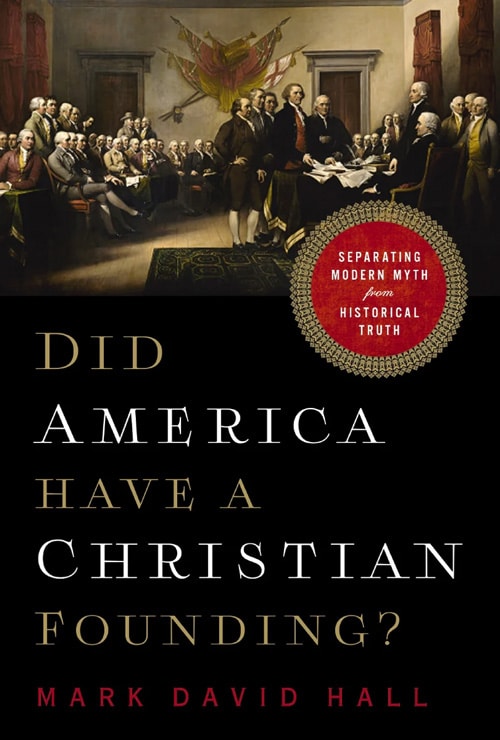
Did America Have a Christian Founding? offers straightforward clarity. Even before the reader reaches the first chapter, the introduction has already laid out the book’s entire argument. It begins, as it should, with a problem: in this case, a misconception about whether America had a Christian Founding. Both popular and scholarly authors often give the impression that the Founders were adherents of so-called deism. In the eighteenth century, the book explains, deism stood for “an intellectual movement that emphasized the role of reason in discerning religious truth.” Furthermore, the Founders are said to have advocated a strict separation of church and state.
Upon closer examination, neither of these views stands up to scrutiny. Mark David Hall argues in this book that the Founders were strongly influenced by distinctly Christian views and, as a result, that America undeniably had a Christian Founding. According to Hall, it is crucial for Americans to acknowledge this past, particularly the principles that led to the Declaration of Independence and the Constitution. After all, these documents remain good news not only for Christians but also for Americans who adhere to a non-Christian religion or who are not religious at all.
The Protestant Character of the American Nation
In the first two chapters, Hall demonstrates how the Founders’ Christian beliefs shaped the Constitution. The first chapter substantiates his argument that the claim that the Founding Fathers were deists is a myth. In short, according to Hall, there is virtually no evidence that the Founding Fathers thought this way. Hall spends the next chapter showing that the United States has anything but a “Godless Constitution.” From a comparative perspective, this is the most interesting of the two chapters. For example, during the attempt to draft a European Constitution between 2002 and 2004, there was much debate over whether it should include a reference to the continent’s Judeo-Christian roots.
From the same comparative perspective, however, a critical caveat can also be raised regarding Hall’s argument. After all, the fact that the American Founders were influenced by Christian ideas does not necessarily mean that they implemented them correctly. Moreover, even if that implementation proved largely beneficial to the United States, that does not mean it cannot be implemented differently elsewhere. For instance, drawing on the same Christian inspiration, Christian Democratic parties in Europe helped establish relatively extensive welfare states after World War II. This implies a greater—though certainly not exclusive—role for the government in promoting the general welfare than in the American model.
Although this is not explicitly thematized in the book, it stands to reason that this difference can be attributed, at least in part, to the difference between Catholic and Protestant views on the role of the state. Hall does note that the American republic was predominantly Protestant in character at its inception and remained so for a considerable time. It is only relatively recently that Catholics have come more to the fore, for example in Congress and the Supreme Court. It is no coincidence that the Catholic Church has a well-developed social doctrine, unlike most Protestant churches that instead stress the importance of individual responsibility. This is not to say, of course, that there is no room for criticism of Catholic social doctrine, and there is debate about it also among Catholics themselves. It is, however, conceivable that Catholic ideas could complement Protestant ones in the search for answers to the different challenges of the twenty-first century compared with those of earlier centuries.
Hall himself illustrates the idiosyncratic nature of the American interpretation of Christian views on the state when he notes that while the Bible formed the source of highest authority for the Founders, it could by no means serve as a political recipe book for them. For example, they also turned to Enlightenment thinkers such as John Locke (1632–1704). On at least one point, however, the Founders’ views remained distinctly Christian: namely, the concept of sinful human nature and the related idea that power corrupts. From this arose fundamental constitutional principles, such as federalism, the separation of powers, and checks and balances. Hall rightly sees in this the explanation for why the American system of government has proven more successful than the ones founded on the principles of the French Revolution.
Another distinctive element of the American constitutional order is undoubtedly the idea of inalienable individual rights. Hall also makes a compelling case that this has deep roots in the Christian natural-law tradition, as well as in Protestant views on a right to resistance. Thus, the idea of a right to life arose from the conviction that man is created in the image of God. The concept of “freedom” itself was also explicitly understood by the Founders in a Christian—and thus limited—manner. For this reason, for example, freedom of speech was not considered absolute. Moreover, these rights were deemed to apply to all Americans, religious or not, even though it would be quite some time before this idea was realized in practice.
The Need to Defend a Free Society
The next three chapters of the book then specifically address the themes of church-state relations in general and religious freedom in particular. It is interesting here how Hall demonstrates that there was no support among the Founders for contemporary views on a strict separation of church and state, as if, for example, there were no place for religious symbols in public spaces. He labels the idea that they would have wanted to erect a “high and impregnable” wall between the two, referring to a quotation from Madison’s Memorial and Remonstrance Against Religious Assessment (1785), as “pure fantasy.” Yet the Supreme Court cited this document no fewer than 24 times in the postwar period and even printed it in full on two occasions.
Indeed, the opposite was true. The Founders were overwhelmingly in favor of an intertwining of church and state in which these institutions were to support one another. This was not to degenerate into the establishment of a state church. Instead, chiefly for theological reasons, they emphasized the importance of religious freedom. If this “sacred right” threatened to conflict with general rules, the inclusion of religious exceptions and accommodations therein was the appropriate solution. In this way, the objectives of the rules—assuming they were in the public interest—could still be achieved. The growing skepticism toward such legal arrangements is therefore unfounded.
This section of the book also warrants a critical comment. It concerns Hall’s argument that religious freedom should apply fully to Muslims as well: “The moment we start picking which convictions we choose to protect and which we do not, is the moment we abandon the Founders’ commitment to defending ‘the sacred rights of conscience’.” Formulated in such general terms, that is indeed correct. Yet a look at the European situation in particular shows that not all religions are equal and that some may at times pose a greater threat to the democratic constitutional order than others. This fact, of course, complicates the application of the principle of equality, which has been almost canonized in modern times. Nevertheless, it would be better not to leave the consequences of unreflective, universal application of religious freedom to currents that may turn out to be untrustworthy with respect to the rule of law.
Of course, it is understandable why Hall decided not to elaborate on these matters in this book primarily focused on the past. It is true, however, that the era in which the Founders lived was, in this respect as well, different from the present day. This means that, once again, certain aspects of their body of thought may require adaptation to preserve its very essence. For example, some academics, politicians, and writers in Western societies have been under constant guard for 25 years now, or, in the case of Salman Rushdie, for nearly 40 years. The consequences of this for, among other things, freedom of speech—which can be regarded as a cornerstone of the same Western society—are difficult to overestimate. Not to mention the threat that Islamic extremism poses to the position of Jews and women, for example.
This concern is explicitly not about Islam or Muslims in general. Nevertheless, it is naive to ignore the problem of extremism and terrorism, which, as intelligence reports show, is very real. There are no simple solutions to this either. Yet U.S. immigration policy offers an interesting example that may also deserve broader emulation. Formally, there is no discrimination based on religion in this policy. At the same time, various measures are in effect in practice, including “ideological vetting,” which seek to mitigate the risks to a free society. As is well known, Europe still has some catching up to do in this regard compared to the United States, but there too, thinking—especially from a Christian perspective—should not stand still.
Carrying These Ideas Forward
The conclusion of Did America Have a Christian Founding? leaves little doubt that the author advocates “preserving and protecting the remarkable constitutional order bequeathed to us by America’s Founders, and encouraging the passage of laws that promote the common good.” For Hall, religious freedom certainly falls under the latter category. In that regard, he rightly mentions organizations such as First Liberty and Alliance Defending Freedom that are working toward this goal. Drawing such a connection to the present is also a natural inclination for me as a constitutional law scholar, as the above amply illustrates.
However, precisely those who seek to trace this contemporary relevance cannot help but express concern about the state in which the American constitutional order appears to find itself. Is it not, for example, a sign of the times that so many cases regarding religious freedom must be brought to court by First Liberty and other organizations? Anyone who broadens their perspective to the state of Western constitutionalism in general will hardly become more optimistic. Thus, despite the appropriate celebrations surrounding the 250th anniversary of the American Declaration of Independence, historian James Hankins rightly observes at the end of Volume I of his masterpiece, The Golden Thread; A History of the Western Tradition (2025), co-authored with Allen C. Guelzo, that: “At the present moment, it is all too obvious that we moderns are fully capable of … thoughtlessly discarding three thousand years of cultural achievement, along with our political traditions, our society, and the health of our souls.”
At the same time, Hankins, on receiving the 2026 Bradley Prize last May, called for the initiation of “a New Renaissance.” The latter was undoubtedly more in the spirit of Hall and of this essay. After all, not only is hope generally a Christian virtue, but at this moment there seems to be at least as much need for a Christian constitution in the sense in which Hall uses the phrase as there was in the time of the Founding.
In response to his inspiring book, I have two suggestions for meeting that need even more effectively. First, bring the rich Protestant sources in the treasure trove of Christian tradition into even more conscious dialogue with the Catholic ones. In that regard, America could use a touch of historic European-style Christian Democracy. Second, while preserving the valuable pluralistic tradition, we must become more aware of the dangers that Islamic extremism poses precisely to that tradition as well.
Hans-Martien ten Napel (Ph.D., Leiden University), is an associate professor of constitutional and administrative Law at Leiden University, the Netherlands, and a Senior Fellow at First Liberty’s Center for Religion, Culture & Democracy.