

This is a biography of a brilliant but troubled person. Thomas Jefferson would seem to need no introduction, yet among the Founding Fathers he is the greatest enigma—and the greatest source of controversy. Jefferson left a massive collection of carefully curated papers, but he seems virtually unknowable as a man. Most of the controversy about him comes back to questions of character. How could the author of the Declaration of Independence keep hundreds of human beings in bondage? How could he carry on a long-standing sexual relationship with one of his bondspeople, who was also his dead wife’s half sister? His relationship with Sally Hemings produced at least one and perhaps as many as six children. The children who survived to adulthood he acknowledged only by letting them go free, unlike most of the other people he owned.
“Hypocrisy!” Jefferson’s critics cry. When you look closer at Jefferson, however, hypocrisy doesn’t quite penetrate the mystery, doesn’t explain Jefferson’s troubled genius and vacillating life. For all his blazing intellect and inspired rhetoric, Jefferson held a host of beliefs and inclinations that were unreconciled, and maybe irreconcilable. To be fair, most of us struggle with forms of incoherence and hypocrisy. And it is undoubtedly easier to see these problems with the benefit of historical hindsight. We never know if we would have done better if we had lived the same life as a person in the past. We will never know if we would have outdone Jefferson if placed in his situation.
But Jefferson’s inconsistencies often transcended the failure to live up to his stated beliefs, which is the definition of hypocrisy. On issues such as slavery, he held ideas that were difficult to reconcile, even in the context of his time. (A more charitable reading might describe his philosophy as “eclectic.”) Many people pointed out the incoherence to him, to little effect. He often failed to connect his theoretical musings to lived reality. We’re so used to treating Jefferson as a great thinker—along with Madison, our founding thinker—that his unreconciled beliefs can be difficult to discern. Even Joseph J. Ellis, a relatively critical biographer, insisted that Jefferson “knew what he meant and meant what he believed.” I am not so sure.
The dissonance between stated belief and practiced reality is perhaps more acute for Jefferson than any other American, ever. That’s quite a burden to bear. Yet Jefferson carries it, because of the Declaration of Independence. Jefferson did a great deal to promote the Declaration, listing it first on his epitaph, followed by the Virginia Statute for Establishing Religious Freedom (1786) and the founding of the University of Virginia. By the end of his life Jefferson cultivated his image primarily as the author of the Declaration, and indeed we have come to remember him as the writer of that “American Scripture,” in historian Pauline Maier’s phrase. But “all men are created equal” is not the definitive word on Jefferson’s philosophy, or on his life. That phrase is better understood as a national self-image and lodestar than a code by which Jefferson lived.
His sheer brilliance, political doggedness, inherited resources, and occasional good luck led to history-changing accomplishments, not only the Declaration and the other items listed on his epitaph, but other achievements not included there, such as the Louisiana Purchase. Jefferson could also be mystifyingly impractical, however. By “impractical” I mean that his ideas sometimes failed to manifest themselves in reality, especially on a personal level. Or he stated positions that he did not act upon, at least not in a sustained way. Again, tendencies toward impracticality are common among politicians, perhaps increasingly so in recent decades. America has had innumerable government leaders who have held incoherent positions, though few of them have also been as imaginative as Jefferson. When someone as brilliant and powerful as Jefferson also struggles with incoherence, it can have disastrous consequences. Those consequences meant trouble for many people with less power (meaning virtually everyone around him) around the nation and within his household.
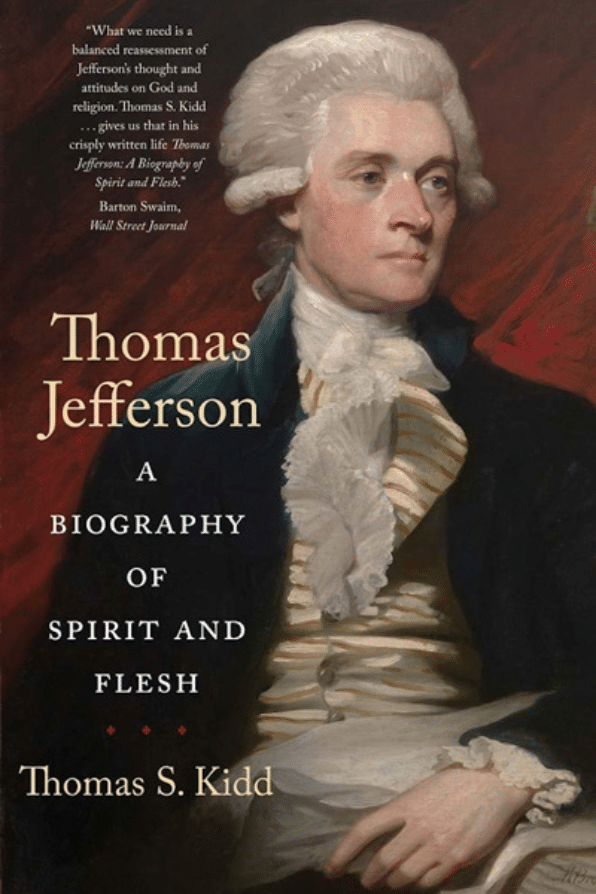
Thomas Jefferson: A Biography of Spirit and Flesh tells Jefferson’s story with special attention to the man’s dissonant beliefs and actions. This book is a narrative of Jefferson’s moral universe more than a traditional biography. It is not a step-by-step account of his political or diplomatic career, although these aspects play a significant role in my account. Readers wanting to know more about politics and diplomacy should consult comprehensive Jefferson biographies by Merrill Peterson, John Boles, and others, or the many excellent books (which I hope are adequately cited in the notes) on Jefferson’s presidency, foreign policy, economic views, and other topics.
Read more in Thomas Jefferson: A Biography of Spirit and Flesh (Yale, 2022).