
Thomas Jefferson does not fit comfortably into any of the categories that many would like to place him in. He was neither the orthodox Christian some defenders of the American Founding wish him to be, nor the uncomplicated secularist hero imagined by later admirers of Enlightenment skepticism. He was the author of the Declaration of Independence who held men and women in bondage; the champion of republican virtue who lived beyond his means; the reverent admirer of Jesus who rejected many orthodox Christian beliefs. He remains, in other words, one of the most brilliant and morally vexing figures in American history.
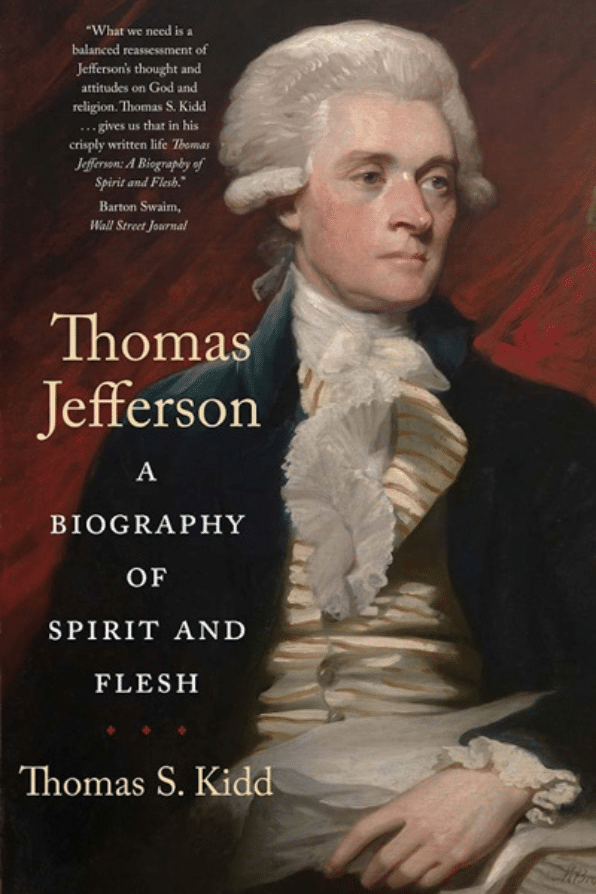
But of those difficulties, Jefferson’s relationship to Christianity remains the most puzzling. And while Thomas Kidd promises his readers that he will make no new disclosure concerning Jefferson in his biography, Thomas Jefferson: A Biography of Spirit and Flesh, he nevertheless offers a nuanced portrait of Jefferson’s religious life. Jefferson, Kidd writes, “was a skeptical providentialist, a higher critic of Scripture yet a lifelong reader of biblical texts, and a pioneer of church-state separation who could not have imagined a public sphere stripped of religious symbols and rhetoric.”
At points, Jefferson’s view of Christianity seems almost utilitarian. Jefferson admired Joseph Priestley, corresponding over the completion of Priestley’s Jesus and Socrates Compared. Priestley developed a sort of theological utilitarianism, which had a concept of happiness that implied human beings can keep endeavoring to attain higher happiness in the future—crucially, guided by divine providence. Similarly, in writing to Priestley, Jefferson praised Christianity as “the most sublime & benevolent, but most perverted system that ever shone on man.” For Jefferson, then, Christianity’s value lay not in orthodox practice as such, but in its particular moral goods that could be recovered once priestcraft and corruption were stripped away.
Jefferson’s 1787 trip to France and Italy is emblematic of his distaste for the trappings of religion as compared to its moral goods. “The journey also exposed Jefferson to local Catholic life, confirming his long-standing suspicions about the corruption and ignorance endemic to religion,” writes Kidd. Discussing the French peasants, Jefferson asked, “Are they thus collected by that dogma of their religion, which makes them believe, that to keep the Creator in good humor with his own works, they must mumble a mass every day?” Here, the elements of religion that Jefferson finds most objectionable are not its moral teachings, but its rituals, hierarchies, and inherited doctrines—those practices that, in his mind, obscured rather than advanced the ethical religion Jesus had taught.
These criticisms, too, reveal something about Jefferson’s religious views: that Jefferson’s appreciation for Christianity was for Christianity qua an ethical system (hence, the prior claim about utilitarian), and, as such, Jefferson especially admired Jesus as a moral teacher. Jefferson, Kidd points out, found the four evangelists to have developed the most “pure & sublime system of morality [ever] delivered to man.” Simultaneously, Jefferson rejected other parts of the Bible as the “ravings of a maniac” and excised many biblical miracles from the Jefferson Bible. He even went so far as to question the Trinity. In a 1788 letter to one of his Virginia neighbors, Jefferson declined to serve as a godparent because he could not profess “faith in articles, which I had never sense enough to comprehend.” In particular, he wrote, the “difficulty of reconciling the ideas of Unity and Trinity, have, from a very early part of my life, excluded me from the office of sponsorship.” Truly, for Jefferson, the central element of Christianity is its moral teachings, and even theological commitments like the Trinity are only ancillary. Jefferson believed that “[d]octrines such as the Trinity, which divided sects and denominations, were irrelevant to one’s acceptance [at the gates of heaven],” Kidd writes.
The complicated nature of Jefferson’s faith does not solely limit itself to his more rationalist understanding of Christianity. Kidd, as another example, points out that even the Jefferson Bible was not completely naturalistic, observing that while Jefferson cut out some references to angels, he kept others, including, for example, Jesus’s teaching in Matthew 13:41–42 that “the Son of Man shall send forth his angels, and they shall gather out of his kingdom all things that offend, and them which do iniquity; and shall cast them into a furnace of fire: there shall be wailing and gnashing of teeth.”
At other points, Jefferson spoke in more orthodox religious terms for prudential reasons. That prudence, Kidd argues, impacted Jefferson’s presence on the Declaration of Independence’s drafting committee:
Despite his [religious skepticism], Jefferson often had traditionalist Christians like Sherman in his political orbit, sometimes literally sitting next to them in meetings. He needed to be cognizant of their orthodoxy when he spoke in religious terms.
That same prudence can be seen again in Jefferson’s elaboration of his religious views prior to the 1800 election. “Jefferson became convinced that true Christianity (as opposed to priestcraft) enhanced liberty and republican virtue,” Kidd writes. That stance was politically calculated, though. Adherence to “true” Christianity let Jefferson refute Federalist charges of irreligion without surrendering his deeper skepticism toward orthodox Christianity.
But despite Jefferson’s many unorthodox religious beliefs, his commitment to religious liberty remains constant throughout his life—and that commitment is certainly an underlying theme throughout Kidd’s book. For Jefferson, liberty of conscience was the basis for all other freedom. To that end, Jefferson believed “Christianity would return to its healthy original form only if Americans lanced the boil of the church-state alliance.” In his brief notes for a 1776 speech, Jefferson outlines out his argument for religious freedom, arguing that the “spirit of the times” was “in favor of the rights of conscience.” Responding to the objection that disestablishment would lead to a decline in religion, he cited Matthew 16:18, asserting that if Jesus did not need coercion to bolster his religion, why should his followers.
And Jefferson’s commitment to religious liberty continued throughout his life—even when it was politically costly. During the embargo crisis of 1807 and 1808, Jefferson refused to call for a day of fasting and prayer, explaining that would mean the assumption of “an authority over religious exercises which the Constitution has directly precluded.” As Kidd explains, “Jefferson’s unwillingness to declare prayer days tested the resolve of other devout Americans, who thought that the president’s convictions regarding religious freedom and the First Amendment had led him to behave foolishly in a time of national crisis.”
At the same time, Kidd complicates more secularist readings of Jefferson’s position on religious liberty. Many Christians, especially sectarian evangelicals, supported Jefferson in large numbers, in large part because of Jefferson’s record on religious liberty. Jefferson’s advocacy for religious liberty was perfectly compatible with a devout society. In fact, as Kidd points out, the nation began to enter the era of the Second Great Awakening just as Jefferson became president, and some of his supporters connected the two events, arguing that religious liberty made true revival more likely.
In practice, religious liberty most impacted sectarian Christians’ ability to practice their faith, and many of Jefferson’s political allies were sectarian Christians. For example, the Delaware Baptist Association sent an admiring letter to Jefferson, declaring, “With emotions of Gratitude to the Almighty Ruler of the Universe, who manageth the affairs of the Terrestrial Globe … we lift up our hearts, and render the Tribute of Thankfulness to him who hath indulged us with worshiping according to the sacred Scriptures and the dictates of our Consciences.” That is certainly not an atheistic statement, exhorting the ability to worship no God at all. Jefferson’s position on religious liberty did not lead him to marginalize religion, but to simply protect the public exercise of religion from civil coercion.
Jefferson remains a remarkably complicated figure. Even in the narrow field of his religious life, he appears at times prudent to the point of political calculation and at other times remarkably principled, even at the loss of power or public approval. His Christianity was not the Christianity of creeds, sacraments, miracles, or ecclesial authority; it was a Christianity of moral teaching, rational inquiry, providence, and civic usefulness. Yet neither was Jefferson simply the secularist hero later readers have sometimes wished him to be. He read Scripture throughout his life, invoked religious language in public, admired Jesus as the greatest moral teacher, and defended religious liberty not because he wanted religion to disappear from public life, but because he believed true religion required freedom from coercion. Kidd’s achievement is not that he resolves these tensions, but that he lets us see them clearly: Jefferson was heterodox but not irreligious, anticlerical but not indifferent to Christianity, skeptical of doctrine but deeply invested in religious liberty.
Logan Tantibanchachai (B.A., University of Houston Honors College) is a research associate at First Liberty’s Center for Religion, Culture & Democracy and a doctoral student in political theory at the University of Dallas. As an undergraduate, he completed research fellowships at the Mellon Foundation and the University of Houston’s Center for Creative Work and served as a research assistant to Dr. Jeffrey Church.