
What does it mean to be an American? It is a truism that there can be no single, objective answer to this question. Indeed, even the framing smuggles in an important presupposition: placing “an American” in the singular suggests from the outset that one’s answer to this inquiry about belonging to a political experiment involving hundreds of millions of people is best considered through an individualist lens. Perhaps we should ask instead who we are today as Americans. And who did our forebears—who embarked on this political experiment and from whom we’ve inherited this country—understand themselves to be?
It is often claimed that we Americans comprise a creedal nation, such that our way of life and governing structures are undergirded by universal and unalienable rights that adhere to human beings as human beings. Lincoln borrowed from Proverbs in describing these truths expressed in the Declaration as “an apple of gold supported by a frame of silver,” with the frame standing in for our Constitution and the latticework of laws, states, and localities that manifest those truths in the mundane and everyday lived reality of citizens.
Hamilton observed in the debut Federalist paper that Americans were unique in history and opportunity insofar as we could draw upon “reflection and choice” instead of merely being subject to “accident and force” in establishing good government. Such an opportunity means both that we Americans can employ our reason in working on this project, and that we will disagree heartily throughout. Even the claim that we are a creedal people must be tempered with the undeniable historical reality that the vast majority of the earliest Americans were, as John Jay put it in the second Federalist paper, “a people descended from the same ancestors, speaking the same language, and professing the same religion…,” even as they shared principles of government and were the joint heirs of a successful revolution.
Our undergirding foundational truths may make us creedal, but how to manifest those truths is no less contested because our differences are “sown in the nature of man,” as Madison put it in Federalist 10. And so our forebears debated what it meant for them as citizens of Virginia, Georgia, Massachusetts, New York et al. to also be citizens of these new United States, and so we modern Americans have been debating ever since. Were the earliest Americans modern and liberal individualists, fighting for their right to pursue the good as each saw fit? Were they inspired instead by the classical republican tradition of ancient Rome, such that they were not individualists after all, but committed to self-control, tight-knit communities, and fulfillment through secular political engagement? For decades, academics have made careers producing evidence and arguments on either side of the liberal and classical republican interpretations. But what if there are more than two sides?
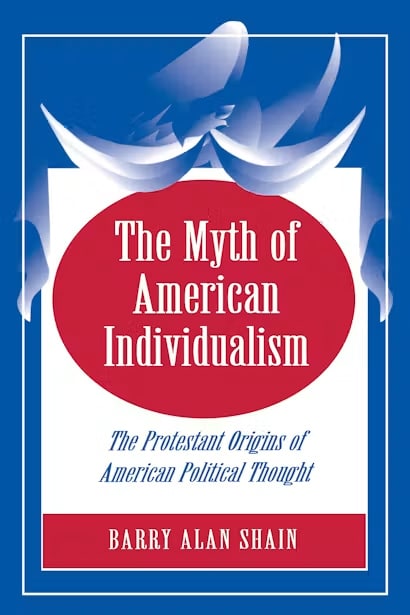
Over thirty years ago, Barry Alan Shain of Colgate University irrevocably changed the academic landscape of that debate with his book The Myth of American Individualism. Shain’s overall argument is meticulously framed, exhaustively researched, and enduringly provocative as it upset what had been a two-theory race to explain who Americans were, and thus also who Americans are now. Shain’s book has endured in part because, with apologies to William Faulkner, the American past is never dead, and it’s not even really past.
The predominant modern scholarly understanding of the Founding is most associated with Harvard’s Louis Hartz (1919–1986), whose 1955 book The Liberal Tradition in America argued that the American founding was characterized by an emphasis on liberal individualism, such that “the master assumption of American political thought” was “the reality of atomistic social freedom.” That is to say that the earliest Americans were animated by concerns for individual liberty that seem very familiar to modern Americans: the Revolution was fought and the Constitution written to ensure that Americans could pursue their own individualistic notions of happiness. Shain notes that while this view was not held by the majority of historians of the American Founding, it was a dominant view of political scientists and theorists. Some political scientists went so far as to praise Hartz for identifying individualism as “the rock upon which all else in American politics was built.”
The republican interpretation arose as a rival to liberalism through the work of several scholars in the 1960s and 70s, including Shain himself. Shain acknowledges his own political views were informed by the radical activism of the 60s, and thus he expected and hoped to find in early American history the resources that would help counter what he took to be an overly individualistic and materialistic modern American society. Republicanism counters atomistic individualism by emphasizing “the need for individual sacrifice and the active participation of all citizens in the life of the polity.” It also tends to be more secular, which can make it more attractive to scholars who find liberalism problematic but are also unlikely to embrace a religious outlook on politics. Suffice to say that Shain’s study of eighteenth-century American political theory contradicted his expectations. The eighteenth century cannot be best characterized as individualist and liberal, nor republican and classical, but rather Protestant (and Reformed at that) and communal.
There are two crucial questions to ask in determining what political ideas were regnant during the eighteenth century. First, what sources do we privilege in figuring out what counts as representing what people thought? Second, what are we looking for such that we will know when we find evidence for one theory or another? On the first question, Shain favors what he refers to as the written evidence from the “political elite” or the “political class.” These figures were not, as we might imagine, the very icons of American history like George Washington and Benjamin Franklin. Rather, they are the ministers who delivered election sermons, state and local officials, college presidents, prominent lawyers, and more. These figures acted as a “social, religious, and political bridge” between the famous Founders and regular people; thus, the voluminous sources we have from them give us a better grasp of what ideas were dominant than we might glean from a “canonical” approach that offers close readings of the public and private writings of a few great men. This is not to diminish the importance of those writings, nor the statesmen who produced them. Rather, Shain’s point is that those great sources are not necessarily the best for answering that first question of what counts as representative.
As to the second question, Shain argues that if the individualist interpretation is correct, then we would expect to find “that human flourishing was best promoted by freeing the individual from the restrictive confines of familial, communal, and religiously imposed traditional limits.” As Shain details through several chapters of the book, we do not find anything like that, even as it is arguably the dominant view of American liberty today. Nor do we find much widespread evidence for the republican interpretation as applied to the bulk of early Americans. True, several well-educated elites familiar with the classical sources adhered to the republican ideal that a virtuous and free life was made possible by direct and intensive participation in “political debate and the direct crafting of legislation.” But most American Protestants—which is to say most Americans—did not see the political route as the primary means to a good life. “Americans were different,” Shain notes. “They were a Christian people.”
It is impossible of course to recount here the rich details of Shain’s analysis as he looks over the primary and secondary sources to apply these questions to concepts such as 1) how the individual was conceived, 2) how the public and private good relate, 3) American communalism, and 4) liberty. But this last example of liberty serves as a good illustration for how Shain problematizes an all-too-simple importation of what passes for freedom among modern Americans for what it would have meant to our eighteenth-century forebears. Citing Lincoln’s quip that “we all declare for liberty; but in using the same word we do not mean the same thing,” Shain describes no less than eight distinct types of liberty that were extant for eighteenth-century Americans, only one of which bears a resemblance to our modern understanding of freedom and liberty as the absence of external restraints that might restrict doing whatever an individual might desire to do. The much more common understanding of liberty among the eighteenth-century Americans was the freedom to act and do as one should. Extending the work of some other scholars, Shain describes how Americans used “liberty” to refer to the following freedoms: “philosophical (freedom of the will), political, spiritual (or Christian) prescriptive, familial (economic independence or autonomy), natural, civil, and individualistic (modern individual autonomy).”
Shain’s investigatory work shows that regular eighteenth-century Americans were much more informed by their Reformed Protestantism than they were by any atomistic individualism or classical republicanism. They believed strongly that the public good outweighed individual liberties, that original sin was pervasive and limited what we might expect from politics, that genuine liberty for individuals required tight communities and reliance on God, and the liberty of those communities was meant to protect them from external interference while enabling the sanctification and moral improvement of their members. Notably, the one individual liberty that Shain notes was the exception insofar as it was consistently valued and sacrosanct was individual religious liberty.
Thirty-two years after its publication, Shain’s work remains invaluable not only for its historical interest but for how we modern Americans understand ourselves as individuals and members of groups, what we think of our liberties and our rights and the appropriate governmental role their protection, and for how we pursue our understanding (not just my understanding) of what human flourishing looks like amidst so many alternative and at times incommensurable rival approaches. Shain does not pretend that he has given us the story of how beliefs and norms changed from the eighteenth century to the present day, but he does give us a much clearer view of that foundation era such that we can be more clear-eyed ourselves as to what we have gained, and lost, in the intervening years. We do well to revisit his work not only for its content but to heed his warning that the past is much more complex than we often want it to be, and that it takes integrity and effort to describe what has actually been the case historically and politically when we can be tempted to let our own normative commitments suggest ready-made conclusions in search of all-too-superficial explanatory arguments.
Reformed Protestants, as well as other Christians and people of faith, can also benefit a great deal from Shain’s exposition even beyond the political and historical. We might ask what it means to be a Christian who is an American, or who we are as Christians living in America. What characteristics of the early religious Americans do we still share today, albeit in a much more contested public square? To what extent have we ourselves adopted a more modern understanding of liberty and human flourishing, and are those changes consistent with our faith traditions or possible signs of ideological capture? It may be that being a creedal people, politically and religiously, means we must continue to live and wrestle with these questions, God helping us.
Micah Watson (Ph.D., Princeton University) is a senior fellow at First Liberty’s Center for Religion, Culture & Democracy and the Paul B. Henry Chair for the Study of Christianity and Politics at Calvin University.