
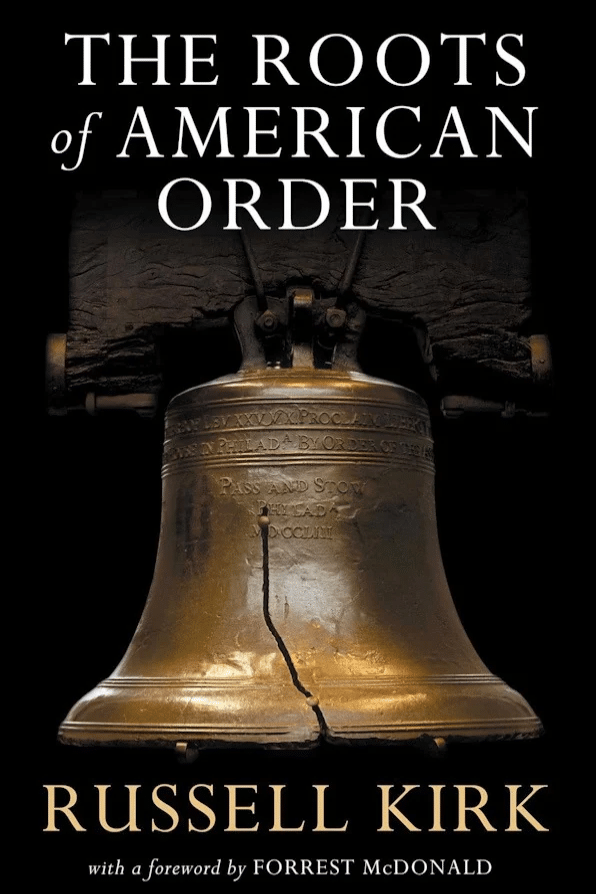
Two centuries after the founding of the new nation called the United States of America, we need to renew our understanding of the beliefs and the laws which give form to American society. Our own society, like that of any other people, is held together by what is called an “order”. The character of that order is the subject of this book. What is “order”?
Imagine a man travelling through the night, without a guide, thinking continually of the directions he wishes to follow. That is the image of a human being in search of order, says Simone Weil, a woman who suffered much: “Such a traveller’s way is lit by a great hope.” Order is the path we follow, or the pattern by which we live with purpose and meaning. Above even food and shelter, she continues, we must have order. The human condition is insufferable unless we perceive a harmony, an order, in existence. “Order is the first need of all.”
Before a person can live tolerably with himself or with others, he must know order. If we lack order in the soul and order in society, we dwell “in a land of darkness, as darkness itself,” the Book of Job puts it; “and of the shadow of death, without any order, and where light is as darkness.”
When she wrote figuratively of a man travelling alone through the night, Simone Weil was thinking of herself. All through her brief life of thirty-three years, she sought to order her soul. She was French, Jewish, and Christian. In search of spiritual order, she studied Greek and Indian philosophy, Sanskrit, the Christian mystics, quantum theory. She worked in fields and factories so that she might come to understand and to share the life of hard toil.
And at the same time, Simone Weil was thinking of social order in the modern world. Her slim book The Need for Roots has the subtitle “Prelude to a Declaration of Duties towards Mankind.” She wrote it while exiled from France, then occupied by German troops; she wrote it at the request of the French provisional government in exile, as a study of how the French, should they be liberated from the Nazi domination, might find anew the roots of their order and so live together in peace and justice.
Spiritual doubt and social disorder Simone Weil knew all too well. To understand the Spanish civil war, in 1936 she spent several weeks with the Republican army on the Catalonian front, a searing experience that haunted her to her death. To share the sufferings of her compatriots in occupied France, she determined in 1943 to eat not more daily than the subjugated French were allowed; she was then in an English sanatorium, in wretched health—and, in effect, she starved herself to death. Her several books were published after her death.
Our twentieth century, Simone Weil wrote, is a time of disorder very like the disorder of Greece in the fifth century before Christ. In her words, “It is as though we had returned to the age of Protagoras and the Sophists, the age when the art of persuasion—whose modern equivalent is advertising slogans, publicity, propaganda meetings, the press, the cinema, and radio—took the place of thought and controlled the fate of cities and accomplished coups d’état. So the ninth book of Plato’s Republic reads like a description of contemporary events.”
This analogy of fifth-century Greece with our age is too true. One may add that our time of troubles also is like the disorder of the Roman republic in the first century before Christ, and like the catastrophic collapse of Roman civilization in the fifth century after Christ. As individuals and as a civilization—like that man without a guide in the darkness, like Simone Weil, like societies that are dust now—we people in the closing decades of the twentieth century grope for order.
Like many other concepts, perhaps the word “order” is best apprehended by looking at its opposite, “disorder.” A disordered existence is a confused and miserable existence. If a society falls into a general disorder, many of its members will cease to exist at all. And if the members of a society are disordered in spirit, the outward order of the commonwealth cannot endure.
We couple the words “law and order”; and indeed they are related, yet they are not identical. Laws arise out of a social order; they are the general rules which make possible the tolerable functioning of an order. Nevertheless an order is bigger than its laws, and many aspects of any social order are determined by beliefs and customs, rather than being governed by positive laws.
This word “order” means a systematic and harmonious arrangement—whether in one’s own character or in the commonwealth. Also “order” signifies the performance of certain duties and the enjoyment of certain rights in a community: thus we use the phrase “the civil social order.”
In this book, we examine the roots of order in the United States of America. Old and intricate, these roots give life to us all. We can distinguish two sorts of roots, intertwined: the roots of the moral order, of order in the soul; and the roots of the civil social order, of order in the republic.
Although to some extent we trace the history of civilization when we describe the origins of our order, this book is not a comprehensive survey of culture—that work having been done by others. Rather, this book emphasizes certain institutions and customs, and certain ideas and beliefs, which continue to nurture order in the person and order in the republic, down to our time. No study could be more relevant to our present discontents.
We examine, successively, the legacy of order received from the Hebrews; from the classical culture of the Greeks and the Romans; from the medieval world and the age of the Reformation, particularly in Britain; from the turbulent civilization of the seventeenth century; from the elegant civilization of the eighteenth century; and from America’s colonial experience. We discuss both the beliefs and the institutions out of which American order has grown.
Seeking for the roots of order, we are led to four cities: Jerusalem, Athens, Rome, and London. In Washington or New York or Chicago or Los Angeles today, the order which Americans experience is derived from the experience of those four old cities. If our souls are disordered, we fall into abnormality, unable to control our impulses. If our commonwealth is disordered, we fall into anarchy, every man’s hand against every other man’s. For, as Richard Hooker wrote in the sixteenth century, “Without order, there is no living in public society, because the want thereof is the mother of confusion.” This saving order is the product of more than three thousand years of human striving.
The “inner order” of the soul and the “outer order” of society being intimately linked, we discuss in this book both aspects of order. Without a high degree of private moral order among the American people, the reign of law could not have prevailed in this country. Without an orderly pattern of politics, American private character would have sunk into a ruinous egoism.
Order is the first need of the soul. It is not possible to love what one ought to love, unless we recognize some principles of order by which to govern ourselves.
Order is the first need of the commonwealth. It is not possible for us to live in peace with one another, unless we recognize some principle of order by which to do justice.
The good society is marked by a high degree of order, justice, and freedom. Among these, order has primacy: for justice cannot be enforced until a tolerable civil social order is attained, nor can freedom be anything better than violence until order gives us laws.
Read the rest of the essay at the Kirk Center and more in The Roots of American Order.