
University civics education has experienced something of a reawakening over the past decade. Universities have opened schools or centers focused on civic life, and an increasing number of institutions now require all students to take a civics course, at least nominally. Such reforms are laudable—and I have advocated for them. But many so-called civics courses leave too many questions unanswered.
Because most universities equate U.S. history or political science courses with civics, students only get part of the story. These subjects are essential to a comprehensive civics education but are incomplete on their own. Neither political science nor history can truly replace a dedicated civics course. These disciplines give students the what, when, where, and how of our American order, but they don’t explain the why. Students rarely learn the origins or purposes of the American experiment: Why does America have a limited government? Why rights rather than privileges? Why representative institutions? Why federalism? Why separation of powers? Why liberty instead of mere license?
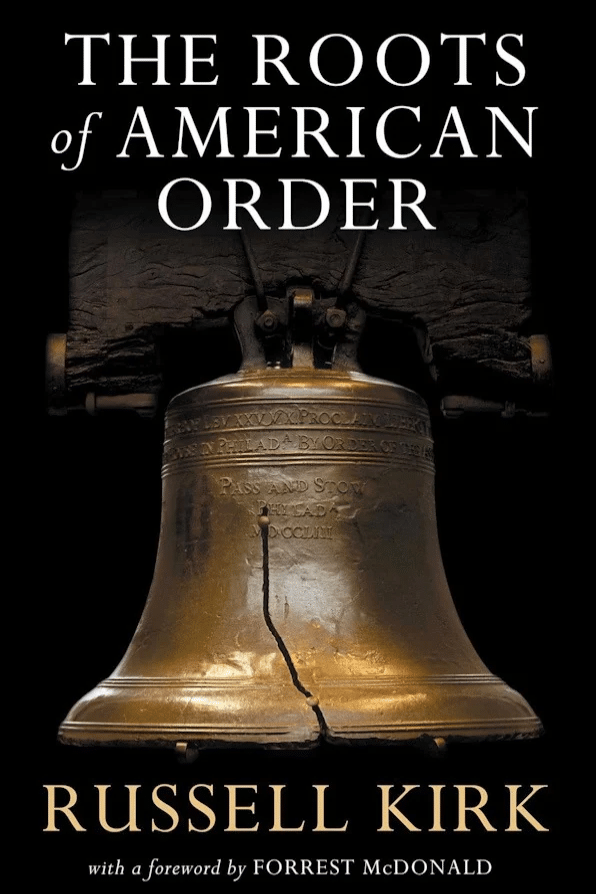
In his 1974 book, The Roots of American Order, Russell Kirk provides an enduring answer to these questions. He does so by exploring the four civilizations that gave rise to the American experiment, represented by their most important cities: Jerusalem, Athens, Rome, and London. These provide the underlying intellectual and moral foundation for America’s constitutional order.
Kirk’s most important insight is that although American independence required a revolution, the ideas informing the revolutionaries have deep roots in the past. The Founders inherited centuries of ideas, customs, institutions, and moral traditions. They read widely from both classical and Enlightenment sources. James Madison, father of the Constitution, was an early graduate of Princeton, which taught “political theorists such as Grotius, Pufendorf, Hobbes, Harrington, Locke, Sidney, and Montesquieu” (to quote The Learning of Liberty: The Educational Ideas of the American Founders by Lorraine Smith Pangle and Thomas L. Pangle).
Most modern civics curricula, often organized around the mechanics of government, pale in comparison to Kirk’s rich understanding and presentation of the intellectual genealogy of American constitutional order and our civilizational inheritance. A curriculum organized along these principles would produce much richer knowledge and appreciation of the American experiment than our current models.
Kirk’s four sources of order provide a ready-made framework for such a curriculum. Kirk begins with “The Law and the Prophets,” explaining how early Hebrews came to a new understanding of the human condition. This new understanding still informs American ideas of moral order, including our conceptions of justice, law, human dignity, covenant, and individual responsibility. A curriculum tied to these ideas might explore where rights come from and whether law is accountable to something higher.
Kirk returns to Jerusalem in a subsequent chapter on “The Genius of Christianity.” In it, he credits Christ’s ethical teachings with many of the moral traditions that still inform the United States and the West more broadly. He notes that Christianity teaches that “the establishment of justice must come through the waking of minds and souls.” The success of the church, Kirk writes, came from the concern for the poor, its separation from political systems, and its focus on believers “restor[ing] harmony in their own souls, in this earthly life.” The Founders took Christianity’s moral teachings seriously, believing that, in the words of John Adams, “Public Virtue cannot exist in a Nation without private, and public Virtue is the only Foundation of Republics.”
In his chapter on “Glory and Ruin: The Greek World,” Kirk introduces five Greek thinkers whose work, he argues, became central to understanding the American constitutional order: Plutarch, Solon, Socrates, Plato, and Aristotle. He then traces the influence of each through history. For example, “the Platonic understanding of justice,” Kirk says, “was deeply implanted in the minds of the early American leaders—through its incorporation into Christian thought, through its embodiment in Roman jurisprudence, and through its expression in English law.”
He goes on to explore ancient Greek ideas about virtue, reason, and citizenship, and introduces the idea of a “mixed government” as a response to the dangers of direct democracy. Students following in Kirk’s footsteps might ask, “What makes a good citizen?” and “What is the purpose of political life?”
Kirk’s treatment of Rome, “Virtue and Power: The Roman Tension,” highlights Roman culture’s emphasis on civic duty, the importance of constitutions in Roman governance, and—most importantly—the emergence of republicanism. The Roman experience directly informed America’s Founders as they constructed our written Constitution. James Madison explicitly incorporated many of Cicero’s recommendations in the document, including checks and balances, rule of law, and mixed government (an idea Cicero borrowed from the Greeks).
John Adams makes this provenance clear in his 1787 A Defence of the Constitutions of Government of the United States of America, in which he champions various state constitutions. In particular, he praises Cicero’s formulation of mixed government, wherein monarchy, aristocracy, and democracy are combined under one system. In the American context, these are represented by the presidency, the Senate, and the House of Representatives. Kirk underlines the importance of Cicero to the Founders’ generation:
For Cicero was the spokesman of the idea of ordered liberty, for which the Americans were seeking. His writings were woven into the schooling Americans had received: the study of Cicero lay at the heart of the curriculum, both in Britain and in America, all during the seventeenth and eighteenth centuries.
Lastly, Kirk takes readers to medieval London, “the youngest of the four cities from which American order is drawn,” where he traces the beginnings of English common law. “Knowledge of medieval England and Scotland,” Kirk says, “is essential to a decent understanding of American order.” English law, and the primacy of rule of law, is an essential part of our American system: “The king himself is under the law,” Kirk observes. He traces the principle of the supremacy of the law first to early Norman law and then to the Magna Carta. The Magna Carta also establishes the right to trial by peers, access to justice, due process, taxation controls, and property rights. Many of these same protections appear in our own Constitution or in the Bill of Rights.
All of this is to say that our American constitutional and moral order has very deep roots, and that Kirk is a master of following their tangled paths from antiquity to the Founding. Kirk’s key insight—that the American Revolution was in fact only evolutionary—is ignored in traditional American history courses (which often go back no further than the colonial period). To truly understand our Founding and our government, students must know the many antecedents.
Taking a Kirkian approach to civics courses would give students a much richer understanding and appreciation of the ideas, traditions, and experiences that led up to 1776. To today’s students, our moral and constitutional order can seem anachronistic, irrelevant, and even antidemocratic. They simply lack the relevant context to make sense of the tradition and practices they’ve inherited. Once students have read Plato and Cicero, questions such as “Why do we have a Senate?” become much simpler to answer.
Across the country, state legislatures and individual universities are capitalizing on America’s 250th birthday to revive academia’s civic mission. Now is the moment to ensure that this civics fervor translates into comprehensive, meaningful civics courses. To truly understand and appreciate our American republic, students need deep knowledge of the ideas, customs, institutions, and moral traditions that shaped American institutions and people.
In this endeavor, there is no better guide than Russell Kirk’s The Roots of American Order. It is an enduring reminder of the careful, difficult, evolutionary process of creating and sustaining ordered liberty. And it can help American educators chart a path for the next 250 years.
Jenna Robinson (Ph.D., University of North Carolina at Chapel Hill) is president of the James G. Martin Center for Academic Renewal, a leading voice on higher education reform with a goal to renew and fulfill the promise of higher education by educating citizens and policymakers and advocating policies grounded in classical liberal principles.