
I write with motivation that is, broadly speaking, twofold. On one level, I am burdened that within the church we need a rediscovery of the doctrine of vocation and of the design and dignity of work. While we Christians are impeded by both the culture’s view of work as well as that of the church, it is the latter that is especially troubling. Having spent most of my professional career teaching at the university level in a Christian liberal arts context, I am struck by how frequently over the years one distinct conversation reoccurs. That conversation almost invariably revolves around what a student should pursue following commencement. It usually starts with one or more of these questions: What am I to do after graduation? How should I use my gifts and abilities? To what am I personally called? Is there a “call” to the marketplace? If so, is a calling to the marketplace as noble as “Christian ministry”? Can the efforts and energy I expend in the workforce be considered sacred? Often, though this question is not usually vocalized, students want an answer to this as well: Is there really any dignity and meaning in work, regardless of what I end up doing?
Importantly, it is not just people entering the workforce that wrestle with the meaning of work and the question of vocation. Middle-aged workers wrestle with this as well, as do retirees, though they are seldom encouraged to vocalize such concerns. What’s more, most people-and especially students-are surprised and shocked to find out that such matters are not just relevant in the college years, when career or career choices are often confronted seriously for the first time. My view is that children can be shaped and molded by their parents (and other teachers) toward a sense of purpose and vocational direction. In fact, the contexts of family and community facilitate this learning process quite naturally (at least in theory)—where faith is taken seriously. Every human being has the glorious privilege and frightening responsibility to wrestle individually with these matters and pursue avenues of work and service that correspond to his or her overall calling.
Dorothy Sayers’s brilliant essay “Why Work?” was a succinct and forceful attempt both (1) to decry prevailing “Christian’’ attitudes toward work, vocation, and the marketplace and (2) to elevate these spheres of life on the basis of biblical revelation. Every generation needs such an apologist for the marketplace, someone who is convinced that this is where Christian service and stewardship are most needed. Sayers was right: one important “business of the Church [is] to recognize that the secular vocation, as such, is sacred.”
A second personal motivation behind this current volume’s creation needs identifying. Rarely, if ever, are the insights of Wisdom literature applied to the matters of work, vocation, and the marketplace. I am not referring merely to proverbial wisdom in Scripture such as one finds in Psalms or Proverbs but to the little-examined and much-misunderstood book of Ecclesiastes, to which a coming chapter is devoted. To the surprise of many, a serious reading of the Bible’s Wisdom books yields simple yet stunning perspectives on work, calling, and stewardship. This is especially true of Ecclesiastes, when it is viewed through the lens of faith and in light of the writer’s unique literary-rhetorical strategy. Against the backdrop of divine providence and divine inscrutability, the apologetically minded writer argues that for those who revere God, work takes on an entirely different cast than the “meaninglessness” and “vanity” that a materialistic worldview engenders.
The argument of this volume has four principal parts. Chapters 2 and 3 are of a theological nature. They examine the roots of our social and ecclesiastical predicament with a view to then probe its theological underpinnings. Indeed, we may call these “doctrines” of work, of vocation, and of stewardship. Chapter 4 looks back in history to the early sixteenth century in an attempt to appreciate a significant breakthrough in terms of the church’s understanding of work, vocation, and the marketplace. It cannot be overstated how important that breakthrough was, both for the church in Martin Luther’s day and for the church of any era. Chapters 5 and 6 go together insofar as they illuminate perspectives on work in the Wisdom literature of Ecclesiastes and establish a link between our work and our callings (i.e., our vocations). The volume concludes in chapters 7 and 8 with reflections on the church’s presence in society, forming something of an inclusio with the introductory chapter; this includes final thoughts on the knotty and perennial questions of discernment and guidance.
The first order of business is to understand why the church has neglected the marketplace. What accounts for the widespread separation of work and religious faith and the failure to understand and respect the secular vocation, which in turn has rendered the church’s witness to the culture insubstantial? What attitudes inform this seemingly perennial split in the church’s thinking and its teaching? Preliminary reasons for this dilemma have been suggested. Let us probe more deeply.
J. Daryl Charles (PhD, Westminster Theological Seminary) is a senior fellow at First Liberty’s Center for Religion, Culture & Democracy. He teaches, writes, and speaks on the ethics of war and peace, natural-law ethics, and the high calling of the marketplace. He is author or editor of twenty-four books, including, most recently, Just War and Christian Traditions (2022), Our Secular Vocation (2023), The Russian Invasion of Ukraine and the Ethics of War (2024), and The Idea and Significance of Natural Law (2025).
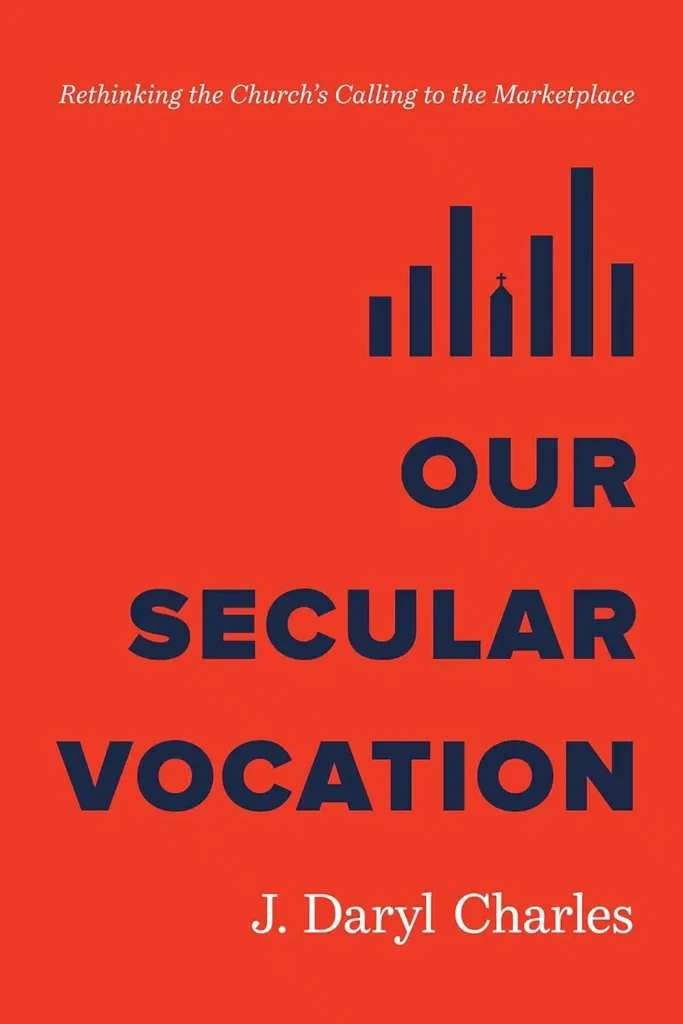
Read more in Our Secular Vocation: Rethinking the Church’s Calling to the Marketplace (B&H Academic, 2023).