
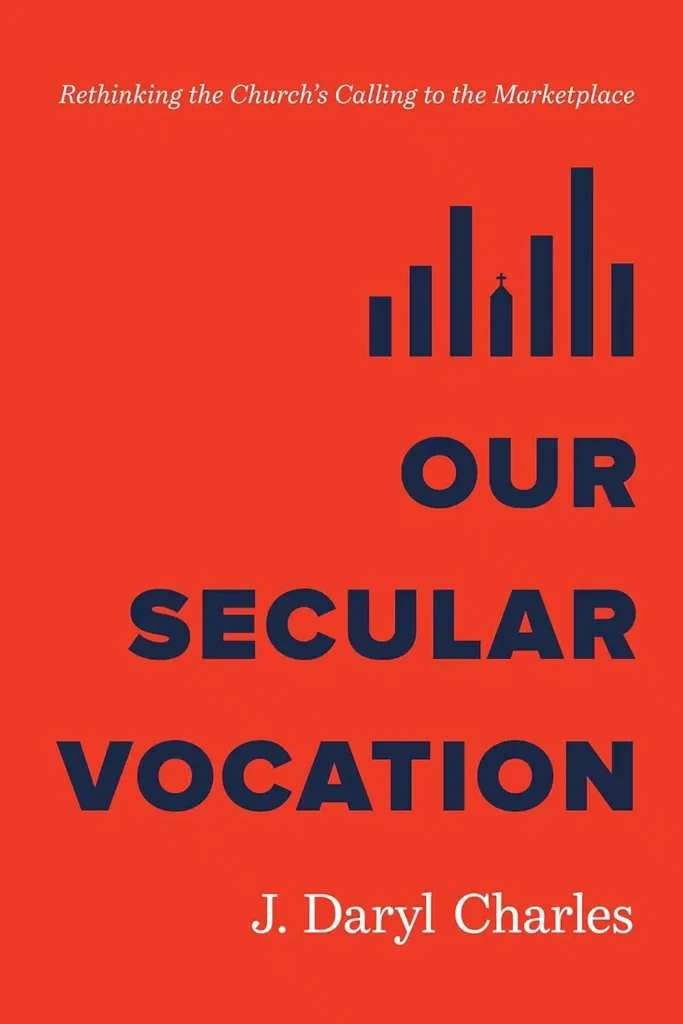
The marketplace, then, is the chief setting in which Christians impact society. It is there that, day in and day out and generation after generation, Christian influence will produce its greatest effect.… The church’s main witness to the world occurs in the marketplace.
– J. Daryl Charles, Our Secular Vocation: Rethinking the Church’s Calling to the Marketplace
In Our Secular Vocation, J. Daryl Charles takes issue with the idea that a Christian calling to secular work in the marketplace is somehow less noble than a Christian calling to work as a pastor, monk, or missionary. The vast majority of Christians are, in fact, called to the marketplace, yet many compartmentalize work at their Monday through Friday jobs from the rest of their lives as believers in Christ. Charles argues that it is essential for Christians called to the marketplace to have a proper perspective about their vocation.
By producing a useful good or service and displaying the joyful, diligent attitude of the redeemed through the secular workplace, a Christian can serve others and thereby serve God. Whether you work as a butcher, baker, or candlestick maker, understanding your work as meaningful because of your ability to serve others and display the love of Christ allows believers to find fulfillment and give glory to God in even the most mundane of jobs. Charles’ book is a reminder that the marketplace is “the very place where the transforming influence of Christ in our lives can be most powerfully observed. Our mission is the marketplace.”
The book could be a valuable read for someone struggling to understand his or her purpose in society or in the workforce and how it connects to one’s calling or vocation in Christ. The book draws on church history, primarily the insights of Martin Luther, as well as scripture, primarily focusing on the book of Ecclesiastes. It explains Luther’s perspective that vocation is the call to love one’s neighbor through life’s daily tasks, and reminds us that, “Whatever your hand finds to do, do it with all your might” (Ecclesiastes 9:10). He concludes with suggestions for how to discern the calling that God may have for your life.
Yet I found myself wondering if Charles would have guidance for the Christian who is confronted with a crisis of conscience while seeking to fulfill her calling in the marketplace. As an attorney for First Liberty Institute who focuses on protecting religious liberty in the marketplace, I hear from countless people of faith across America who face such dilemmas at work. Seemingly every day, people of various religious backgrounds must choose between losing their jobs or violating their religious convictions.
Such a crisis of conscience can happen when a company requires its employees to do something that violates an employee’s religious beliefs or requires the employee to refrain from doing something that he or she feels compelled by faith to do. Some of the most common examples that we see at First Liberty Institute involve employers’ vaccine mandates, employer mandates related to gender ideology, and employers who refuse to accommodate employees’ Sabbath observance or other religious scheduling needs.
Take for example a medical practitioner who feels a calling on her life to serve others and her community through the practice of medicine. What happens when her hospital requires her to facilitate a procedure that she believes will harm her patient and contradicts her religious convictions?
Charles briefly touches on the moral dilemmas that can face the believer in the secular workplace. “Most occupations and professions do not raise obvious questions of moral legitimacy. Today, however, the lines might be blurred by any number of social, economic, and cultural factors,” he writes. Perhaps a sequel to his book could be a practical and accessible deeper dive into these issues that can seem like obstacles to fulfilling a believer’s calling (and perhaps a future focus for the Reading Wheel Review might be Charles’ Natural Law and Religious Freedom: The Role of Moral First Things in Grounding and Protecting the First Freedom).
I suspect that when the believer faces such a crisis, Charles’ framework would emphasize the distinction between a job and a calling. A job may be temporary, whereas God’s calling on a believer’s life is comprehensive. Sacrificing one’s job with integrity rather than compromising one’s convictions may be a part of God’s larger plan and may help contribute to the witness that a Christian can play in the marketplace.
At my law firm, I have had the privilege of working with many courageous clients who have made the difficult choice to stand by their religious convictions, even at great personal cost. Gerald Groff is one such man. He holds a deep religious conviction about honoring the Sunday Sabbath. When the U.S. Postal Service started requiring him to work on Sundays, he chose to give up his career at the USPS and his security rather than compromise on that conviction. For his choice to stay true to his faith, he faced ridicule and derision.
But because of his stand and his decision to bring a lawsuit to protect the religious liberty rights of others, the United States Supreme Court took up his case. In a landmark decision, the Supreme Court clarified the law in a way that strengthened religious liberty rights for employees across the country. Because of Groff’s decision, fewer people will be faced with the same dilemma. All it takes is one person to take a stand for an entire area of law to be redefined in a way that helps people of all faiths in our community.
Of course, even with the law trending in a direction that is more respectful of religious freedom in the workplace, there is still much work to be done to protect employees of faith in the workplace. Every day, Americans still face crises of conscience.
From my perspective as an attorney, I believe that if more people of faith stood strong for their religious convictions, the workplace would be completely transformed. When people are willing to engage in Spirit-led conversations, risk promotion opportunities, or even sacrifice their jobs to maintain their religious convictions, not only does this sacrifice send a powerful message, it also could impact change. If enough employees of faith took such a stand, then perhaps employers would be more tolerant of people with different religious beliefs and backgrounds.
This is an area where the church should be providing support to members of its congregation. It is absolutely true that churches and Christian communities should help the people in their congregations understand their calling and recognize the importance and dignity of a calling to the secular workplace. They should also provide support for believers when they encounter a crisis of conscience while pursuing their calling.
Of course, a crisis of conscience may take many forms. Whenever fallen people work together in any organization, there can be sinful behaviors that can corrupt an otherwise noble endeavor. These may not manifest as overt requirements to violate religious tenets. They may be more subtle. How should a Christian respond to workplace cultures that are permeated with gossip, laziness, or alcoholism? It may not always be clear when are Christians called to be lights in the darkness and when are they being complicit by going along with sin or the wrongs of the company. This is why, for the believer, the Christian community is vital. No one should walk these difficult roads alone.
As Charles concludes, “It is the church’s duty to equip the body of Christ for responsible and redemptive service in the marketplace. Given work’s inherent dignity and the fact that, based on our design, we mirror the very likeness of God, our vocation is to—rather than away from—social and cultural institutions.” By working with integrity in these institutions, consistent with religious convictions, Christians can transform society in a way that benefits people of all faiths and backgrounds and supports the common good.
Stephanie N. Taub (J.D., Harvard Law School) serves as senior counsel with First Liberty Institute, focusing on restoring religious liberty in the marketplace by advocating for the rights of employees and business leaders of faith to work with integrity, consistent with their religious convictions.