
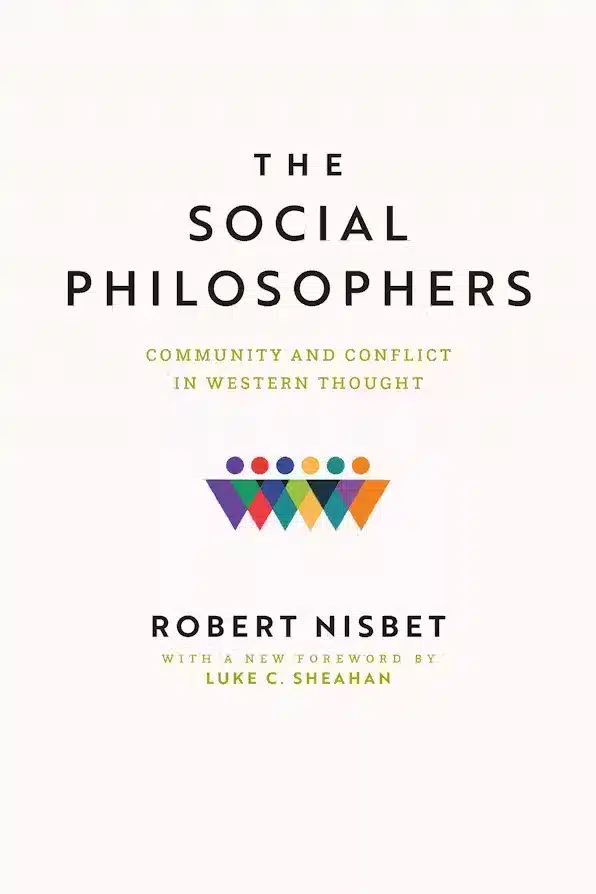
While Robert Nisbet is best known for his diagnoses in The Quest for Community regarding social disintegration and individual alienation in the modern era, he also has profound things to say about the kinds of communities people have formed over the centuries and the dynamics of those communities.
In The Social Philosophers, Nisbet describes three major forms of community (military, political, and religious) and three less major, but more recent, forms of community (revolutionary, ecological, and pluralist). Some forms of community are more authoritarian than others. Some are more hostile to religion. But which community will win in the U.S. over the rest of this century?
Many of the most important developments of Western civilization have emerged out of conflicts and dislocation. The pressures of war in sixth century Athens and at the end of the Roman Republic led to militaristic communities based on contract, conflict, and competition, which displaced fundamentally kinship-based community. This transformed law, property, and government in these societies. It also released incredible forces of creativity and innovation.
The Greek poets Aeschylus, Euripides, Aristophanes, and Sophocles and the Greek philosophers Socrates and Plato developed their ideas in response to the dynamics of these social and political changes. So too did the Roman lawyers who laid the foundation of much of Western civilization’s legal traditions.
The many conflicts and wars in Western Europe over the past millennia have also profoundly shaped our views of laws, rights, the state, and citizenship. These conflicts and the military communities they breed have brought about explicitly political communities; eventually, the modern nation state focused on sovereignty, territory, and citizenship. Thomas Hobbes and Jean-Jacques Rousseau saw their works as developing and defining the political (as opposed to the military or the religious) community.
Of course, Western civilization has been deeply shaped by religious community as well—especially Christianity. Augustine’s City of God set off a thousand years of theological discussion and influence in philosophy and politics. The religious community endures, even in modern political, ecological, revolutionary, and plural communities.
The rise of the revolutionary community presents grave challenges to the modern world. The revolutionaries blend elements of military, political, and religious communities to advance their goals. While being fanatical and militant, revolutionaries replace God with some idea of philosophical virtue or utopia. With no metaphysical grounding in nature or in God, revolutionaries are always adrift. Their revolutions never end—they are fundamentally totalitarian.
Revolutionaries do not simply seek different legal and political institutions. They seek reformation of hearts and minds in line with their political, social, and philosophical ideals. Affirmation, not toleration, is the goal. And this has obvious connections to our own current moment in the West. The cultural revolution of Mao and the political commissars of Lenin and Stalin have made their way into Western Europe and the United States. They are the cultural Marxists, the critical theorists, the diversity and equity officers, the sustainability czars, the LGBTQ+ “allies.” What people on the right call “woke” or social justice warriors are, in fact, revolutionaries. And we see in them nearly religious fervor for their causes—including a deep need for ideological purity.
They are divided, though, in their aims. On the one hand, they often criticize war and oppression. Yet, as true revolutionaries must, many in this group want to sanctify violence for their cause. Stealing from or attacking “oppressors” (whether police, Israel, the wealthy, or white people) is not really wrong. In fact, it can be right because it addresses or reverses wrongs or injustices inflicted upon the oppressed in the past.
The ecological and the pluralist communities share many characteristics. They both prioritize the local, the organic, and the voluntary associations. Both have deep distrust of highly centralized authority, bureaucracy, and sovereignty. The pluralists, however, have a broader view of social order. They are more conservative as they emphasize preserving existing institutions and associations or more liberal as they emphasize human freedom. The ecologists on the other hand, tend to be radicals (anarchists)—both in terms of how much they want to see change and in their emphasis on specific kinds of associations.
So to return to the question of this essay: Which community will win in the U.S.? The military, the political, or the religious? The revolutionary, the ecological, or the pluralist? People are duking it out right now. In the U.S., at least, the military organization seems less prominent. Should actual war break out with China though, that could change rapidly. One could also imagine deepening political polarization leading to more militarized social structures as we see with Antifa and the Proud Boys. Yet these seem limited in their social reach.
More interesting is the milieu of political, religious, and revolutionary communities. Two movements among Christians have sought to reassert the religious over the political. Catholic integralists such as Patrick Deneen, Sohrab Ahmari, Adrian Vermeule, and Gladden Pappin have questioned and criticized the “liberal” political foundations of modern U.S. government. “Can laws really be value-neutral?” they ask. Can the state be umpire rather than player?
These thinkers claim that society (and government) must have some orientation toward metaphysical good, and they assert that such good must arise from religious foundations. And so we have “Common Good Constitutionalism” arguing that liberal rules of law may need to be rethought or abandoned if they don’t advance a substantive vision of the good.
Similarly, many prominent Protestant thinkers have begun discussing Christian Nationalism as a potential direction society ought to go. They, too, are motivated by the idea that governments must be oriented toward some substantive metaphysical good. The increasing secularization in the U.S. and Western European countries makes their case, they argue, pointing to instances of more legal and social norms breaking down. Assaults on religious liberty, on the family, and on conservative values have increased rapidly because our existing liberal institutions do not offer enough substantive focus on the good to resist being co-opted or being cut down.
Disagreements abound, though, over what these positive Chrsitian visions of society and government will entail. Christian creed adoption? Punishments for violating religious norms and practices (blasphemy, adultery, homosexuality, Sabbath, and more)? How do non-Christians fit in a Christian commonwealth? These are difficult questions, and neither Catholic Integralists nor Christian Nationalists have agreed on shared answers.
At the same time, revolutionary community is brewing on the political left. Although the resurgence of the Trump administration has put these groups into retreat, they remain powerful forces in our society. And the revolutionary (or “woke”) mindset seems to be spreading into various parts of the political right. This is particularly troubling because the revolutionary mindset is ultimately the totalitarian mindset—seeking ideological purity and seeking to quench all disagreement and opposition. There is no room for one’s adversaries (including institutional ones) in a revolution.
How should Christians think about this moment and what should we work toward? As I mentioned, many have been drawn toward rebuilding a national religious community. I won’t spend much time here laying out more objections and challenges to such an approach. I will say that Nisbet presents two alternatives: the ecological and the pluralist communities. The ecological community focuses on cooperation, voluntarism, and withdrawal. Nisbet associates Saint Benedict’s monastic order, Thomas More’s Utopia, and the philosophical anarchists of the eighteenth and nineteentth centuries with this community. Not surprisingly, I think Rod Dreher has sketched a pretty good modern Christian ecological community in The Benedict Option.
The final community, according to Nisbet, is the pluralist community, best understood as “communitas communitatum,” a community of communities. Obviously there are challenges to this position. It cannot be made absolute because some broad political or religious order must exist to arbitrate disputes between communities. Yet this system works far better with limited overarching authority. It matches both the federalism of the founding fathers and the Roman Catholic idea of subsidiarity.
Another challenge pluralism faces is its lack of monism. It doesn’t have the unifying all-encompassing appeal of a military unit or ecclesial body. It requires its advocates to hold tensions, even contradictions, in their moral and social priorities. As a result, pluralism has a tough time holding its own against military, religious, and political loyalties.
Yet pluralism offers the most conservative—dare I say the most human—approach to community because it recognizes the complexity within and between human persons. It also offers one of the best safeguards of liberty because it diffuses power and sets ambition against ambition and faction against faction.
Pluralism has something uncomfortable for everyone. But it is also the only configuration that everyone can be a part of within their own communities and associations.
Paul D. Mueller (PhD, George Mason University) is a senior research fellow at the American Institute for Economic Research and a research fellow and associate director of the Religious Liberty in the States project at the Center for Religion, Culture & Democracy.