
As part of his polemic in setting Christianity over against its surrounding classical culture, the second-century Christian apologist Tertullian famously asked “what has Athens to do with Jerusalem?” We might very well in our own day ask an analogous question, setting Paris or Rome against Washington, London, or Glasgow as a way of asking, “What has the natural law to do with liberalism?”
For partisans on both sides of the divide, the answer has all too often been, “Not much.” Some of liberalism’s most ardent—or at least most pugnacious—defenders vividly distinguish it from the natural law tradition’s most basic set of commitments, while the natural law’s defenders, very much in the minority in our day, often return the favor in spades. Are they right? Not entirely, and there is clearly no iron law of enmity between the two traditions. Natural law thinkers like Jacques Maritain, John Courtney Murray, and John Finnis have found much to appreciate in liberal democracies, and even the ur-liberal John Rawls could acknowledge, if a bit grudgingly, the reasonableness of natural law arguments.
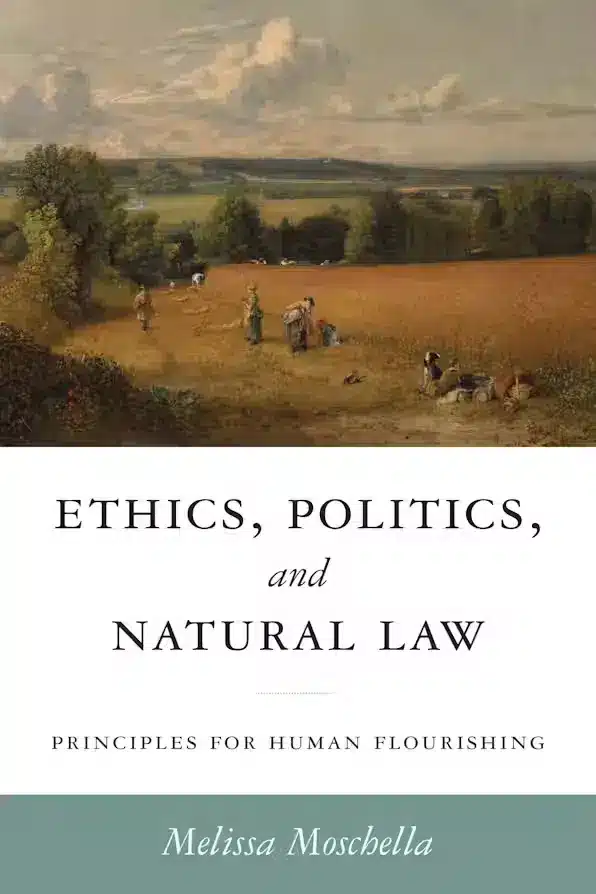
But the disagreements are real and, for many, insuperable. Whether it’s their underlying assumptions, methods of argument, or practical conclusions, liberalism and the natural law tradition have been at odds for what seems like a very long time. One of the real virtues of Melissa Moschella’s new book, Ethics, Politics, and Natural Law: Principles for Human Flourishing, is that it helps us see better the nature, extent, and limits of those disagreements—and where we might look to resolve or soften them.
Perhaps the place to start is with those disagreements: Where is it that liberalism and natural law theories properly disagree? Though it is certainly difficult to nail down precisely what makes an argument properly “liberal,” the range of liberalisms all broadly reject the natural law tradition’s claims about the nature and purpose of political authority. In particular, liberals reject the idea that political authority is natural and, at least ideally, intrinsically ordered to the flourishing of all. Instead, political authority is something that we construct (or perhaps reconstruct) to serve our interests or preserve liberties or provide public goods and the like.
Alternatively, every natural law argument I know of agrees with Aristotle’s claim that we are naturally political creatures, which just means that our flourishing fundamentally depends on the political communities to which we belong and how those political communities operate. Indeed, for the natural law tradition, the measure of a political community is not how wealthy, powerful, or advanced a society is. It is how much a society cultivates in its citizens the virtues constitutive of a well-lived life (even if a society’s material wealth does matter nonetheless).
One way to think about this disagreement is as flowing out of a deeper disagreement about the idea of nature. For liberals, moderns that they are, nature just is. It’s the stuff of everything around us (and us as well, of course), ordered by laws that seem utterly indifferent to human well-being and in some measure irrelevant to our moral and political understanding. That’s a bit of an overstatement, since general laws of physics, biology, chemistry, and the like certainly tell us something about how we ought to live and live together. But that’s very far afield from the natural law tradition that, for the most part, understands nature teleologically, as having some sort of inherent purpose to it and thus capable of informing our proper individual and collective ends. On this account, we have ends proper to our nature as human beings, and political communities are correspondingly bound to promote those ends to our flourishing, what we call the common good.
It is pretty easy to see here, then, how the liberal and natural law accounts of political authority find themselves in such disagreement. Though liberal accounts never quite escape nature, their understanding of human nature is so thin as to accommodate a wildly capacious range of what counts as good lives. What matters is that we have the freedom to live our lives as we so choose, with a few narrow exceptions. Though liberal theories disagree about the particulars of how this might be accomplished, political authorities then exist merely to protect that capacity to choose and exercise our individual wills. Princeton’s Stephen Macedo has a little vignette where he suggests that liberalism makes it possible for a man to abandon his wife, children, and career to choose to become a Buddhist monk. We might in our own particular judgment look askance at such a choice but, if we’re good liberals, we deign to put any political barriers to his exercise of “freedom.”
This is typically construed as the idea of political neutrality, where the liberal state does its level-best to not take sides in disagreements about what constitutes a good life, except perhaps where those disagreements bear on the sustenance of the liberal state. Much ink has been spilled on the nature and limits of neutrality and its relation to liberalism more broadly. But suffice to say that for liberalism’s defenders and natural law critics alike, neutrality is central to their disagreement precisely in how it implicates core claims about the nature and purpose of political authority. For liberalism’s advocates, political neutrality vitiates their commitment to the freedom of individuals to live as they so choose. In contrast, for the natural lawyers, political neutrality amounts to abandoning political institutions’ responsibility for the common good and leaving those individuals to flounder. For anyone looking to resolve or soften the dispute between liberalism and the natural law, this disagreement has become central.
Consider, if you will, the text that serves as the headwaters of liberalism’s arguments for political neutrality, Locke’s “Letter Concerning Toleration.” Some versions of liberalism defend neutrality as a kind of modus vivendi, a way to keep diverse peoples from trying to seize the state and oppress (or kill) their neighbors. Locke’s argument in the main is quite different, for it claims that political authorities should not take sides, at least among Protestant Christians. To do so would itself violate what he takes to be a core Christian claim: the doctrine of free faith, the notion that faith is only genuinely faith if it is freely chosen. Thus, states that try to compel people into a profession of faith against their conscience are undermining the end for which they claim to be acting. The state thus does not have the mandate, never mind the expertise, to make those sorts of judgments. Expand that out to religion in general, and indeed to the wide diversity of ways people conceive of the good life, and you get very quickly to a more or less principled argument for political neutrality.
But for some of liberalism’s most committed natural law critics (Adrian Vermeule and the Catholic Integralists most prominently), this sort of claim to neutrality is a complete fraud. Set aside the fact that Locke limits his toleration argument only to Protestant Christians. Even with a generalized argument for political toleration and neutrality, these critics argue, you still will find that liberalism is in fact doing much more than just trying to not take sides unnecessarily. It is, as with Locke’s original argument, operating on the basis of a claim that some reject, namely that what matters about human beings is that we can choose (or something close to that). And what’s more, they argue, liberalism does not even mean in practice to be neutral; instead, it is engaged in a sometimes not so subtle project of turning us into people who see ourselves as primarily and maybe entirely as these choosers. On this view, liberalism does indeed have a view of the good life, and it is John Stuart Mill’s or Immanuel Kant’s or John Rawls’s: the autonomous individual, chooser of his or her own good.
This is, it seems to me, where the disagreements between liberalism and natural law really come to a point and where it’s difficult, maybe impossible, to entirely resolve things. Moschella’s argument suggests two ways we could mitigate the conflict. As I’ve noted, the natural law tradition largely agrees with Aristotle’s view that the political order has responsibility for citizens’ flourishing and thus should be ordered to the common good. But that seems incompatible with a liberalism ordered to individual freedom, where my good is almost entirely defined by my own lights and quite likely at odds with others’ sense of their own good.
The key here is to think about the relation of the political order and the common good. Moschella argues (rightly, in my view) that the natural lawyers need not endorse the idea that the political order has full or complete responsibility for the common good. That makes it responsible in a way that exceeds its competency. States are clumsy things, well-suited to taxation, spending, war, and the like, and not so good in practice at the more fine-tuned and personal work needed to help persons flourish. Moschella suggests instead that we recognize that the state has responsibility for what she calls the “political common good.” This is the part of the common good that it can, by virtue of its ordinary capacities, actually shape: public order, protection against external threats, provision of public welfare and regulatory goods, and so on. In this way, the properly functioning state ought to help create a context in which elements of civil society—churches, neighborhoods, civic groups, families, and so on—can do the real work of virtue cultivation.
That seems right and a helpful correction to the tradition’s Aristotelian sources. Societies are not—nor should we ever want them to be—merely a swathe of individuals superintended by some putatively benevolent state. Politics can and should do certain things, but its reach is inherently limited; the disasters of twentieth- century totalitarianism surely taught us that. But still we have a real dilemma: toward what ends do we want people to be shaped? The natural law tradition cannot be thought indifferent to the ends we pursue, and liberalism often aspires to be, if not quite indifferent, something pretty close to it.
Moschella tries to navigate around this by pointing out that, in ways redolent of Locke’s argument for toleration, that many of the goods we properly pursue as constituent of our well-being are only goods insofar as we pursue them freely. Being compelled in education has its place—I do give exams in my classes, after all—but surely pursuing knowledge for its own sake is something quite different and more valuable. Thus a properly conceived natural law politics does not for its own reasons need to compel as much as its liberal critics might worry. Still, as the writer and physician Matthew Loftus has suggested in a bit of a different context, we natural law thinkers might yet want the political order to make it easier for people to do the right thing and, more worryingly to liberal thinkers, more difficult to do the wrong thing.
Return, for example, to Macedo’s vignette. A man abandoning his wife and children is bad, no matter what you might think about Buddhism or Buddhist monks. Should the state make it relatively easy, as our liberal state does, for him to pick up and take off? If it should make it harder, what should it do? There are a ton of thorny questions here that quickly surface the tensions between even a pretty liberalism-friendly natural law theory like Moschella’s and liberal theories more generally.
This, I think, should be a central focus for natural law thinkers of our day. For while liberal democracies are in so many ways a marvel, they seem beset with the sorts of internal and external challenges that could prove their undoing. For a certain group of natural lawyers, that is all to the good and inevitable in any case; they will be there to pick up the pieces as things unravel. But that expectation seems both implausible practically and unattractive morally. But the moral weaknesses of a liberalism rooted in little more than servicing aggregated individual interests seems just as fraught (though in rather different ways). Recovering the natural law along the lines Moschella suggests, even if only as a way of framing our public political conversations, could go some way toward mitigating liberalism’s challenges without collapsing into an ugly authoritarianism. To my mind, that is the challenge of the moment. Let’s hope we can meet it.
Bryan McGraw (PhD, Harvard University) is the dean of natural and social sciences and professor of politics at Wheaton College, where he also serves as director of the Aequitas Fellows Program.