
I remember my first official introduction to moral philosophy as a freshman at Harvard. I was taking Ethics and International Relations, cotaught by the eminent professors Stanley Hoffmann and J. Bryan Hehir. Early in the course we were taught various moral theories we would then use to analyze ethical issues in international relations. I don’t recall exactly what we read—the course had 300 to 500 pages of reading per week, so I suppose I can be forgiven for not remembering all the details—but I do dearly remember being dissatisfied with all of the moral theories presented. We were taught that there were basically two types of moral theories: deontological theories that define what is morally right independent of the consequences or considerations of what is good for human beings, and teleological or consequentialist theories that define what is right on the basis of consequences, with a view toward promoting (usually maximizing) the good, variously defined. Deontological theories, we were told, had moral absolutes—moral prohibitions on certain actions, such as rape or killing the innocent—that were binding in all circumstances. Consequentialist theories did not.
Yet neither of these options seemed appealing to me and neither seemed compatible with my own moral convictions or what l thought of as “commonsense morality.” Divorcing morality entirely from the good seemed problematic. According to my commonsense view of things, morality was concerned with promoting the good; being a good person and acting in morally upright ways meant trying to do good to people, or at least refrain from harming them. At the same time, it was dear to me that consequentialist theories had major problems. In fact, my first paper for the course (which I still have and still consider to be philosophically sound) was a critique of consequentialism. Further, the absence of moral absolutes in consequentialist theories seemed contrary to moral common sense. At least in my view, any theory that could not absolutely forbid actions such as rape or the torture of innocent children just had to be wrong. Clearly there had to be a third way?
In another course, I was reading Aristotle’s Nicomachean Ethics. I found Aristotle’s approach more attractive, but it did not fit into either of the categories I was learning about in my other class, and it seemed insufficient on its own to answer a number of important moral questions. Aristotle’s emphasis on moral character and on ethics as fundamentally about eudaimonia or human flourishing seemed right to me, and he also dearly expressed a belief in certain moral absolutes, but the basis for those absolutes was left unexplained, as was the basis for determining what actually counts as a virtuous rather than a vicious action. Aristotle tells us that the standard for a virtuous action is how the practically wise man would act in any given situation. This advice is not without merits as a practical rule of thumb for the moral life, at least if one is able to identify genuine moral exemplars, but in terms of actually providing a principled account of what makes an action right or wrong, it seems somewhat circular or at least insufficient. How can we identify a practically wise person to imitate if we do not already know what it means to act virtuously?
This book is the fruit of more than two decades spent trying to identify and articulate satisfying answers to these questions, both for myself and for my students. The book presents an ethical theory that is fundamentally Aristotelian in that it conceives of ethics as ultimately about promoting and respecting human flourishing, recognizes the centrality of character to the moral life, and understands ethics to be a distinctively practical inquiry that must therefore be carried out from the first-person perspective, that is, the perspective of the deliberating, choosing, and acting agent. What I mean by this will be explained more fully in chapter 1. At the same time, I recognize that significant advances in moral philosophy and in philosophy more generally have been made since Aristotle’s time.
In particular, the work of Thomas Aquinas built upon and refined Aristotle’s ethical theory in a number of important ways, including by incorporating it into an explicitly natural law approach to ethics. Among Aquinas’s key contributions in this regard was his articulation of ethical first principles identifying a set of basic human goods as intrinsically choiceworthy, or “to-be-pursued”: these goods are the basic purposes toward which all genuine human choices and actions are directed, and thus the foundations of all practical reasoning. This articulation of the foundations of ethics as a set of practical principles identifying basic human goods as the basic reasons for action (something arguably implicit but never dearly articulated in Aristotle’s work) is an important first step in overcoming the apparent circularity of Aristotle’s account, and of grounding the moral absolutes that Aristotle presupposes but does not explain. Yet Aquinas’s account still leaves important logical gaps between the articulation of first principles and the specification of particular moral norms, such as moral rules prohibiting adultery, theft, or murder.
More recently, the work of Germain Grisez, Joseph Boyle, and John Finnis has sought to fill in these logical gaps, and more broadly to develop an ethical theory within the Aristotelian-Thomistic tradition that is articulated and defended with the precision and rigor characteristic of contemporary analytic philosophy. This approach was dubbed the “New Natural Law” (NNL) theory by Thomistic philosophers who criticized it as unfaithful to the Thomistic tradition. I believe these critics are wrong to see the theory as a departure from the tradition, but I will nonetheless adopt the label simply because it is so widely accepted that using any other label would likely cause confusion. No theory is perfect—refinements and corrections are always possible—but I have slowly become convinced that NNL theory provides the best account of ethics that has been developed up to this point, and that it offers a rigorous and satisfying alternative to deontology and consequentialism, largely resolving the questions I have had since I first began studying moral philosophy during my freshman year of college.
Melissa Moschella (Ph.D., Princeton University) is a professor of the practice in philosophy at the University of Notre Dame’s McGrath Institute for Church Life.
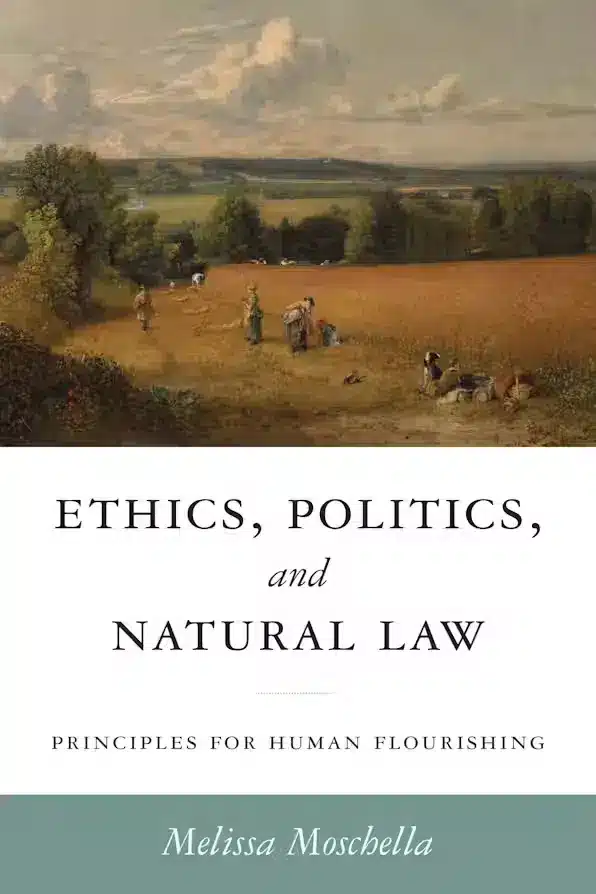
Read more in Ethics, Politics, and Natural Law: Principles for Human Flourishing (University of Notre Dame Press, 2025).