
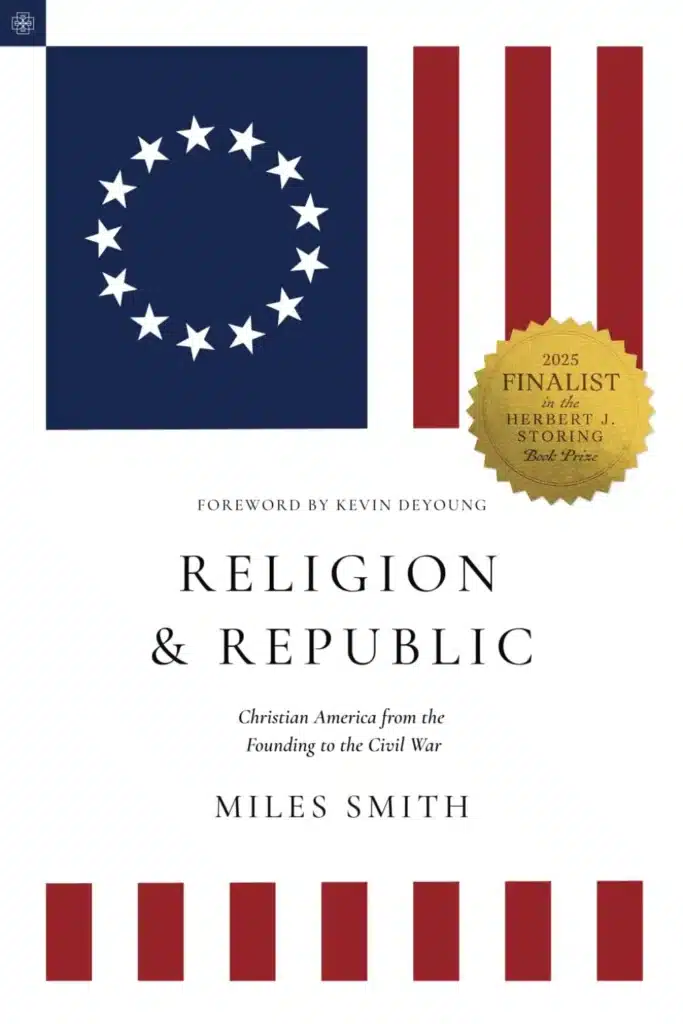
Dr. Miles Smith’s Religion & Republic: Christian America from the Founding to the Civil War gives a careful rendering of the role Christianity played in the Early Republic. He argues the mainstream of American opinion saw itself neither as a theocracy run by the church nor a secularized state that ignored or even suppressed religious institutions. Instead, religious liberty co-existed with a public faith that informed popular opinion as well as the words and deeds of statesmen.
While I agree with the general consensus that this is a thoughtful, careful, and timely book, my purpose is not to review Religion & Republic. Instead, I will expand on one aspect by taking up a particular thread and figure Dr. Smith mentions in his historical narrative.
Chapter IV concentrates on the views and actions of the American judiciary during this historical period, which spans from the founding to the Civil War. Smith recounts how judges in the Early Republic routinely assumed, articulated, and applied Christian principles, texts, and examples in deciding cases. These judges gave prominent roles for biblical passages, showed great respect for religious institutions, and saw Christianity as an important, even essential, basis for American law.
Prominent among those judges was Joseph Story (1779–1845) whom Smith briefly mentions. Despite Thomas Jefferson’s warnings about Story’s views, Madison appointed Story to the Supreme Court in 1811. The Senate would confirm Story that fall. He would take his place on the bench in 1812, develop into a giant of American law, and serve until his passing in 1845. In addition to his significant contributions as a judge, Story taught at Harvard (his alma mater) and published extensively on legal matters; his works then instructed generations of budding American lawyers.
Story’s views exhibit Dr. Smith’s description of the judiciary’s perspective regarding religion in the Early Republic. Story took up the theme of Christianity’s role within the country in several venues. He clearly declared Christianity a part of the Common Law inherited from England and he gave a speech in strategic praise of the Puritans to celebrate the founding of Salem, MA.
Yet his most concise treatment of the relationship between religion and public life came in his Commentaries on the Constitution of the United States. This work stands as second only to the Federalist Papers in its influence on interpretation of the American Constitution. We will focus on its view of religion and America, one that parallels Smith’s claim of a polity committed both to a significant role for public religion and a clear dedication to religious liberty.
We will begin with the public role for religion. Story zeroes in on this point in his treatment of the Constitution’s First Amendment, which famously contains two religious clauses, declaring that, “Congress shall make no law [1]respecting an establishment of religion, or [2]prohibiting the free exercise thereof.”
In his Commentaries, Story observes that many prominent political commentators throughout history believed that the government had “the right and the duty to interfere in matters touching religion.” He does not reject this view but instead embraces it. He notes that this historical trend did not result from accident, prejudice, or mere tradition. People held it for entirely good and rational reasons.
The Justice writes that “the right of a society or government to interfere in matters of religion will hardly be contested by any persons, who believe that piety, religion, and morality are intimately connected with the well being of the state, and indispensable to the administration of civil justice.”
Story goes on to explain how religion pertains to the public good and to the administration of justice through the relationship between theology and society. He declares that religious doctrines taught the existence of God, His attributes, and His providence over the world. Together, these points then establish the foundation for justice, an obligation to obey God’s rules, the promise of reward and punishment, and, through all of the preceding, the means for the “cultivation” of the “virtues.”
In other words, Christianity forms a crucial foundation for the moral education of citizens required for them to exercise responsible self-government. It is no wonder that Story concludes by declaring that “these never can be a matter of indifference in any well ordered community. It is, indeed, difficult to conceive, how any civilized society can well exist without them.”
In this claim, Story merely echoes George Washington in his “Farewell Address.” Our first president there notes that “of all the dispositions and habits, which lead to political prosperity, Religion and Morality are indispensable supports. In vain would that man claim the tribute of Patriotism, who should labor to subvert these great pillars of human happiness, these firmest props of the duties of Men and Citizens.” Thus, religion is a necessary foundation for forming good, just, happy, self-governing citizens.
Moreover, Story says that society’s interest in religion goes beyond the merely useful. He continues by observing that “it is impossible for those, who believe in the truth of Christianity, as a divine revelation, to doubt, that it is the especial duty of government to foster, and encourage it among all the citizens and subjects.” Story here seems to mean that the government exists for the good of the people. People are more than physical bodies; they also include eternal souls. Those points affirmed, it makes no sense for a government entirely to ignore religious matters since they are of such great importance for the good of particular individuals and society as a whole.
The tricky question for Story comes in what the government can and should do in fostering religion. He gives three options. In the first, the government, “affords aid to a particular religion, leaving all persons free to adopt any other.” The second involved the state setting up “an ecclesiastical establishment for the propagation of the doctrines of a particular sect of that religion, leaving a like freedom to all others.” The third option involved establishment of a particular sect with the addition that it, “excludes all persons, not belonging to it, either wholly, or in part, from any participation in the public honours, trusts, emoluments, privileges, and immunities of the state.”
Story opts for the first choice. He argues that his view stood in the mainstream of America’s common opinion and historical practice. Regarding the common opinion of the Early Republic, Story writes that “there will probably be found few persons in this, or any other Christian country, who would deliberately contend, that it was unreasonable, or unjust to foster and encourage the Christian religion generally, as a matter of sound policy, as well as of revealed truth.” He later adds that historically “the general, if not the universal, sentiment in America was, that Christianity ought to receive encouragement from the state.” He notes how some state support for Christianity took place in every colony except Rhode Island (and Story is not ready to concede it entirely as an exception).
In staking this position, Story was not ignorant of another option: to make the government entirely neutral regarding faith. “An attempt to level all religions, and to make it a matter of state policy to hold all in utter indifference,” he declares, “would have created universal disapprobation, if not universal indignation.” As Smith persuasively displays in his book, the young American republic did not see itself as formally or functionally secular. Its First Amendment, therefore, did not embody such a foreign (and, to its makers, a repugnant) concept, either.
Nor did Story think the American Constitution commits the country to complete religious neutrality. He notes that the First Amendment did not seek “to countenance, much less to advance Mahometanism, or Judaism, or infidelity, by prostrating Christianity.” Instead, the Constitution seeks “to exclude all rivalry among Christian sects, and to prevent any national ecclesiastical establishment, which should give to an hierarchy the exclusive patronage of the national government.” This point means the Establishment Clause intends “to exclude from the national government all power to act upon the subject” of privileging a particular religious faith. The ban on religious tests in Article VI also furthers the goal “to cut off for ever every pretense of any alliance between church and state in the national government.”
Yet removing national competition among religious believers is seen as consistent with the commitment “that Christianity ought to receive encouragement from the state.” This encouragement could take a more vigorous and particular form in the states, Story says. But some form of supportive encouragement applies to all levels of government.
At the same time, Story says any support for Christianity could not interfere with religious liberty. He declares that “the duty of supporting religion, and especially the Christian religion, is very different from the right to force the consciences of other men, or to punish them for worshipping God in the manner, which, they believe, their accountability to him requires.”
However, human history showed that those in power often did not make that proper distinction. Story laments the tendency “that bigotry was unceasingly vigilant in its stratagems, to secure to itself an exclusive ascendancy over the human mind; and that intolerance was ever ready to arm itself with all the terrors of the civil power to exterminate those, who doubted its dogmas, or resisted its infallibility.” Story believes that the “Free Exercise Clause” clearly prohibits these attempts to control religious belief and practice. Thus, for current debates, we also should notice that this protection extends beyond men’s “consciences,” meaning their internal beliefs, also to include actions manifesting in worship practices.
Story adds a philosophical defense of this position, declaring that “the rights of conscience are, indeed, beyond the just reach of any human power. They are given by God, and cannot be encroached upon by human authority, without a criminal disobedience of the precepts of natural, as well as of revealed religion.” Thus, Story thinks that all forms of God’s revelation—natural and revealed—require the state to respect and protect religious liberty. He laments both the example of England’s Establishment and even criticized his own New England for historical episodes where religious belief and practice were public crimes.
Taken together, Story embodies well the view Dr. Smith sees generally in the Early Republic. Public articulation and support for Christianity did not require coercing individuals, and religious liberty did not demand an indifferent, much less a secular, state.
Smith’s historical discussion and Story’s timeless contributions have important contemporary applications. In his Commentaries, Story observes, “It yet remains a problem to be solved in human affairs, whether any free government can be permanent, where the public worship of God, and the support of religion, constitute no part of the policy or duty of the state in any assignable shape.” Story meant to ask, given the importance of Christianity for a well-ordered republic, if we could maintain twin commitments to public religion and individual religious liberty.
Historically, America seems to have answered this question in the affirmative. We can foster public religion and the virtues attending it while also guarding the free exercise of faith. Though not always perfectly, we substantially did so for a long period of time.
However, today we are faced with a different version of that question. Can our republic continue absent a general belief that Christianity helps order our polity’s education and principles? Can we maintain the republican goods we have long enjoyed but now as a secularized state? Dr. Smith and Joseph Story give the Early Republic’s definitive answer: no.
Assuming that this conclusion is true, then Religion & Republic is as much a warning and an invitation as it is a historical work. Readers are challenged to consider the perspectives of our nation’s formative figures as we engage the challenges of the moment and our shared, albeit uncertain, future.
Adam Carrington (PhD, Baylor University) is an associate professor and holder of the Archer Endowed Position in History and Political Science at Ashland University, where he also serves as co-director of the Ashbrook Center.