
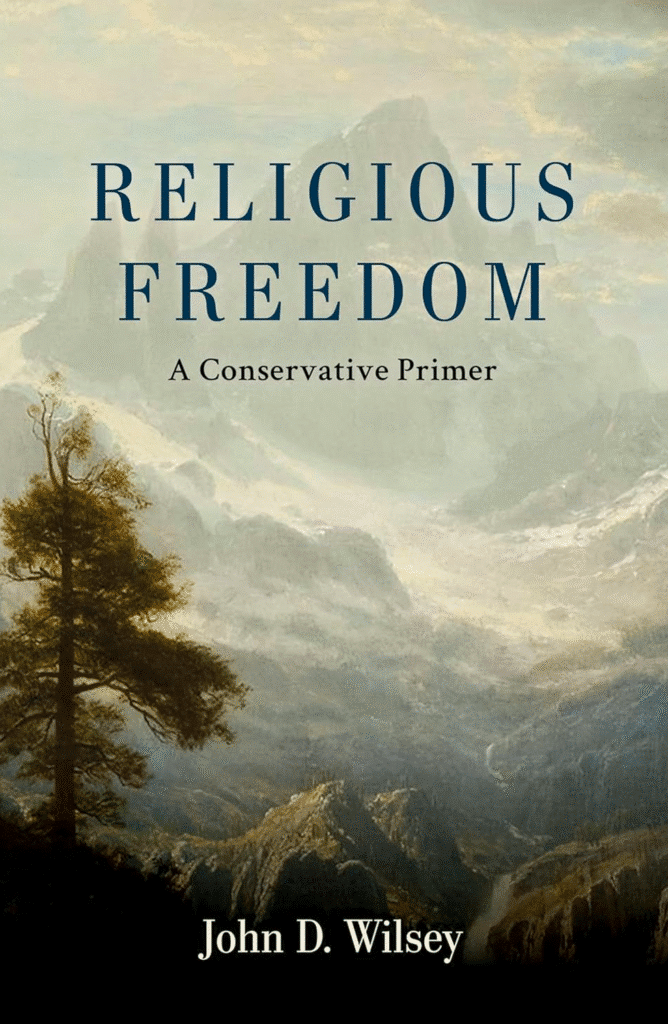
John Wilsey’s Religious Freedom: A Conservative Primer, considers the best means of preserving “America’s two spirits,” the spirit of liberty and the spirit of religion. The title may lead the reader to assume that this is an introductory work on the jurisprudence or philosophy of religious freedom. It is not. Far from being an introduction to one particular topic, Wilsey’s book is a comprehensive examination of the dispositions and virtues necessary for preserving the truths and traditions that have defined America, including and especially the tradition of religious freedom. Written with a young audience in mind, Wilsey aims to equip the next generation with the intellectual heft—and the character—to preserve the core American principle of religious freedom that is under siege from elements on both the left and the right.
In defending the complementarity of the “spirits” of liberty and religion, an idea first articulated by Alexis de Tocqueville in his mid-19th century opus Democracy in America, Wilsey aims to defend America itself. Wilsey, a professor of church history and philosophy at the Southern Baptist Theological Seminary, argues that the compatibility between religion and liberty is an essential element of American identity. America was formed by a multiplicity of traditions, including liberalism, republicanism, classical antiquity, and, undoubtedly, Christianity. “To throw out the baby of a national identity informed by religion is to throw the bathwater of America out with it,” he writes. America was founded upon the idea of a transcendent order that ultimately serves as the foundation of our cherished liberties rather than being in tension with them.
Wilsey contends that conservatives are in an ideal position to take up the Tocquevilleian mantle of defending and transmitting the tradition of religious freedom. By “conservative,” he is not referring to a contemporary political movement, but rather an intellectual inheritance that values tradition and moderation over abstraction and extremism. Specifically, he has in mind American conservatives whose ideas have been formed by the “Burkean” tradition. In his Reflections on the Revolution in France, the 18th-century British statesman Edmund Burke championed a form of statesmanship that entails leading with the insights gained through experience rather than devising an ideal political order through rationalistic abstractions. Burkean conservatism thus offers the clearest understanding of liberty “grounded in eternal truths and in the American experience.” Human experience is often what reveals these eternal truths.
In his writing, Wilsey practices this Burkean approach himself: the theme of encountering universal truths through particular experiences is woven throughout the book in reflections on historical events, great works of literature, and even film. Wilsey, a gifted and witty storyteller, also utilizes stories of his own ancestors to cultivate the reader’s imagination concerning how to live a life of sacrifice. In doing so, he demonstrates the importance of handing down an inheritance of noble examples that offer guidance to succeeding generations. Intellectual arguments may persuade—and Wilsey’s book is full of complex argumentation—but it is the great stories of nobility that provide the hope that motivates action, especially for a generation of young people experiencing disturbing levels of depression and despair.
One may wonder why the philosophical tradition of a British Parliamentarian is so crucial to preserving American religious liberty. The answer is that the Burkean tradition, which was “translated into American political culture” through the writings and actions of many great Americans, including Alexander Hamilton, James Madison, and Abraham Lincoln, offers insights concerning the disposition of mind that is necessary for preserving religious freedom. Wilsey aptly demonstrates that its preservation requires more than legal protections and rightly ordered governmental institutions. It also requires a rightly ordered understanding of the world and human nature. Eschewing both cynicism and uncritical nostalgia, Wilsey argues instead for a conservatism that accepts the reality of human nature as limited and fallen but also capable of renewing the true, the beautiful, and the good in human societies. As he puts it, “Conservatives value a well-ordered imagination, because an imagination that realistically takes stock of the intersection between the eternal and the temporal prepares the person to accept the world as it is, but with hope.”
Wilsey describes the form of conservatism for which he advocates as “aspirational,” explaining that it “puts the focus on what could be based on what has been.” This type of conservatism is “pre-political” and humanistic in that it is primarily concerned with the attitudes and characteristics—not the political strategies—that are most conducive to leading our fellow human beings to a higher good. Relying on a distinction drawn by historian Peter Viereck, Wilsey contrasts two conservative traditions in America, the measured and evolutionary Burkean conservatism, which seeks to preserve traditional liberties, and the extreme, counterrevolutionary form of conservatism that resists change and primarily seeks to preserve traditional authority. The latter, rooted in the ideas of the French thinker Joseph de Maistre, was coined by Viereck as “Ottantott,” referring to 1788, the year before the French Revolution. Aspirational conservatism, which acknowledges the need for cautiously considered, gradual change, falls squarely within the Burkean tradition.
This distinction between Burkean and Ottantott conservatism is essential to Wilsey’s navigation of the debate over Christian nationalism, which plays a central role in the book. While Christian nationalism, he argues, is difficult to define and is often discussed without precision, one book that provides a careful definition of it is The Case for Christian Nationalism by Stephen Wolfe. According to Wilsey, Wolfe makes a sophisticated case for a “magisterial Christian state” led by a Christian prince who is expected to lead citizens to their “earthly and heavenly good.” What is unique about Wolfe’s argument, Wilsey explains, is its purely rationalistic foundation. Wolfe explicitly states that he does not appeal to historical examples of nationalism in crafting his vision of the Christian state. His vision is quite explicitly not drawn from “what could be based on what has been.”
Wolfe’s rationalistic means of devising a Christian state is incompatible with what Wilsey sees as the best tradition of conservatism. The best conservative disposition encourages imagination, but imagination must be shaped by “concrete experience, actual articulations, examples, and instances of liberty, and liberty’s opposite, slavery, in time and through the lives of real people in actual places in the past.” Yet rather than rely on history to examine the noblest attempted political arrangements that may inspire possible changes to the American order, Wolfe builds an ahistorical a priori model that is strikingly similar to Hegelian state theory, albeit distilled through Protestant scholasticism. “Wolfe has done his readership a worthy service in reinvigorating the Reformed Protestant tradition. But the results of his work are not renewal,” writes Wilsey. Echoing Edmund Burke, who cautioned against political abstractions, Wilsey warns, “[Wolfe’s] model points to revolution, the overturning of order in the creation of something altogether unprecedented in the American experience.”
This unprecedented creation may lead to unexpected results, as is typically the case with rationalistic and utopian plans for change. For examples of this, advises Wilsey, “look no further than the conceptual plan put forward by Friedrick Engels and Karl Marx in 1848.” Thus, in his analysis, Wilsey demonstrates that without a proper understanding of the conservative disposition—an imagination formed by history and with an appreciation of limits—the conservative’s goal of ordered liberty is ultimately self-defeating. Wilsey agrees with Wolfe that classical liberalism has weaknesses, but the prudent—and possible—solution is reform rather than revolution.
Instead of a magisterial Christian state that attempts order without room for much liberty, Wilsey advocates for free religious institutions that play a prominent role in the public square: “The role of religious institutions, specifically the church—not the state—is to point people to the highest good, which for Christians is eternal life in Christ.” Government, which is not competent to define the highest goods for human beings, has the purpose of securing ordered liberty within society so that religious institutions can define the heavenly goods. But, Wilsey clarifies, religion is not concerned only with heaven; it plays a meaningful role in public discourse. Wilsey explains that he agrees with Wolfe concerning the need for cultural Christianity, or, as Wilsey would put it, “civil religion.” A religiously-informed culture is necessary for helping us to understand which policy issues are subject to compromise and which entail universal truths rendering compromise impermissible. In other words, religion helps us to understand human dignity and what is required to protect it. Hence, the spirits of religion and liberty must be preserved not simply because they shaped American identity at the Founding; they must be preserved because they are necessary for a truly just society even today.
In order for religion to play its salutary role in society, the political community itself must be preserved through patriotism rightly understood. As Wilsey writes, “The harmony between the spirit of religion and the spirit of liberty can only exist in a nation that is, first, at peace with itself, and second, grateful for the trust handed down to it by earlier generations.” In a rich chapter on nationalism and national identity, Wilsey again considers how the right dispositions, virtues, and habits of mind are necessary for preserving America. He contrasts nationalism, or a “disordered devotion to country” which prioritized country over all other goods, with patriotism, a “rightly ordered love for country” that celebrates America’s contribution to human liberty without denying America’s failings.
One claim that merits further discussion is Wilsey’s point that Burkean conservatism is the “predominant conservative tradition in American history.” How might Wilsey’s insights about the Burkean influence on America illuminate the debate over America’s liberal foundations? Is there a significant tension between the Burkean conservative tradition and the Enlightenment liberal tradition? If so, how might this tension be resolved? Though not the task of this book, it would be interesting to see Wilsey address these questions, particularly how they might be resolved in the ideas of Lincoln, Madison, and some of the other American statesmen who he rightly identifies as having traditionalist elements in their thought.
John Wilsey’s book is an invaluable contribution to the scholarly discussion of how to understand the relationship between religion and the American regime and should be read alongside other recent works such as Kody Cooper and Justin Dyer’s The Classical and Christian Origins of American Politics and Mark David Hall’s Did America Have a Christian Founding?. While he wrote the book with younger generations in mind, it is essential reading for anyone who wants to understand what kind of American character is necessary for the preservation of a free society.
In writing this book, therefore, Wilsey takes part in the “task of gratitude” to the American Founders with which Abraham Lincoln charged his own young audience at the Young Men’s Lyceum of Springfield, Illinois, in 1838. In a speech titled “The Perpetuation of Our Political Institutions,” the 28-year-old Lincoln considered how best to preserve American republicanism after the Founding-era passions that once preserved it had faded. Concerned about a decreased affection for the laws by the people, Lincoln asks, “how shall we fortify against it?” Wilsey’s work in explicating the type of character that is necessary to preserve religious freedom and therefore America is an essential element of this fortification.
Deborah O’Malley (Ph.D., Baylor University) is a fellow with the Center for Religion, Culture & Democracy and an assistant professor in the Institute of American Constitutional Thought and Leadership at the University of Toledo.