
The challenge to the American experiment in the early decades of the twenty-first century is to defend the tradition of the harmony between the spirit of liberty and the spirit of religion. In defending America’s two spirits, we defend what it means to be an American. The two spirits are not all that animates America. But the two spirits are essential to American values and American identity. Both the spirit of liberty and the spirit of religion require protection, cultivation, maintenance, and development from generation to generation. They require active citizenship predicated upon imagination, proper love of country, a realistic account of human nature that calls for ordered liberty, a virtuous and mature approach to history, and a humble submission to the eternal. Active citizenship does not happen by accident or pessimism, and a citizenry that is not aspirational will never be able to attain the blessings that come with active citizenship.
Who is in the best position to meet this challenge to the American experiment? My argument for this book is simple. American conservatives are in the best position to articulate and defend the best of the American character by receiving, venerating, applying, and handing down the tradition of harmony between the spirits of liberty and religion. The American conservative tradition is predominately based in the evolutionary, dispositional, humanistic, and aspirational conservatism of Edmund Burke. Burkean conservatism offers the clearest and most reliable understanding of liberty, grounded in eternal truths and in the American experience. Therefore, American conservatives living consistently within the Burkean tradition are in the best position to guard and advance the complementary spirits of liberty and religion as Tocqueville observed and articulated that complementarity nearly two centuries ago.
The book’s argument will proceed through seven chapters. Chapter 1 will seek to answer the question, what is a conservative? It is a particularly fraught question, for conservatives are infamous for fighting each other over that very question. It is also a difficult question because, although Edmund Burke is the traditional founder of modern conservatism, Burke never used the term “conservative” to describe himself, nor did he intend on launching an intellectual movement by that or any other name. Nevertheless, conservatism can and should be defined in precise terms. And while there are many schools of thought in contemporary discourse on the right, I follow historian Peter Viereck in arguing that conservatism in American history has been articulated in two forms, one evolutionary and dispositional, and the other, reactionary and political.
Chapters 2 through 6 will consider conservatism and the imagination, the nation, ordered liberty, history, and religion. Imagination represents a humanistic part of conservatism, specifically, that part of conservatism that builds up and supports human dignity and worth. Human imagination is undermined by our modern aversion to boredom, resistance to religion, politicization of the humanities, tedium in ordinary tasks, and impatience. It is also undermined by an overreliance on technology, which results in dehumanization. Imagination helps to form the conscience by serving as inspiration toward the good, the true, and the beautiful. And imagination contributes to tradition by serving as a form of experience via the collected wisdom of previous generations.
A conservative understanding of the nation is predicated on differentiating three terms: “nationalism;’ “patriotism;’ and “nationality.” Nationalism and patriotism are often contrasted with one another, but the concept of a nationality has evolved since the national founding. Every generation has asked and answered the question, what is an American? We continue to ask that question today. Patriotism is not something from which to shrink out of shame for past failures, because it involves sincere, yet ordered, love for country. Love for country takes the forms of both celebration and critique, because we know that all people, Americans included, are fallible.
Order precedes liberty. Liberty flourishes under order, which provides for just law. Liberty is a means to an end, not an end in itself. The end of liberty is happiness, in the sense that Jefferson intended when he drafted the Declaration. Happiness refers to private and public flourishing, which is the individual and corporate enjoyment of the good. The state’s role is to create the conditions in which citizens may pursue their own flourishing justly in private and public life. The role of religious institutions, specifically, the church—not the state—is to point people to the highest good, which for Christians (my own religious tradition) is eternal life in Christ. Religious institutions and religious people must be free from state or cultural interference in publicly living out their faiths to fulfill their functions. If the freedom of religious institutions and people to live their faith out in public is stifled by external political or cultural pressures, then happiness and flourishing in the citizenry are not attainable. Apart from permanent things, liberty degrades into license and order degrades into authoritarianism. The nightmare of anarchy and tyranny is the sad result.
History and tradition are closely related, in that tradition is understood through the critical lens of history and a dedicated submission to virtue. History tells us what the present generation can morally retain in the tradition, and what traditions that may have held in the past no longer apply. History helps us make sense of the past, in order that we may have wisdom for living in the present. Rootless nostalgia and cynicism, which are prominent ways in which Americans interpret the past, both emerge from an ahistorical sense of despair. But history, when interpreted in light of permanent things, can be an antidote to despair. Unmoored from permanent things, history is a nightmare, but when universals such as virtue guide our interpretation of the past, history is redemptive.
Finally, religion defines what conservative thinker Russell Kirk called “permanent things.” The permanent things refer to eternal truths that apply to everyone, everywhere, at all times. They are the basis for human interactions, thus, morality and law are directly related to religion. Religion tells us what is universal and unchanging. Religion gives us a standard by which we can judge those issues that are open for compromise, and which issues are not.
In the final chapter of the book, we will return to the theme of America’s two spirits of liberty and religion. What does religious liberty mean, given our considerations of the Burkean conservative temperament concerning the imagination, nationality, ordered liberty, history, and religion? We will find that liberty and religion are not mutually exclusive categories. Religion is necessary to liberty, from philosophical and practical standpoints. Conservatives are in the best position to defend American liberty, because conservatives conserve the values and traditions handed down by previous generations. Those who want to remake American society along the lines of a priori, deductive, abstract theorizing, whether on the left or the right, are radical. We do not need to remake America. The constitutional order established by the founders in the eighteenth century has not become obsolete just because it is old. The America that our parents, grandparents, and great-grandparents fought for, often died for, and handed down to us is still worth defending. Conservatives conserve the American tradition of harmony between liberty and religion. Conservatives should be the ones standing for American liberty now as much as ever.
I write this book primarily to the younger generations. It is they who have the most to gain from a generous Western and American inheritance, and the most to lose if that inheritance is lost or squandered.
John D. Wilsey (Ph.D., Southeastern Baptist Theological Seminary) is professor of church history and chair of the Department of Church History and Historical Theology at The Southern Baptist Theological Seminary in Louisville, Kentucky. He is also a senior fellow with the Center for Religion, Culture & Democracy. His publications include American Exceptionalism and Civil Religion: Reassessing the History of an Idea and God’s Cold Warrior: The Life and Faith of John Foster Dulles.
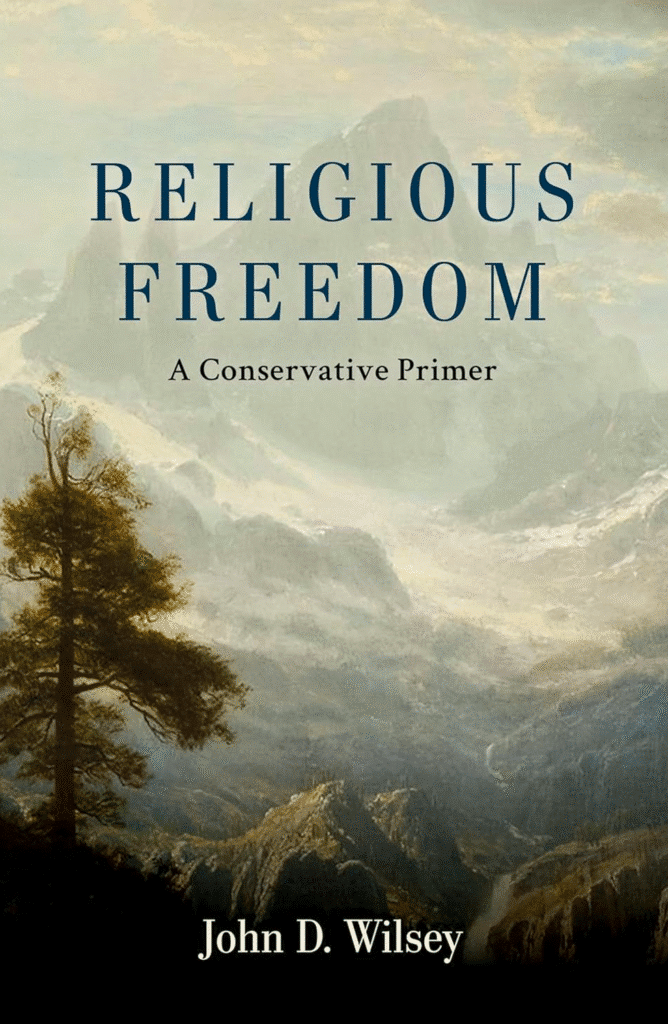
Read more in Religious Freedom: A Conservative Primer (Eerdmans, 2025)