
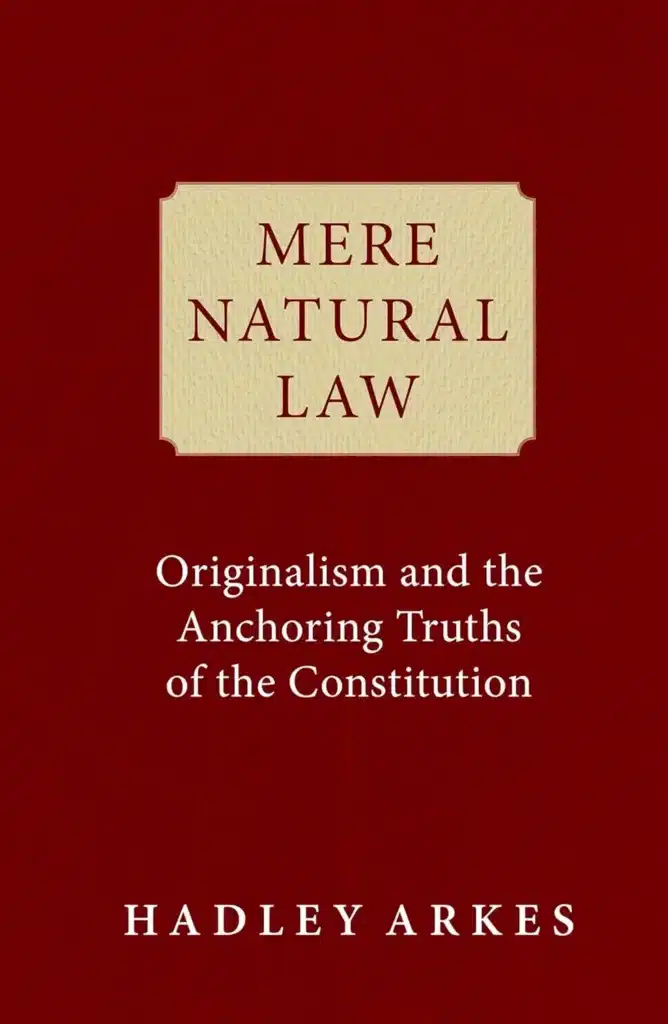
Borrowing his title from C.S. Lewis’ monumental work, Mere Christianity, Hadley Arkes sets an ambitious goal for this book: to provide the general public a readable explanation of natural law theory and how it underlies the U.S. Constitution. To Arkes, the Constitution cannot be understood without recourse to the eternal moral truths on which that document rests. According to Arkes, natural law was woven into everything the constitutional framers did and was “so fundamental that it did not need to be explicitly named” in the document. (However, it should be noted that on this matter—of whether the natural law beliefs of the founding generation were actually incorporated into the Constitution, as they were into the Declaration of Independence—there exists much debate.)
Just as Lewis grounded Mere Christianity on the experiences of ordinary people, Arkes in Mere Natural Law attempts to demonstrate how natural-law constitutionalism rests on moral principles knowable to “virtually everyone.” He hopes to articulate those “anchoring truths” in a way that will show us that “we have known them all the time.”
Arkes is supremely qualified to undertake this task. As one of the most prominent natural-law philosophers writing today, he has been publishing noteworthy books on the subject since the 1980s. His most recognized works involve his advocacy of natural rights for the unborn and his condemnation of abortion as a violation of those rights. He links his opposition to abortion with Abraham Lincoln’s opposition to the institution of slavery, with both positions resting on natural-rights arguments. In this book, as in his previous writings, he argues for a revival of natural rights principles that would end abortion, just as the Thirteenth Amendment ended slavery.
Natural law refers to those immutable principles knowable to human beings through the process of moral reasoning eloquently set forth by Thomas Aquinas centuries ago. Natural rights include those “unalienable rights” mentioned in the Declaration of Independence and grounded in nature. Not being of human creation, natural rights are not dependent on the whims of governing majorities.
Contrary to moral relativism, which Arkes condemns, natural law contains eternal truths discernible through human reasoning. Natural law, unlike relativism, does not simply advocate for a liberty that is indifferent to its use; rather, it seeks a discovery of truths that direct people to the good life—to a life where freedom leads to virtue.
To Arkes, relativism has become the moral sinkhole into which society has fallen. Although the movement began more than a half-century ago in academia, it has spread to the broader public, infecting everything from churches to corporate boardrooms. Relativism has so plunged us into moral confusion that we can no longer define the genders or even recognize the existence of “truth.” Banishing any moral judgment, relativism cannot guide the use of freedom to good or virtuous ends.
Arkes’ position on abortion reflects his condemnation of mere freedom as the ultimate constitutional goal. The pro-choice position represents the pinnacle of relativism, elevating freedom of choice over any connection to what is being chosen. As Arkes notes, in liberal jurisprudence the right to abortion is seen as “the anchor of personal freedom, far more than the freedoms of religion and speech.” Arkes even criticizes the Supreme Court’s decision in Dobbs, which struck down a constitutional right to abortion but failed to recognize the personhood of the unborn child possessing a natural right to life.
In asserting that natural law and its concomitant moral judgments underlay the U.S. Constitution, Arkes argues that the judiciary must enforce these judgments through its constitutional jurisprudence. This means that courts must assert non-textual rights discerned through a moral reasoning process involving natural law. As Arkes notes, the Supreme Court has previously used moral reasoning in cases involving segregated schools (Brown v. Board of Education) and contraceptive use (Griswold v. Connecticut). But whereas in Brown the Court hinged its decision on the unwelcome effects of segregation, Arkes argues that the Court should have articulated a universal principle, declaring segregation morally wrong under all conditions, regardless of its effects.
Conservative jurists have opposed the use of moral reasoning by liberal justices to find rights not included in the constitutional text. Since the 1960s, activist liberal justices have employed moral justifications to sneak into the Constitution their own views of morality. Indeed, originalism largely arose because of the way liberal justices used their moral views to create new rights. The abortion right articulated in Roe v. Wade came from just such a process.
Critics worry that Arkes’ natural-rights constitutionalism risks handing a powerful open-ended tool to the left and that it pushes courts beyond their proper role. Courts are not law-making authorities and cannot create rights not found in the written Constitution. Moreover, with the vast majority of current federal judges being Democratic appointees, there is a good chance that their moral judgments may not coincide with Arkes’ view of natural law.
Arkes postulates that his desired moral judgments logically emanate from natural-law principles underlying the Constitution. In his chapter “The Ploughman and the Professor,” he argues that the farmer and construction worker are better able to discern natural-law principles than are college professors. Arkes quotes Jefferson as saying that “the ploughman is more apt than the professor to get the moral questions right because he will not be dazzled and distracted in the same way by artificial rules or theories.” Perhaps Jefferson was right, but it will be a challenge for a diverse and divided American society to arrive at some uniform conclusions on what constitutes justice and morality.
Arkes aims his sharpest criticism at what he calls conservative jurisprudence, or originalism, for abandoning moral judgments and embracing relativism as a futile way of avoiding the moral values of the left—as if conservatives can counter the vice of “zany” liberal activism conducted under the rubric of moral reasoning by simply avoiding “moral reasoning altogether.” According to Arkes, this conservative retreat from moral judgment has conceded the field to the left, which displays no hesitancy to moralize: the “advocates of same-sex marriage are seized with deep conviction of its moral rightness—and therefore of the moral wrongness of those who oppose it.”
Originalism as an approach to constitutional decision-making took root in the 1980s as a conservative response to the liberal activism of the Warren and Burger Courts. But Arkes criticizes originalism as a morally empty jurisprudence. Even in Dobbs, conservative justices “did not touch the wrongness of taking innocent human life in abortion.”
However, Arkes’ recognition of the left’s willingness to make moral judgments might pose a challenge to his argument that universal natural-law truths are objectively available through a process of moral reasoning. Indeed, the left possesses a stable of moral values—personal autonomy, sexual liberty, race- and gender-based justice claims—to assert as constitutional rights, if given the opportunity.
Many conservative judges would probably agree with Arkes about the dangers of relativism and the need for a moral reawakening in America. That said, those same judges might also argue that such a moral reawakening does not fall within the province of the courts. They might argue that it is the people, through their elected representatives, who are responsible for moral judgements; that the Supreme Court, as nine unelected individuals, carries neither the authority nor the credibility to hand down sweeping moral pronouncements. They might argue that the ultimate moral principle for courts commands that they not exceed the limited constitutional role assigned to them.
Arkes’ discussion of First Amendment jurisprudence reveals how his natural-rights constitutionalism might work. Arkes sees the Court’s free speech jurisprudence as riddled with the corrupting influence of relativism. Speech is protected regardless of content. Arkes’ favorite speech case seems to be Chaplinsky v. New Hampshire (1942), where the Court denied constitutional protection to “fighting words.” That, in itself, is telling, since most First Amendment scholars would probably pick a case in which speech had been protected. But Arkes uses Chaplinsky to show how the Court exercised commonsense judgment regarding whether offensive and destructive speech should receive protection.
Arkes does not agree with Justice Harlan’s famous, though admittedly relativistic, quote: “One man’s vulgarity is another’s lyric.” Arkes wants the Court to make moral judgments regarding the content of speech. Contrary to the Court, Arkes would not protect the words “F*** the Draft” printed on a jacket in Cohen v. California; nor would he have protected the chants of “Thank God for Dead Soldiers” outside the funeral of a military serviceman in Snyder v. Phelps.
The Court’s speech relativism ignores Aquinas’ admonition that “the aim of the law is to lead people to virtue.” Unfortunately, this relativism becomes a way to strike down “virtually any law seeking to apply even the most minimal restraints that a civilized community would seek to establish in its public life.”
Much of modern free speech jurisprudence stems from Justice Holmes’ famous 1919 marketplace of ideas metaphor. Under this metaphor, the more speech the better; but to Arkes, it is a relativistic doctrine, detached from “the moral character of the speech.” Ever since Chaplinsky, according to Arkes, “the moral case for freedom of speech has faded, along with the moral sense of the rightful limits to that freedom.”
Once again, Arkes criticizes conservative jurists who have mistakenly embraced relativism in the false hope of shoring up protections of speech that the left wants to eliminate. Haunted by the specter of speech codes and the outright repression of conservative speakers on campus, conservatives sought refuge in relativism. But this sweeping relativism has not succeeded, since “the climate of intolerance and repression on campuses has only become ever more aggressive.”
Despite the “freewheeling relativism” of the Court’s speech jurisprudence, double standards still prevail. Whereas people offended by vulgar, offensive, and hateful speech must simply “avert” their eyes, those opposed to the speech of protestors outside abortion clinics have the power to significantly restrict the expression of such speech. Critics of Arkes, however, may argue that giving courts the power to uphold content regulations on speech will only intensify these double standards.
With respect to religious freedom claims, Arkes presents an interesting argument as to how they might be handled under a natural-law approach. Currently, courts focus on granting religious exemptions from laws burdening an individual’s “sincerely held beliefs.” Arkes’ preferred approach would be to judge the natural-law truths of those beliefs rather than the mere existence of such subjective beliefs.
Hesitant to act as theologians, judges ignore the objective truths of religion; but in so doing, according to Arkes, they reduce religion to an array of subjective individual beliefs detached from truth or reason. Consequently, under the First Amendment, religion is purged of its defining substance. However, if we avoid “any moral test of what is offered in the name of religious teaching, then we have also removed the moral ground” for treating religion as something meriting constitutional protection.
Arkes proposes defending the rights of the religious by invoking the same core moral principles that come into play in other instances, e.g., when we defend the rights of people not to be enslaved. According to Arkes, the defense of the religious will be grounded “in principles that can stand as objectively true and rightful even for people who do not share his religious beliefs.” Often unrecognized, he explains, is how law has lived “on the moral capital of our religious teaching.”
The questions arising from this challenging perspective is just how this defense is to be waged—how can we ground religious liberty in a natural law that does not depend on or incorporate particular religious beliefs? And how does this fit with the First Amendment Establishment Clause?
In Mere Natural Law, Hadley Arkes provides an illuminating reminder of the timeless truths of natural law, which he then uses to offer a provocative proposal for the future of constitutional law. As with most illuminating and provocative books, Mere Natural Law will undoubtedly prompt much debate. And readers will surely benefit from its challenging discussion.
Patrick M. Garry (J.D., University of Minnesota) is a professor of law at the University of South Dakota and the Director of the Hagemann Center for Legal & Public Policy Research. He is also a senior fellow at the Center for Religion, Culture & Democracy.