
In story or song, there are few caricatures of the moral skeptic sharper than the figure drawn by Tom Stoppard, with his usual dash, in his play Jumpers. The temper of the skeptic was caught in Stoppard’s description of the man who is reluctant to concede that the train for Bristol has left Paddington Station unless he himself has been there to see it leave-for after all, that piece of intelligence might be “a malicious report or a collective trick of memory.” And even then he would credit that report only under the proviso that “all the observable phenomena associated with the train leaving Paddington could equally be accounted for by Paddington leaving the train.” What was a caricature in 1972 quickly became real, for that character walks among us. He votes, he runs for office, and he raises children. He does these things without a second thought, even when he disclaims any grounds for knowing what constitutes the “good” in the men and women he forms through his parenting.
But even the savvy and clever Tom Stoppard, writing in 1972, could not have imagined just how far the passion for relativism would unfurl—to the point where people with advanced degrees forcefully insist that we cannot tell the difference between a male and a female. That difference now is regarded in some quarters as merely “assigned” at birth. And so we are required by the courts to affirm that a man may pronounce himself a woman—or a woman, a man—solely on the strength of an earnest report on his (or her) feelings. The people around them in their offices or businesses will be compelled to respect that judgment, in word as well as deed—or else put themselves and their employers in legal peril.
No one who has spent some time in the academy over the last fifty to seventy years could have failed to see this movement revving up for a long while. But no one who has lived through it all, and paid attention, could be anything less than staggered by the way in which these doctrines of relativism have spread out from the colleges and universities to the broader public, upending many churches and finding aggressive support now in the boardrooms of the leading corporations. In the face of these trends, even many people who count themselves as “liberals” have had the experience of feeling, as the saying goes, disoriented. As they recoil from this long march to liberation-from what they see as “a bridge too far”—they find themselves reaching longingly back. But reaching back for what? For one thing, they may want to recover the simple willingness to recognize what is there, before our eyes. It’s the old “what is” question: What is a chair? What is a man? What is a woman? It may soon kick in on them that they are really asking for a willingness to respect the “truth” about what is before them and the way the world moves—though if they have come through an American college, they may be shy of speaking that loaded word “truth.” And if they are concerned with questions of right and wrong, at a time when children are lured away from parents for surgeries, they may realize that they had always taken for granted that, among the things we may really know as truths, some of them must have been moral truths.
But if they find themselves moving along this path, looking for some ground of confidence in speaking seriously of moral truths, then they are on a path that, in one way or another, will lead back to … the Natural Law. We might be tempted to say that they are engaged in a “recovery” of the Natural Law, except for one cardinal point: the Natural Law has never been missing. It has always been with us. It has been blocked from view at times, in part because it is so deeply planted in our assumptions and language that we may hardly be aware of it. But it has been further blocked from view as people have been more and more drawn to a world of theories bold and novel, and so removed from the language of ordinary folk that only people schooled at the most expensive colleges can understand them. What has been lost, without much notice, is that commonsense understanding of ordinary people, in which the Natural Law finds its ground.
Hadley Arkes (Ph.D., University of Chicago) is the Edward N. Ney Professor of Jurisprudence and American Institutions Emeritus at Amherst College and the founder and co-director of the James Wilson Institute on Natural Rights & the American Founding in Washington, D.C.
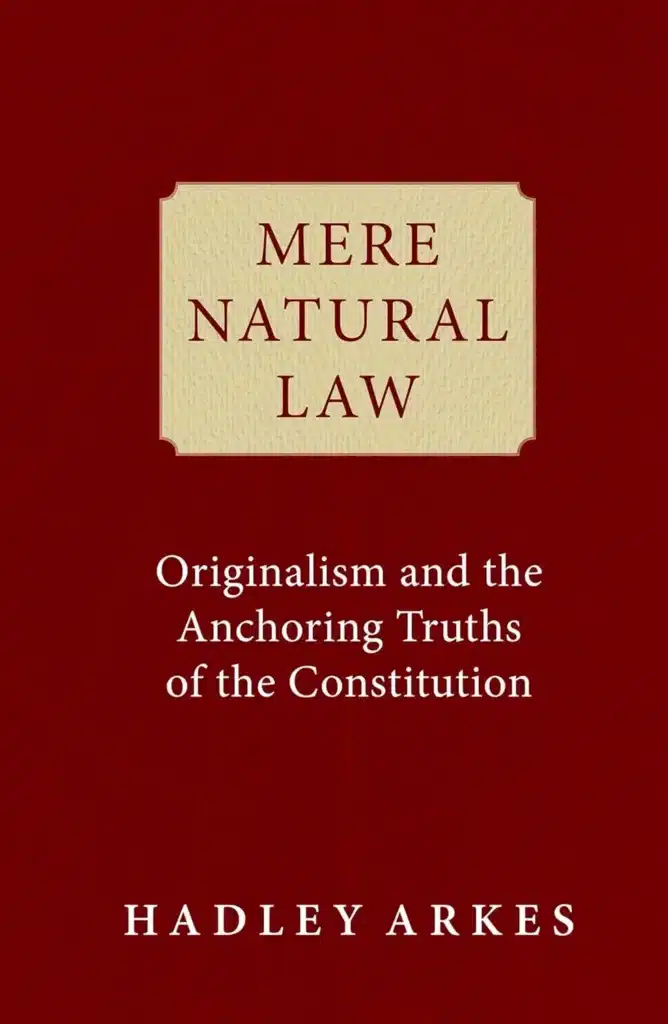
Read more in Mere Natural Law: Originalism and the Anchoring Truths of the Constitution (Regnery Gateway, 2023)