

In 1964 the British pop group Herman’s Hermits put King Henry VIII on the minds and lips of teenagers. Their little ditty began, “I’m ‘Enery the 8th I am, ‘Enery the 8th I am, I am. I got married to the widow next door, and she’s been married seven times before!” If the English-speaking world didn’t already think the Church of England began with a strange marriage situation, now it had reason to.
Henry’s divorce
But was it true? Did Anglicanism really begin because (as is often alleged) Henry VIII lusted after Anne Boleyn and for that reason divorced his wife Catherine who had borne him five children?
Like most important events in history, the reality was more complex than the legend. Henry’s parents had arranged his marriage to Catherine for political reasons, when Henry was 18 and Catherine 23. Catherine had been married to Henry’s brother Arthur, who died after five months of marriage. Because marrying a brother’s wife was proscribed by the Bible (Lev. 20:21), Henry’s parents had to get a special dispensation from Pope Julius II.
Catherine had seven pregnancies with Henry, and none resulted in a son who survived infancy. Nearly everyone was convinced that a male heir was necessary, since a long civil war (1135-54) was the result the last time a woman (Empress Matilda) had taken the throne.
Henry—and others—concluded that his marriage to Catherine was cursed because he had violated the biblical prohibition, and he had received the very punishment which that verse predicted: “If a man takes his brother’s wife, it is an unclean thing. He has uncovered his brother’s nakedness; they shall be childless.”
Of course Henry and Catherine had borne a daughter, Mary, who acceded to the throne in 1553 as a Catholic and proceeded to burn three hundred Protestants in the fires at Smithfield. Thus her nickname “Bloody Mary.” But Henry interpreted the word “childless” to mean lacking the only kind of child—a male—who could prevent England’s descent into anarchy.
Besides, as Ashley Null has pointed out, Henry’s scholars believed that the Deuteronomic injunction to marry your brother’s widow if she and your brother had not produced a male heir (Deut 25:5)—which was what Henry had done—was considered part of the civil law of Jewish Israel and therefore no longer applicable to Gentiles like Henry after Christ. But these same scholars taught that the prohibition in Leviticus was part of the moral law and therefore universally applicable, to Jews and Gentiles alike. They told Henry he had broken God’s law when he married Catherine. So Henry appealed to Pope Clement VII to annul his marriage as contrary to Scripture.
Stephen Neill pointed out that popes had done far worse. Englishmen knew that in 1152 the Pope had separated Eleanor, Queen of France, from her husband Louis VII after fourteen years of marriage and the birth of children, because of supposed incompatibility of mind, and three months later she married Henry of Anjou, later King Henry II of England.
It didn’t hurt that Anne Boleyn was charming. Henry’s marriage to Catherine was eventually declared null by newly appointed Archbishop of Canterbury Thomas Cranmer, but then Anne produced—ironically—a daughter who in 1556 became Queen Elizabeth I.
It was doubly ironic that when Henry eventually had a son who lived long enough to reach the throne, that son, King Edward VI (1547-53), turned back much of his father’s Roman Catholic theology and thereby helped steer the English reformers back to the Fathers’ era before Roman distinctives emerged.
The bottom line, however, is that Henry VIII’s motives for divorcing his first wife were as much political and even biblical as personal or romantic.
Sordid beginnings?
Critics protest nevertheless that these factors are mostly worldly. How could a sincere Christian devote himself to a Church with such earthly beginnings?
I would give two answers to this question.
First, the Bible is full of messy—even sordid—history, and God’s church has always been stained with spots, wrinkles and blemishes (Eph 5:27). After all, David was Israel’s most beloved king, the father of the dynasty that produced the Messiah. Yet he was a murderer and an adulterer. Remorse over his adultery produced on of the Bible’s most affecting psalms (Ps 51). The churches at Ephesus and Corinth were wracked by immorality and heresy, yet Paul calls them the Body of Christ. God has always delighted and redeeming glory and beauty from sin and degradation.
Anglicanism is far older
Second, Anglicanism did not begin in the sixteenth century but in the very first few centuries of Christianity. England was colonized by the Roman Empire in the first two centuries AD. There is historical evidence that soldiers, administrators, and traders on Roman commissions might have brought the gospel with them and won converts among the “Angles” in those first two centuries.
Tertullian wrote in the year 200 that parts of England had been conquered by Christ. We know the name of the first recorded Christian martyr in England, Alban, who was slain in the persecutions of Diocletian around 304. By 314 we know there were several English bishops. Athanasius tells us that the Council of Nicaea (325) was accepted by the British Church.
At the end of the sixth century Pope Gregory the Great (590-604) was concerned that the Empire was being overrun by pagans devoted to Germanic gods. So in 596 he sent Augustine (not the great theologian from Hippo in North Africa but the evangelist and bishop of Canterbury in England) to launch a new evangelization of the island. It was a great success. On Christmas Day 597 Augustine baptized ten thousand converts. The new bishop of England gave now-famous instructions about the liturgy to his evangelist-priests: “Make your own rite, choose from the best of the churches, but adapt them to the needs of the English.” Already there was developing a distinctive English way of worshipping the Triune God.
During the Middle Ages the English Church became even more distinctive. The great philosopher and theologian Anselm was an Italian who became Archbishop of Canterbury (1093-1109). His prayerful arguments for God’s existence (the Monologion and the Prosologion) and his elegant theory of the Atonement (Cur Deus Homo or Why the God-Man?) influenced Anglican thinking for the next millennium.
Another Archbishop of Canterbury showed the Church what it means to stand courageously for God’s truth. Thomas Becket (1162-70) resisted King Henry II’s attempts to try clergy in state courts, arguing that God’s law is higher than state law. For his obduracy he was slain in his cathedral, in a moment memorialized by T.S. Eliot’s poetic drama Murder in the Cathedral (1935).
Challenging Rome
We should also know that Anglicans—which means catholic Christians in England— were challenging Rome for centuries before Henry VIII. The Celtic church—an early tradition within English Christianity—differed with Rome over the date of Easter, tonsure, penance, and Eucharistic consecration. These differences persisted until the Synod of Whitby in 633.
But resistance to Rome became more acute in the Middle Ages. Archbishop Lanfranc was passive-aggressive in response to Pope Gregory’s VII’s mandate for priests to be celibate (1074), enforcing it with deliberate unhurriedness. King John, of Magna Carta fame (1215), locked horns with Pope Innocent III over the appointment of Stephen Langton as Archbishop of Canterbury. The pope deposed John, who then submitted. But the result was widespread English resentment of Rome. Later in the thirteenth century that resentment deepened as Rome extracted more money from the English church to pay for its wars against Islam. When a papal nephew was recommended by Rome for an English canonry, Bishop Robert Grossteste of Lincoln refused to approve it: “With all filial respect and obedience I will not obey. I resist. I rebel.”
In the fourteenth century King Edward I forbade English Christians from sending money overseas in the Statute of Carlisle (1307), a dig against Rome. This was probably in retaliation against Pope Boniface VIII whose Clericis laicos (1296) forbade prelates and monasteries to pay taxes to the state without his permission. When Boniface claimed the power of both swords—the spiritual and the material—in Unam Sanctam (1302), the English throne struck back in its First and Second Statutes of Praemunire, which stopped appeals to Rome for benefices or legal redress. So it may not have shocked many English Christians when the Oxford philosopher and priest John Wyclif (1328-84) called the pope “a poisonous weed” and denied transubstantiation. They probably agreed with the first and accepted the second since Wyclif affirmed the Real Presence of the Body and Blood of Christ in the Eucharist. He simply refused Rome’s philosophical explanation of it.
So when in the sixteenth century King Henry VIII made noises about separating the English Church from Rome, this was a radical step, to be sure. But it was also in keeping with a long-standing English skepticism toward Roman authority. In sum, then, Anglicanism started almost fifteen hundred years before Henry VIII. And his break with Rome was nothing new. It had been a pattern in English Christianity for more than nine centuries before Henry.
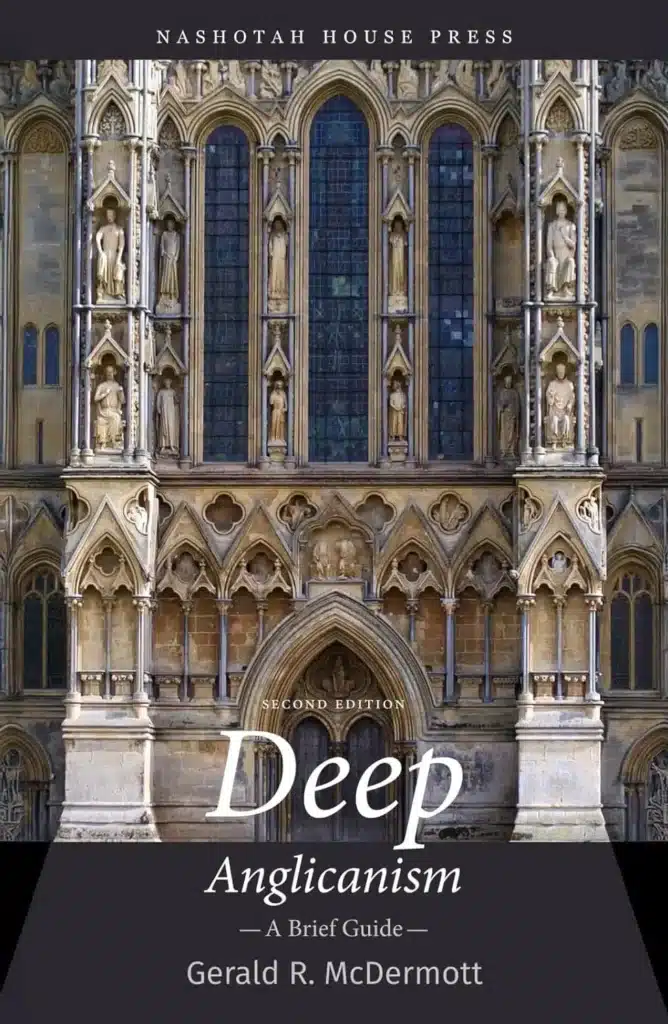
Gerald R. McDermott (PhD, University of Iowa) is an Anglican priest and theologian who teaches at Jerusalem Seminary and Reformed Episcopal Seminary (ACNA). He is a senior fellow at the Center for Religion, Culture & Democracy and a priest-in-residence at Holy Cross Anglican Church in Crozet, VA.