
Returning home from a trip, backpack at my feet, I settled into a seat along the side of a Virginia Railway commuter train from D.C. to Manassas with my infant son snuggled at my chest. It was the spring of 2010, after I defended my dissertation but before I graduated in June of that year. He was three months old, downy-soft head peeking out from a front wrap. I had never ridden that train before, and I have never ridden it since. I was surrounded by working professionals headed home for the night, and the passengers noted my baby with surprise. A middle-aged woman asked, “Is he your first?” I have no idea why this is such a common question to ask a mother with an infant, but over the years I spent traveling with babies it was easily the most common icebreaker. The question poses a dilemma for those of us with lots of children. Like the canned “How’re you doing?” to which no one ever expects a negative response, “Is it your first?” is supposed to be answered with a “Yeah,” and then followed up with some kind of rejoinder along the lines of “Enjoy it while it lasts,” or “Don’t worry, eventually he’ll sleep.”
What no one expects, not anywhere and least of all on a rush-hour train, is “He’s my sixth!” At that answer, there was murmuring among the train riders. But above the din I heard one response that I never expected. The woman who had questioned me gave a swift, plaintive reply: “Six! I guess your husband still wants you.” She was right, of course. He did, and he still does—we’ve since had two more children, eight altogether. But I had never considered his desire for me as causal in relation to our family size—even though, in some sense, it clearly is. Nor had I ever wondered whether having a lot of babies might make us love each other more. I still don’t know. But no other response to my family in public has struck me with the same tragic force as that one fourteen years ago.
In a two-child world, an eight-child choice begs for an explanation. What I chose is unusual, rare, maybe a little crazy. But I certainly didn’t choose it for those reasons. I like to be on trend. I always know where denim is going, and I spend more on shoes than I should. Why not be on trend with my number of kids? Why have all these children? I had every door open in front of me. Why this choice and not another? I get asked this question a lot, and it turns out that other women with big families get asked too.
I know what the answer isn’t. It’s not because I don’t believe in using artificial birth control—even though I don’t. I know when every one of my kids was conceived, and we could have avoided any one of them. Natural family planning has its problems, but so do IUDs, condoms, and pills. Knowing how to avoid getting pregnant is easier than most things I do. Besides old-fashioned wisdom, there are apps to track fertility, wearable wristbands, and simple at-home fertility tests with red lights and green lights. None of my kids was an accident or unplanned in any strict sense. We always said, “Let’s go—we’re ready for another one if we can conceive.”
And it’s not because I’m a Catholic and the Church says that I should have a big family—because it doesn’t. One might describe the Catholic Church as “pro-natalist” because of its stance on abortion and birth control or the history of large Catholic families among Italians, Irish, and other immigrants. But whatever the Church teaches officially, Catholics nowadays use birth control at about the same rates as everyone else. And in my forty-seven years as a practicing Catholic, I have never heard a sermon on the value of having children. I have never been urged in the confessional to have more kids. There’s no doctrine that it’s holier to end up with more kids.
Of all the Catholic women in history with big families, the Church has canonized precious few of them, the American educator Elizabeth Bayley Seton being one of them. The childless Maria Goretti, my confirmation saint, is more typical. She was canonized for forgiving her attempted rapist (and murderer). Meanwhile, her mother, Assunta Carlini, a devout woman who raised seven children as a widowed sharecropper in desperate poverty, isn’t a saint. Whatever we might say about the Catholic Church and natalism (and that would be a separate book), it would be difficult to make a case that there is any kind of social norm among Catholics to have big families. Nothing to my mind sums this up better than Pope Francis’s airplane quip that women don’t have to breed “like rabbits” to be good Catholics—a comment I found deeply offensive.
Then there is another more personal reason that isn’t the answer. When I got married, my husband was a widowed father of six. He didn’t “need” more kids, we had our hands full, and we could have counted ourselves happy if we had raised those children and dedicated the balance of our lives to research and teaching. He already had tenure in philosophy, and I hoped to follow in an academic job. I was a graduate student in a top economics program. I had a promising “career” in front of me, and the sensible thing would have been to finish that program on time and seek a tenure-track job like my husband. And yet—we had more children anyway. By the time I finished my doctoral work, we had six more kids. A tenure-track job seemed out of the question.
So if those are not the answers, what is the answer? It’s hard to say. I suppose it boils down to some sort of deeply held thing, possibly from childhood—a platinum conviction—that the capacity to conceive children, to receive them into my arms, to take them home, to dwell with them in love, to sacrifice for them as they grow, and to delight in them as the Lord delights in us, that that thing, call it motherhood, call it childbearing, that that thing is the most worthwhile thing in the world—the most perfect thing I am capable of doing.
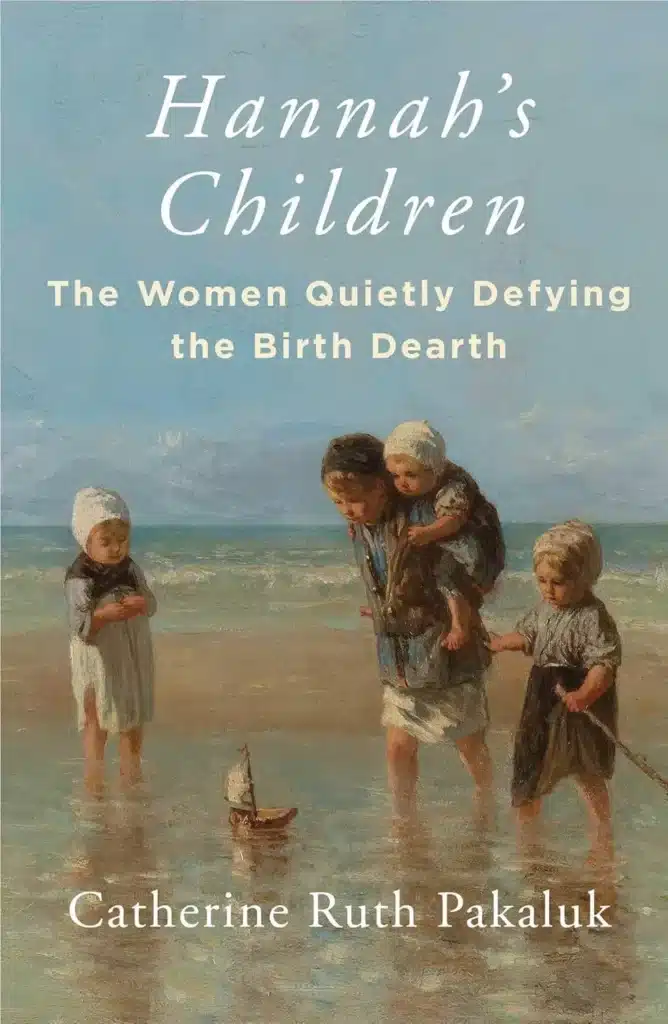
But that is not easy to say. Not on a train, not in a dental chair, and not in the checkout line at a grocery store. That day on the train, I began to wonder if other women who shared my choices had ideas about why they do this, and better ways of explaining it. I began to wonder if it was a common experience, and if so, whether it had a common expression. Did it have a story? Did it have a name? So I went in search of reasons, perhaps to know my own for the first time. Hannah’s Children is the result of this search. In summer 2019, I and my colleague Emily Reynolds traveled to ten American regions and interviewed fifty-five women with five or more children to find out why they do what they do and what they think it means—for themselves, for their families, and for the nation.
As it happens, in a two-child world trending to a one-child world, the desire for children and how it is charted in relation to competing human goods isn’t a small thing. It’s a really big thing—the thing that ultimately says how many of us there are and what kind of people we will be. Birth rates and childbearing are not a question of merely personal interest. There is no more economically significant question than where people come from, and nothing more deeply informs the way we order our lives together than the first society we experience: the family. So Hannah’s Children sits squarely at the intersection of personal and professional interests for me.
I will make the argument for the economic importance of this work in chapter 4, but my method notably breaks with Nobel economist Gary Becker’s seminal approach to the economics of the family. Becker argued that the childbearing desires of a household are properly outside the scope of economic analysis. The “economic” approach, he argued, assumes “that individuals maximize their utility from basic preferences that do not change rapidly over time….” In Becker’s work, household demand for children is modeled like a “consumer” preference: a simple taste for a good that is informed by things outside the analysis of the economists. We take desires as given. This isn’t the whole of the story, but in general economists have moved away from qualitative work, preferring deterministic models with fixed preferences and quantitative studies using samples large enough to make statistical inferences based on probability models.
In contrast, the heart of the project of this book is conversations with a small number of women about the nature of their childbearing decisions. Since my sample is not large enough to be representative of women with large families in general, each subject is herself, N=1. The narratives that make up my data do not yield descriptive statistics or causal inferences. But as MIT economist Michael J. Piore has pointed out, “What open-ended interviews do yield, and yield consistently, are stories the respondents tell. The story is the ‘observation.’ The stories are basically narratives. The question is thus what to do with the stories. Typically, stories are not analyzed as statistical data; stories are ‘interpreted.’ … The stories [act] not as data points but to suggest particular revisions in theory.” It is in this spirit that I took up this work: to find the stories that may ultimately assist in a revision of economic theories about birth rates and population growth.
Catherine Ruth Pakaluk (Ph.D., Harvard University) is associate professor in the Busch School of Business at the Catholic University of America.
Read more in Hannah’s Children: The Women Quietly Defying the Birth Dearth (Regnery Gateway, 2024).