
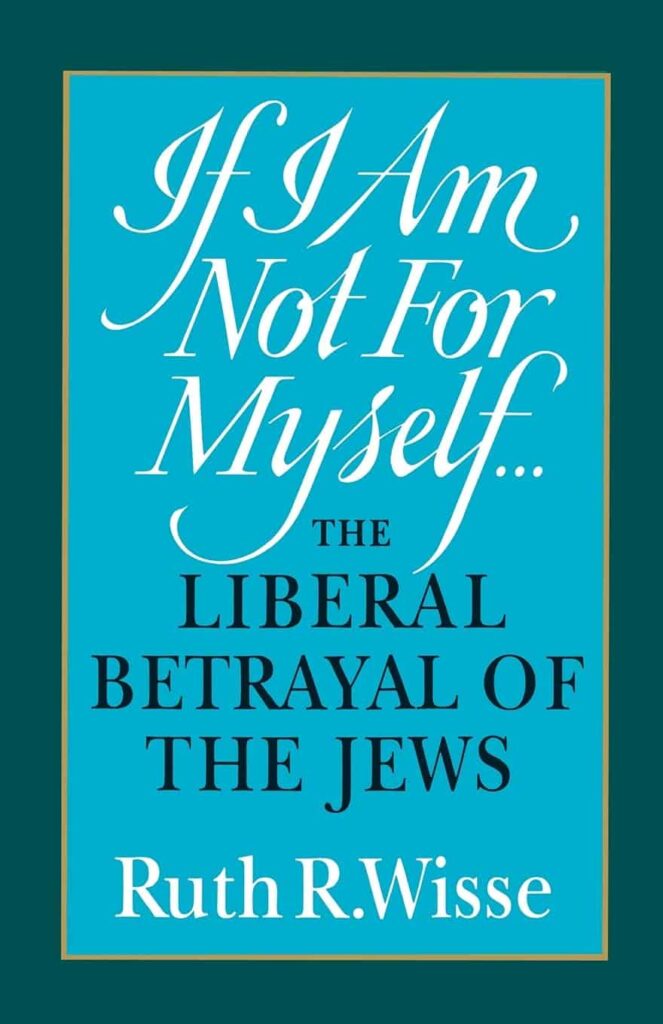
Culture abounds with examples of supposed prescience and prophecy, from overreading political analogies in 1984 or The Handmaid’s Tale to more trivial examples like the popular meme of The Simpsons predicting the future. However, especially in a post-October 7th world, Ruth R. Wisse’s If I am Not for Myself…: The Liberal Betrayal of the Jews is one of those books where one cannot help but wonder if the author had the gift of foresight. Published February 19, 1992—8 months before I was even born—Wisse’s book appeared to have predicted events that occurred as I was reading it, from Justin Trudeau’s condemnation of Israel for fighting back against Hezbollah after a year of constant missile attacks to the UN Walkout during Bibi Netanyahu’s speech. Even Wisse’s tone is prophetic, coming off as a voice like Jeremiah or Isaiah, albeit with heavy dashes of Song of Songs thrown in for good measure.
It might have been expected that a book like If I am Not for Myself… would have enjoyed a surge in popularity after the October 7th massacre, as did similar works like Dana Horn’s People Love Dead Jews. However, Wisse’s work seems to have remained undiscovered. This should not be allowed to continue; this work deserves a renaissance and has much to teach Jews and Gentiles alike in a world where antisemitism and a conscious, deliberate rejection of liberalism are both rising at alarming rates.
Despite its brevity (a mere 220 pages), this book is packed with meaning. It is an almost exhausting barrage of thought-provoking arguments and points, and there is so much that could—and should—be written about this book, so many discussions that should be had, so many questions Wisse raises that deserve to be further explored. However, most important and relevant to the current day is what this book has to teach us about liberalism and human nature and how antisemitism has, for decades, had lessons on these topics that liberals have refused to learn.
To begin, Wisse’s definition of liberalism is a broad one, encompassing classical, progressive, and social liberalism under the same banner. She defines liberalism as
belief in rationality and a rational approach to political questions; in freedom for the individual within a constitutional, participatory democracy; in cultural pluralism within an open society; and in the rule of law…. Liberals trust that all human problems are amenable to negotiated solutions, that all people are united in a spirit of brotherhood, and that history itself is a record of progress…. The pure liberal spirit precludes the possibility of intractable hatred or intransigent political will.
Thus, to Wisse, liberalism is both a set of beliefs and a broader emotional orientation. Inherent in this definition are what Wisse sees as liberalism’s weaknesses and limitations. In perceiving itself as the natural result of progress, liberalism easily assumes itself to be an inevitability, and in its valuing of rationality, it believes that to reject it must be irrational. This naïve optimism is what leads liberalism into the titular betrayal of the Jews.
The word betrayal is not incidental to Wisse’s argument. She does not consider liberalism to have passively failed—it’s not that liberals tried their best and their best wasn’t good enough to stop antisemitism. No, it is liberals’ desire to maintain their naïve, Polyannaish optimism even in the face of reality that has led them to act against their principles. Although she does not use the term cognitive dissonance, Wisse nevertheless beautifully describes how, when faced with the discomforting truth of the incompatibility of beliefs and attitudes with reality and behavior, we humans almost always take the easiest way out, even to the point of self-delusion. When it comes to antisemitism, Wisse puts it quite bluntly: “Many good people find it psychologically and politically necessary to abandon the Jews to their fate so that they may preserve their easy optimism; if they can then blame the Jews for incurring such hostility, they can assuage their conscience at the same time.” Wisse dates the beginning of this betrayal to the 1970s, when Israel’s competence at winning wars made them unlikable, the global politics version of the New England Patriots. However, that betrayal has escalated to a new level in a world where open sympathizing and even praise of terrorist entities like Hamas, Hezbollah, the Houthis, and even the Islamic Republic of Iran has become popular, while demonizing the Middle East’s only ethnically and religiously pluralistic democracy is being held as taking a moral stand—so long as one substitutes “Zionist” for “Jew” in one’s blood libels and conspiracy theories.
Although not a psychologist by training or trade, Wisse’s work is nonetheless deeply psychological. In addition to her powerful description of cognitive dissonance, Wisse also hits on deeper themes by exploring that dissonance’s underlying motivation: Liberalism’s refusal to admit its own fragility.
Liberalism views itself as the inevitable outcome of historical progress and reason, but this is far from true. It is rooted in what cultural psychology calls dignity culture, which values the innate, inalienable worth of every person. However, dignity culture requires specific environmental conditions to develop and endure: effective legal systems, rule of law, a market economy, and shared social trust. In environments where these are absent—where survival, not individual rights, is the priority—dignity culture and liberalism falter.
Wisse doesn’t use the term dignity culture, but she explicitly identifies its counterpart: honor culture. In the Middle East (Israel aside), rather than assuming human worth, social standing is instead dictated by one’s reputation. Honor is contingent on toughness and intolerance of any insult or disrespect, often involving violent retaliation. The “intractable hatred” Wisse sees as incompatible with liberalism is simply the logic of honor culture, particularly among those attacking Israel. To many in the Arab world, Israel’s existence—Jews thriving in their ancestral homeland, outside of dhimmi status—is a direct insult, one justifying any tactic no matter how extreme, from propaganda and conspiracy theories to the horrific violence of October 7th.
To liberals, such honor-based logic is unthinkable. It seems irrational to fight a battle you cannot win, to continually provoke a militarily superior power. It is unthinkable that using human shields, digging terror tunnels at the expense of infrastructure, or deliberately breaking the rules of war (itself an entirely liberal concept) by embedding in civilian areas would be the default strategy of anyone. After all, we have evolved beyond such brutalities, have we not? Surely no one would willingly be that uncivilized; there must be another explanation!
Thus Wisse, over 30 years before it occurred, explains why so many in the liberal West, almost immediately after October 7th, tried to justify Hamas’s brutality with invocations of “open air prison,” “decolonization,” “occupation,” and more. Such are attempts to shift the narrative back onto dignity’s terms, and if doing so requires demonizing Jews, so be it.
This is not a new issue for liberalism, either. Despite Jews’ long embrace of liberalism (which Wisse ascribes to Jews’ needing religious pluralism to thrive as a religious and ethnic minority), Jews have also been a very convenient scapegoat and sacrificial lamb. Sometimes, this has been for practical reasons—e.g., Arab oil and trade routes. However, Wisse believes that liberals have a more fundamental reason to avoid confronting their history of hypocrisy around the Jewish Question; doing so would be fatal to the naïve optimism about human nature and the assumption that liberalism is the natural endpoint of societal evolution. There is no escaping the fact that liberal societies have still devolved into antisemitism. Even “enlightened” France, the beacon of modern liberalism, has done so, as Wisse describes in her account of the Dreyfuss affair.
Therefore, instead of confronting historical failures, it is easier for liberals to victim-blame, or even change the definition of antisemitism to the level of patent absurdity (for examples of both, check your local social media feed).
This is why antisemitism is not a “failure” of liberalism. Terming it a failure would imply that liberals have made a good faith effort to apply their principles. However, that is not what has happened—not in the 1970s, not in the 1990s when Wisse wrote If Not for Myself…, and not after the October 7th massacre. What has happened is that liberals have found their principles inconvenient to apply to Jews, and so, through the amazing power of cognitive dissonance, they have refused to do so.
Wisse’s critique of liberalism is cutting, especially because of her personal stake in the conversation as a Jewish woman. However, despite the ferocity of her critiques, she does not reject liberalism like a Deneen, an Ahmari, or a MacIntyre. Her criticism is born out of love for liberalism, an acknowledgement of its virtues and strengths while refusing to accept its inconsistencies. This is reflected in how Wisse offers liberalism a way forward past its betrayal, which she calls liberalism’s “ultimate test” in Chapter 7. It is a deceptively simple, yet immensely difficult solution, one very appropriate to consider at this time of year: repentance.
Wisse calls liberalism the “child” of Christianity. However, for liberalism to survive and grow, its repentance must take on more of a Jewish character than the more prototypical Christian one. For Christians, sin is often to be acknowledged and moved on from, as it is ultimately covered by the death and resurrection of Jesus Christ (I acknowledge this to be an oversimplification, but please bear with me). However, that is not how Judaism, especially after the destruction of the Temple, construes repentance. Repentance in Judaism requires a moral reckoning, looking one’s sins fully in the face and reflecting on them in order to grow. Even the Jewish ordering of Tanakh reflects this, ending not in the hopeful Messianic promise of Malachi, as the Christian Old Testament does, but in Second Chronicles, one of the darkest moments in Jewish History before A.D. 70. For liberalism to survive, in Wisse’s view, it must come face to face with its sins and acknowledge them fully and openly.
However, Wisse is not calling for navel-gazing self-flagellation. The goal of repentance isn’t wallowing in misery, but growth. Indeed, Wisse warns against what might be considered “oppression Olympics” when she warns against “making a virtue of powerlessness.” She similarly cautions Jews against “ghettoizing” themselves by retreating from the world. To Wisse, liberalism is worth fighting for; it is worth preserving, both for Jews and Gentiles alike. However, if we cannot bring these moral cases into the real world—if we cannot prove that liberalism is, indeed, good for something, if liberal ideals write checks that cannot be cashed in reality—then liberalism is truly in trouble.
If I am Not for Myself…:The Liberal Betrayal of The Jews is one of the richest books I have ever read. There is much to be learned in its pages. For instance, so-called “Christian Nationalists” could benefit from Wisse’s perspective on why Jews have internalized liberalism so thoroughly. Christian nationalist figures like Stephen Wolfe, Doug Wilson, or even more extreme voices like Cory Mahler and Candace Owens ultimately represent niche groups within small factions of Christianity. Christian nationalists are flawed in assuming that Christianity can stand without liberalism when less than a century ago Christians killed each other over denominational differences.
Similarly one could write a treatise on Wisse’s treatment of pidyon shevuyim—“liberation of the captives”—as an application of Toqueville’s “self interest rightly understood,” and thus an alternative to the oft-abused tikkun olam. Her accounts of the historical roots of Zionism and Arab nationalism are worth treatises far longer than a simple book review. But ultimately, this book serves as an important, necessary, and prophetic rebuke of liberalism’s moral cowardice, and a call for liberalism to take necessary steps forward. It is a work packed with wisdom, insight, and perhaps most importantly, hope, and it cannot be recommended highly enough.
Aaron Pomerantz (Ph.D., University of Oklahoma) is a postdoctoral research fellow at the Doerr Institute for New Leaders at Rice University.