

The editorial staff of the Reading Wheel Review decided to engage the work of Dr. Ruth Wisse in our October 2024 edition well before the events of October 7, 2023. A year ago we were stunned by the horrific images of these coordinated and premeditated acts of savagery that emerged out of Southern Israel. We were even more shocked to see that the West’s response was not unqualified condemnation of the brutality—the murder and kidnapping of innocents, including children, and sexual violence that had elevated these acts of terror to a level nearly unprecedented in this generation. I was in London not many months after the attacks and was amazed to see the streets filled with hundreds of thousands of protestors and unnerved to have no choice but to make my way through a crowd of several hundred mid-week demonstrators shouting, “From the river to the sea!” and holding signs with antisemitic slogans near the Cenotaph on my way to meetings in Westminster.
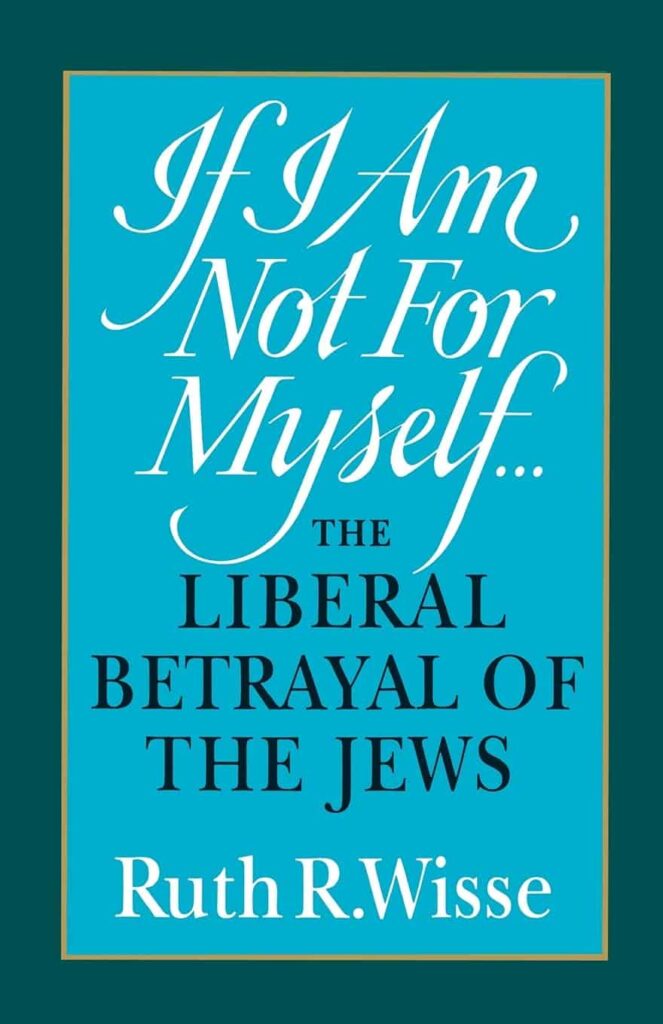
We had considered focusing on one of Dr. Wisse’s other excellent books, Free as a Jew: A Personal Memoir of National Self-Liberation. Anyone familiar with Dr. Wisse’s work understands that her insight, precision of thought, and prescience is evident on every page. But we also felt that her much earlier book If I Am Not for Myself: The Liberal Betrayal of the Jews, presented an opportunity to explore several important themes that have existential significance in a post-October 7 world. The response of elite institutions brought into sharper focus just how out of touch these institutions were and are and, to borrow a phrase, to what extent they had become colonized by the corrosive ideas of Marxist-inspired grievance movements. Columbia University students took over a building on campus and then demanded that the university deliver “humanitarian aid” to the students who were free to leave at any time. And at UCLA, a federal judge had to force the university to guarantee access to all corners of the campus for Jewish students who had been denied it by pro-Hamas protestors. Many campuses experienced similar scenes of moral confusion.
So this month, which marks the first anniversary of the October 7 attacks, we are wading into territory that is inexplicably controversial. Later this month we will be publishing two outstanding essays. One from Prof. Josh Blackmon of the South Texas College of Law discusses legal aspects of the antisemitic protests on college campuses. The other from Dr. Aaron Pomerantz, a social psychologist and post-doctoral researcher at Rice University, explores the psychic injury that a society suffers when it tolerates antisemitism. And we’ll end the month with an interview with Dr. Wisse herself. As this month’s addendum, the last Thursday of October will feature Dr. Drew McGinnis’s review of Rev. Dr. Gerald McDermott’s A New History of Redemption, which builds on the theology of Jonathan Edwards and presents the Christian story of redemption in a way that affirms the Jewishness of Jesus and the essential place of the people of Israel in that story. You can purchas McDermott’s book at the publisher’s website at a discount with the code: CRCD40 at checkout.
But it might be helpful to understand a few of the reasons why If I Am Not for Myself, first published in 1992, is so relevant for our current moment. While there are many reasons, I will limit myself to describing just three.
We Need to Understand Antisemitism to Identify it and Eradicate It
Too many people think of antisemitism as merely a form of bigotry or racism. While it has manifested in similar ways, it is much more than simple racism. Antisemitism is not just focused racial hatred or racial derision. Antisemitism is political and poses an existential threat to the ideas that form the foundational commitments of civilization. The Jews do not and never have defined themselves by reference to race, but rather by shared metaphysical and moral commitments. The Book of Ruth from the Tanakh, commonly known as the Old Testament, records the story of Ruth entering into the covenant community by accepting these metaphysical commitments. When urged to remain in the land of Moab by her mother-in-law Naomi, Ruth insists “…where you go I will go, and where you lodge I will lodge. Your people shall be my people, and your God my God. Where you die I will die, and there I will be buried.” Ruth the Moabite convert eventually becomes the great-grandmother of David, the greatest Israelite king. Antisemites may direct the same hateful rhetoric and strategies toward Jews that racist groups direct at other groups, but something more is lurking behind antisemitism and this book helps to identify what that is.
We Need to Understand Liberalism
Wisse’s work predates Patrick Deneen’s Why Liberalism Failed by nearly 30 years. Since the 2018 publication of Deneen’s work the conversation about western liberalism’s weaknesses have given rise to problematic post-liberal solutions. Western civilization is predicated upon the rationality, freedom, progress, and respect for the rule of law that are inherent in the liberalism that Wisse describes. Authoritarian solutions that attempt to impose order that are found in various alternatives, especially religious ones, will not preserve civilization. Wisse was offering correctives before the rest of the West understood that they were needed.
We Need to Understand the Geopolitical Realities in the Middle East
While much has happened since 1992, we simply cannot arrive at any type of solution to the present violence and unrest in the Middle East if we do not clearly understand the nature of the conflict. Liberalism failed to save the Jews from the Holocaust and is now failing respond to aggression against Israel and the Jews because of a confluence of misunderstandings about what liberalism requires in the face of evil and a clear recounting and understanding of the post-1947 events surrounding the creation of the State of Israel. Wisse’s work is not a work of history that is focused on developing a timeline of Jewish or Israeli history, but she does draw from an interpretation of that history that she very cogently defends.
It is worth noting that the Jewish understanding of the human person recognizes an inherent dignity in each created soul. I know no serious Jew who delights in the deaths of Palestinians in the present conflict. Of course there may be exceptions, but every community has within it those who betray the highest moral ideals that define it. Understanding these things does not merely serve the political ends of the State of Israel or the instinct toward self-preservation of the Jewish people. Finding solutions to these enduring problems is just one more way in which God’s chosen people can prove God’s faithfulness to Abraham: “…in you all the families of the earth shall be blessed.”
So we hope that you will enjoy this month’s engagement with If I Am Not for Myself. We live at a time when there is an urgent need to understand the various political and historical dynamics that Dr. Wisse has spent her life and career considering.
Trey Dimsdale, JD, is executive director of the Center for Religion, Culture & Democracy.