

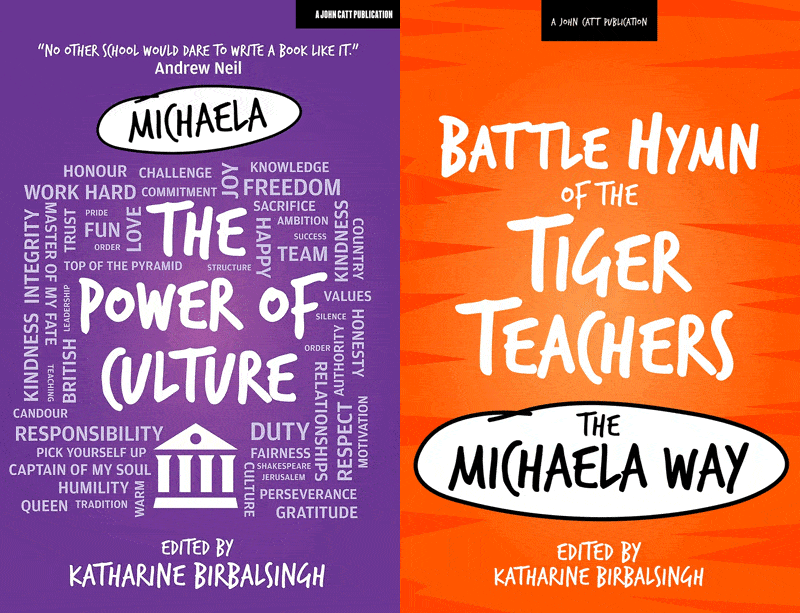
The September edition of the Reading Wheel Review will feature two books. They are both collections of essays—Michaela: The Power of Culture and Battle Hymn of the Tiger Teachers: The Michaela Way. The essays in these books were written by teachers at the remarkable Michaela Community School in Wembley, London, England. Each book was edited by the school’s headmistress, Katharine Birbalsingh. This excerpt, reprinted with permission, is taken from Michaela: The Power of Culture and is written by Mr. Simon Virgo, a Michaela teacher who can be found on X (formerly Twitter) @SimonVirgo.
‘You’re doing what?’ It was a look of incredulity I’d seen many times in the few weeks since I’d made the decision to join Michaela.
‘But Wembley’s miles away! Your commute will be murder!’ I smiled back, thinking of the disastrous journey from my recent interview, which had taken nearly two hours. ‘Let me get this straight,’ he went on. ‘You live a four minute walk from our school. Your kids go to school next door. Your wife teaches next door. You hold your little girl’s hand on the way to school; she can even wave at you through your classroom window. You love this school and you’ve got a great set up here. And you’re going to give all this up for a commute to Wembley?’
I’d had this sort of response so many times that I was fairly well practised in my reply by now.
‘I know! But it’s a pretty incredible school…’, and I’d go on to explain what I’d been reading and hearing about Michaela, and all the various ways I’d been impressed and excited, even inspired as I’d discovered more. It wasn’t the only response of course; congratulations came from those who already knew about Michaela, who’d perhaps read our book The Battle Hymn of the Tiger Teachers, but for those who were less familiar it usually took a while to explain what otherwise looked like a pretty crazy decision.
Of course I’m far from being the only one to make some significant adjustments to become part of the Michaela story. Ask around among the staff and you’ll find people who’ve moved from far and wide to join the school, often having left far more comfortable situations behind to be rewarded with smaller, more expensive accommodation in inner-city London. But there’s a sense among the staff that what you gain in being part of Michaela is well worth the sacrifice.
It’s not necessarily unusual to find a company of people caught up together because of a common passion. But the level of commitment and the sheer absence of cynicism at Michaela makes for what feels like a unique dynamic. I’ve certainly never seen anything quite like it in a school before; teachers giving their absolute heart and soul each day with such devotion. There’s a genuine sense that the teachers feel privileged to be part of it. We recognise the rare jewel we’ve stumbled upon and consider ourselves lucky to play a role in something so deserving of our very best. What’s more, all this was already the case before the school achieved its official stamp of approval from Ofsted, and indeed long before its record-breaking GCSE results started making headlines. These events simply served to confirm to the outside world what everyone inside Michaela already knew: there’s something very special going on here.
As Katharine Birbalsingh often says, you need to come and see it to believe it. A group of teachers who truly feel they’re of one mind, one heart, one cause, and can’t quite believe they get to do something so much fun together.
How does this happen? How can visits to a secondary school end up being life-changingly inspiring? There are some staffrooms where you’ll often find battle-weary souls, bravely enduring their lot, the atmosphere heavy with frustration at the various struggles that burden a teacher’s life. To find an atmosphere of optimism and excitement isn’t necessarily normal. I was in my first year of teaching when I was told that less than a quarter of new teachers make it past their first five years, and I could see why. Teaching is tough. It’s a battle, and sadly in so many places it feels like momentum is against teachers, and heads are down.
I still remember looking in the mirror after one of my first experiences in a classroom in my teacher training year. To this day, it was the worst experience I’ve ever had in a classroom. As a clueless new teacher, I’d innocently stumbled into a lesson with 9S, without the faintest notion as to what made for effective behaviour management, equipped only with a naïve sense that they were bound to respond to my confident delivery. On encountering the fresh-faced, smiling Mr Virgo, the class instantly smelled blood. Within moments my hopes of striking up a positive, respectful rapport with these no doubt lovable characters began to collapse, and by the end of the lesson any sense of control had almost entirely dissolved. Pupils were calling across the room to one another, things were being thrown, and my voice was just one among the din, all but lost in the chaotic waves. At one point a pupil poked my backside.
I remember staggering into the staff toilets afterwards and locking the door behind me, feeling utterly hollow, humiliated, horrified at what had just occurred. I’ll never forget the face that stared back at me from the mirror. It looked like it had just aged about twenty years. Mercifully the lessons all this taught me meant that it never happened again, but one thing stood out from the experience: teaching is about far more than pedagogy. It’s a test of spirit, a test of heart, a test of resolve. And if you don’t fight, you won’t last long.
The question is, how can we fuel the fighting spirit that sustains a teacher’s heart? What can be done to establish a deep well of resolve that endures, and even thrives amidst the pressure? What I’ve observed at Michaela is a measure of courage and wholeheartedness among the teachers which would strengthen schools up and down the country if it could be bottled. But where does it find its root?
A Deeper Desire
Perhaps one of the most important things a leader does is help his or her people find courage. One extraordinary story of a leader doing that in a single moment of genius can be found in an incident that occurred during the French Revolution, in the critical Battle of Toulon. Toulon was a vitally important naval city which the French couldn’t afford to lose, but it had recently fallen to the allied forces determined to quash the Revolution. The revolutionaries were stretched thin, lacking experience and short of leadership. Their hopes of regaining the crucial city were looking slim, and the success of the whole Revolution was hanging in the balance.
Just when defeat looked unavoidable, a twenty-four year old artillery officer named Napoleon Bonaparte arrived on the scene. He could see that the only hope of regaining the port lay in establishing a point from which they could effectively bombard the allied ships. In order to do this, one particularly effective but dangerously exposed gun battery was needed to be constantly manned. The problem, however, was that the battery’s exposed position meant that those who manned the post were all but certain to die doing so, and eventually it reached the stage where men were simply refusing to take the post, recognising it as the suicide mission that it was.
Napoleon knew that the battle had reached a decisive moment, and everything temporarily hung on this crucial point. He walked through the camp, considering what to do, when an idea struck him. He made a sign with a few words on it. He then attached it to the lethal battery position. After this, it never lacked a man, day or night; indeed, men were fighting over the chance to hold the post. The battle was won, and Napoleon’s name was established. The words he’d written stated simply, ‘The battery for men without fear.’
Something greater than the possibility of an immediate victory had been placed before the men. Something more than the threat of a sanction for cowardice, or an immediate reward for compliance. Something deeper had been appealed to and awoken; the prospect of engaging in something requiring wholehearted, full-blooded courage. The men were ultimately thirsty for the opportunity to harness everything they had, and give it their all.
People today are still looking for that kind of invitation: an invitation to give everything you have to something worth fighting for.
Being part of Michaela feels a bit like that.
Michaela’s secret isn’t just about its methods, even though these are given so much thought and are implemented so consistently. It isn’t in how intelligent the faculty are or how responsive the pupils are, and it certainly isn’t to do with the facilities, finances or resources. The fact is that the teachers feel part of something bigger, and have become persuaded of something much deeper, something that cannot be seen but cannot go unnoticed, at least not for long.
It is possible to miss it at first, and to simply be taken in by the immediately striking features; the silence in the corridors, the energy in the classrooms, the rigour, the standards, the politeness of the pupils, the uniqueness of family lunch, and dozens of other things. It’s possible to come in to Michaela, observe some of these aspects, and be fooled into thinking that the genius lies in the systems alone, and that if a few of these tools were applied elsewhere, transformation would inevitably occur. While it’s doubtless true that some of the systems and approaches are transferable (indeed many were imported from other schools in the first place), the danger of only incorporating certain individual aspects could be analogous to having an otherwise healthy body and hoping for life while lacking the beating heart.
It’s natural for people to want to locate a secret ingredient and effortlessly slip it into the mix, without the need for any fundamental re-wiring of principles or the examining of foundational assumptions. And since so many of the features of Michaela’s approach are so unusual, it’s a pretty straightforward process to identify and adopt specific, noticeable practices, which may indeed lead to a measure of improvement. But these various individual practices aren’t ultimately what makes Michaela unique. On their own they don’t explain its success, and they certainly aren’t the reason the staff are so united and wholehearted. No-one leaps out of bed in the morning simply to walk down a silent corridor, or to deliver a Turn To Your Partner routine. Every detail is important, many are indispensable – but none fully represents the essence. They aren’t the engine. They aren’t the heart.
The heart is found beneath all that immediately impresses about Michaela, where a company of people are united in a fight for something bigger than delivering great lessons, managing behaviour effectively and producing excellent GCSE results. It’s found in the convictions of a group of people who believe they’re making a difference in a day when a difference is sorely needed.
The Battle for our Culture
In the closing moments of the second Lord of the Rings film, The Two Towers, the fate of all Middle Earth hangs on a knife edge. Battles surge on every front, as the forces for good and evil class in an epic conflict. In the midst of all the chaos, everything depends on the fate of one character, a hobbit called Frodo Baggins. Frodo carries the Ring of Power – the mysterious embodiment of evil which must be destroyed for hope to prevail, only now hope has all but abandoned him. Desperate, despairing, and now captured, he and his loyal companion Samwise have nearly given up.
‘I can’t do this, Sam’, he whispers, as he labours under the weight of the seeming inevitability of defeat.
‘I know, it’s all wrong’, Sam replies. ‘By rights we shouldn’t even be here. But we are.’
Samwise stands and surveys the scene. Before him lies the desolate wreckage of a previously great city, now ravaged by war, a few noble ruins left standing among the rubble.
‘It’s like in the great stories, Mr. Frodo. The ones that really mattered. Full of darkness and danger, they were. And sometimes you didn’t want to know the end. Because how could the end be happy? How could the world go back to the way it was when so much bad had happened? Those were the stories that stayed with you; that meant something. Even if you were too small to understand why. But I think, Mr. Frodo, I do understand. I know now. Folk in those stories had a lot of chances of turning back … Only they didn’t. They kept going. Because they were holding on to something.’
Frodo, still sitting, disconsolate, dejected, quietly offers back, ‘What are we holding on to, Sam?’
Sam reaches down and pulls Frodo up onto his feet, and looks him in the eye. ‘That there’s some good in this world, Mr. Frodo. And it’s worth fighting for.’
While standing in front of a classroom may not seem much like battling for the future of a civilisation, the truth is that a battle is indeed underway, and what happens in our classrooms has a much greater significance than we may immediately recognise. For, if the culture of our school affects the character of our pupils, and the character of our pupils then eventually shapes the culture of our society, undoubtedly what we teach our pupils does make a genuine difference to the world around us.
And that’s why it’s worth being careful about the beliefs that shape the culture of our schools. It’s also why some of the beliefs which are increasingly common in our schools and in our society should be causing us much more concern than they are, as many of them are based more on sentiment than substance, and so provide a very flimsy base to build from. In so many ways, at Michaela it’s our convictions that have given us strength, and it’s the recognition that beliefs matter that makes us more suspicious of some of the beliefs which have gained broad approval in education. We’re actually finding that some of the old beliefs, which many have come to dismiss, are providing us with a far better bedrock to build from.
A classic example is to consider the influence of the French philosopher Jean-Jacques Rousseau, whose ideas still permeate many of the assumptions undergirding modern education. Rousseau espoused the notion that children are inherently good, and essentially just need space and freedom, not instruction and authority, in order to flourish and develop into their full, naturally good selves. What many fail to realise is that Rousseau had his own children (some of whom he never even bothered naming) sent to an orphanage where their chances of survival were shockingly low. Had he put more of an effort into being a responsible father, he may have noticed that his notions of children’s innate goodness were rather optimistic and didn’t necessarily stack up with the evidence. Any parent will testify that children don’t need to be taught to misbehave; it seems to come quite naturally. To help curb this tendency requires intervention, not abdication, and so reverting to maintaining order, structure and clear boundaries – ideas tried and tested for thousands of years – actually proves to make much more sense.
The Heart of Michaela
Perhaps the most profound way in which Michaela provides a contrast with much of the broader scene is echoed in our slogan. ‘Knowledge is power’. It seems almost bizarre that anyone involved in education could downplay the value of knowledge, and yet this is the battle the team at Michaela has had to fight since its inception. Critics of Michaela’s methods and approach have opposed this emphasis from the outset, preferring the acquisition of skills and the fostering of supposed creativity, both of which we have found are cultivated more fruitfully once basic knowledge is in place.
But ultimately it’s not only knowledge that gives power; it’s true convictions. That’s why what makes Michaela so unique is about more than methodology; its originality finds its root in something deeper. It’s who we are, not just what we do. It’s the ‘why’ underneath all the attractive ‘hows’. It’s the foundation of key beliefs that gives our practices something solid to stand on. That may stand out in a day when it’s not fashionable to hold to such convictions. But that’s who we dare to be. We are people not only united in what we’re against, but what we’re for.
So let me finish by stating simply some of the beliefs we’re prepared to own. These are some of the convictions holding us together, and I pray they’ll keep us steady, and prove a foundation for many years, not only for us but for many others. Maybe you.
We believe that beliefs are important.
We believe that truth exists.
We believe knowledge matters.
We believe that teachers should teach and pupils should learn.
We believe authority isn’t a dirty word.
We believe in the value of discipline.
We believe pupils should respect their teachers.
We believe teachers should love their pupils.
We believe loving pupils involves holding them to high standards.
We believe in the family.
We believe in personal responsibility.
We believe in tough love.
We believe in gratitude rather than entitlement.
We believe it’s good for children to love their country.
We believe being a good teacher takes courage.
We believe education profoundly affects society.
We believe in the possibility of change.
We believe in hope.
And we believe it’s worth fighting for.