
“A weed is a flower growing in the wrong place.”
–George Washington Carver
Over the past four years our small front lawn has become invaded by Glechoma hederacea, ground ivy described as “an aromatic, perennial, evergreen creeper in the mint family,” known in some places as “creeping Charlie.” One sees and smells it in early spring, and it’s not unpleasant; on some lawns, it is deliberately cultivated. But not ours—here it is an invasive species that aggressively chokes out our preferred sun/shade mix. In the first two years of the invasion, my approach was a combination of ignoring it and wishing it away. Last year panic set in and my internet-informed expertise suggested restarting from scratch, killing the entire lawn with burns, tarp covers, or pesticides. That all seemed too hard, so I remained frozen. This fourth year, we finally did something smart—asked a reputable lawn care firm that shared our minimal-pesticide values to intervene. Its prescription was to “encourage the good to crowd out the bad”—to fertilize, water, and overseed our desired grasses, while discouraging the ground ivy in various ways. It seems to be working, and in two years a respectable above-subdivision-average plot of grass should return.
The study of Christian nationalism seems to be on a similar arc: alarmed notice, freezing, panic, and now more systematic analysis. Perhaps treatment where it is unwanted is on the way. Not long ago there was calm description of conservative religious groups, prosaically viewing them as exercising normal pressure activity, mostly within the GOP. Sure, it was a narrow policy platform, but it was described quite like the “amateur Democrats” James Q. Wilson described in the early 1960s who were bringing their own “purity” to that party—demands for specific policy goals, shared party management, enforcement of views on candidates. Fixed policy demands became a feature of both parties—“amateur Republicans” mirroring the Democrats.
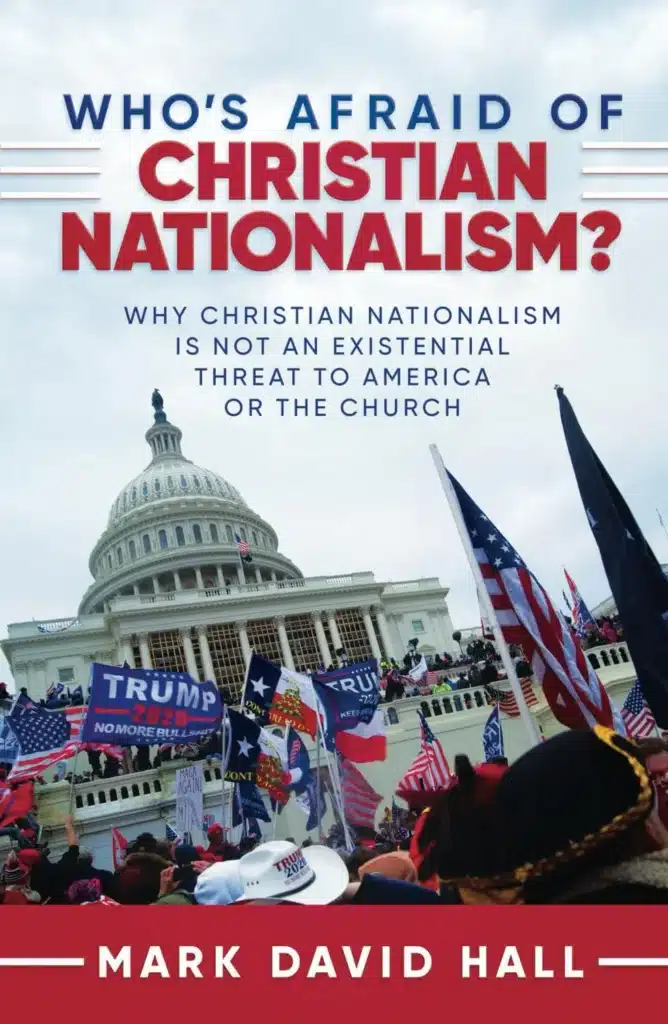
In the last few decades, as the Republican Party grew its proportion of Christian amateurs, concerns in the literature escalated, soon bordering on panic. Alarmism about a murky “Christian nationalism” informs much of the present discussion. Now, new books better grounded in concepts, measurements, and data, and more balanced in their assessments, are helping the diagnosis, perhaps on the way to treatment. Mark David Hall’s Who’s Afraid of Christian Nationalism? is the best so far in the emerging “post-panic” wave of more sober analysis. Its claim that Christian nationalism is not an existential threat to the entire nation or American church is almost certainly correct as a broad generalization. But Who’s Afraid? overlooks some practicalities of politics and details of denominational traditions. It downplays concerns about Christian nationalism, even as it opposes the dangerous, non-pluralistic and politicized version, found only in hidden away places. Some reviewers have misread the less alarming tone as indifference to or even endorsement of Christian nationalism, which the book is not. My concern with Who’s Afraid? is that it tends to overlook the patches of America in which a dangerous type of Christian-claiming nationalism has taken or threatens to take over local politics, through taking over local large churches or several congregations of a dominant local denomination.
One important distinction is between nationalism and patriotism. Here, C.S. Lewis in “The Four Loves” suggests a helpful taxonomy in a short 60-year-old passage on his own Great Britain. There are four toxic types in these few pages (which are worth a read). Lewis’ first and only “good” love of nation is “love of home.” This is the love of the place where one grew up and other places near it or like it. It is not love of the whole nation, but of the small locale—parts of Wales, Scotland, and Ulster are Lewis’ examples. The healthy attitude toward the whole nation is not hubris but gratitude because it allows and nurtures local particularities. Lewis presents a geographically based pluralism, as it were, which can include religious particularity (a minority thesis of the American founding, a third option among the more common “enlightenment” versus “virtuous republic” camps). Although Who’s Afraid does not mention this Lewis passage when it discusses what nationalism is and is not, it seems to have this localistic pluralism in mind—that people with troubling ideas are out in obscure places, defending local cultures, leading locally dominant congregations. Sometimes these advocates get carried away in their universalizing language, but not to worry. Perhaps.
The meatier question is the meaning of Christian in Christian nationalism. Here, Who’s Afraid? is very helpful, particularly when it is read with Neighborly Faith’s Christian Nationalism: A New Approach (2023). It first summarizes the past few decades of public scholarship on politically active conservative Christians, asserting that the scares raised each election cycle are mostly contrived. Then, in the third chapter, methods of authors such as Andrew Whitehead and Samuel Perry are critiqued—the political science home turf of the author showing in his demonstrations that key terms are poorly conceptualized and operationalized, and just where unadmitted biases, unjustified assumptions, weakly supported generalizations all skew toward alarmism. Chapter four focuses on the very few self-proclaimed Christian nationalists. Who’s Afraid? dismisses their reach—their followers are little more than “a handful of idiosyncratic, patriarchal Calvinists” unable to influence much outside their isolated communities. In the fifth chapter Who’s Afraid? offers a less sweeping definition of Christian nationalism, a version the book opposes. Its small but undesirable type has two key elements; the first is a view that the nation was founded as a Christian nation as Christianity is defined by twenty-first-century evangelicals and not as it existed at the founding. The second element is that this bad-history Christianity wants its version to be protected, promoted, and preferred by government at most levels. Who’s Afraid? opposes the imposition of this modern, non-pluralistic Christian nationalism. But it’s not worried much, suggesting only 20 percent of Americans can reasonably be described as such. Even then, living in communities governed by these rules might not be that awful, the book suggests. For generations Christianity was socially and culturally privileged in America while other faiths merely tolerated; Who’s Afraid? surmises reinstating Christian privilege would be more of the 1950s American variety than the 1550s European sort.
Two other data-rich sources complement the caution in Who’s Afraid?. Neighborly Faith’s summer 2023 survey estimates that 30 percent of Americans are open to ideas associated with Christian nationalism. Eighty-four percent of its survey respondents fell into five categories: Zealous Separationists (17%) strongly oppose commingling church and state; Pluralistic Believers (19%) are religious but oppose government endorsement of Christianity; Spectators (18%) are traditional Christians but politically inactive. The groups “open” to Christian nationalism are lukewarm Sympathizers (19%) and hardcore Adherents (11%). Adherents are the more politically engaged of the two groups, wanting to privilege Christianity in law and policy. Sympathizers are not, but in the right circumstances could be activated. Second, a Pew Research study of 2022 deserves mention, particularly regarding how respondents think (actually, rarely think) about Christian nationalism. Pew found 54 percent of Americans had never heard of the phrase. In another set of questions, just under half (45 percent) expressed the view that the United States should be a Christian nation, split about evenly between believing faith should have “a great deal” of influence or only “some.” Most helpful was an open-ended question allowing respondents to offer their own definitions of a Christian nation. Of the 45 percent in favor, only 6 percent said it meant “Christian-based laws/governance” (opponents of a Christian nation defined it in this narrow way more often, which says little about the reality of the threat). Doing the math, Pew suggests that the most dangerous type of Christian nationalism, imposing Christian-based laws on all, is held by around 3 percent of all Americans, those who define it as such, and think that is a good idea for all.
As a “centrist” Christian and political scientist, I have my own biases which influence my read of the work cited here. The well-done review in Who’s Afraid?, corroborated by Neighborly Faith and Pew, suggests non-pluralistic politically active Christian nationalism may be held by as low as 3 percent, or as many as 20 percent, of Americans, quite likely in the higher part of that range. It is possible another slice about the same size could be activated if convinced of a crisis. It seems sensible with the main claim of Who’s Afraid?, referenced in the book’s extended title, that Christian nationalism is “not an existential threat to the nation or the Christian church.”
At least nationwide. But ideas exist in persons, and persons live in particular places, participate in particular political organizations, and attend particular churches, mostly with the like-minded. We know some things about relevant particulars: Christian nationalists in percentage terms live far more often in rural areas and small towns and political party engagement is almost exclusively Republican at precinct and county level. These geographic and partisan concentrations are clear. There are also hints about faith-tradition concentrations, and this is where my Reformed faith and Dutch roots raise my concerns. The New Apostolic Reformation (NAR) movement, from the Pentecostal tradition, is at the center of much dangerous Christian nationalism. Whereas its elevation of spiritual signs and warfare above biblical texts and confessional commitments places it far from Calvinism, it is not completely separate. Who’s Afraid? doesn’t worry much about the potential of NAR and minimizes the influence of peculiar Calvinists like Rushdoony. The Seven Mountain Mandate, however, is a grotesque distortion of sphere sovereignty, but a connected distortion nonetheless. And some Christian nationalists are Calvinist-claiming, even as their ambitions seem localized and unlikely. If this small stream and minimal borrowing of Calvinist concepts were the only thing at issue, I would be as unworried as Who’s Afraid?.
But consider this 1890s assessment of American Christianity by the Dutch Calvinist Herman Bavinck after a visit to the States. Bavinck suggested that Calvinism, emerging as it did from Kuyper’s kleine luyden (“little people”) of culturally and economically marginalized people, would not do well in the United States. Bavinck saw American Christianity of the time as too easy and too pervasive—it was dominated by “Arminians and Methodists” who were too optimistic, accepted, and even rewarded in every place of culture and class. Among American Christians “there is belief, hope, a miraculous optimism, a strong altruism.” As Bavinck also puts it, “Everyone believes it will be different and it can be better, that every man can have a more or less good life on earth.” Bavinck did not care much for the mediocre and superficial character of both American culture and its dominant strains of Protestantism. He saw that Dutch Calvinism, developed among the disrespected and brashly offering an alternative vision of a grand Christian society for themselves, had little appeal in an America of easy Christianity. Despite these criticisms, Bavinck continued in a more appreciative tone: “I think we do better to incorporate and imitate the good things, than to condemn it all…. Let American Christianity develop according to its own law. God has entrusted America with a high and great calling. Let it pursue that in its own way. After all, Calvinism is not the only truth.”
Perhaps today’s American Christians are more anxious about their social status than late nineteenth-century American Christians, and more like those of that time in the Netherlands. Certainly, condescension toward (the mainstream’s definition of) Christianity is common. So, although direct distortions by Christian nationalists are likely limited by Calvinism’s creedal and scriptural foundations, the social roots of neo-Calvinism and today’s sense of alienation and even victimhood by many American Christians today are similar. This suggests that looking within historically Calvinist communities for some version of dangerous Christian nationalism makes some sense. I’m most familiar with the traditional Dutch immigrant archipelago in the Midwest, and somewhat in the East, and can see things to worry about in my western Michigan, and other “islands” of the chain such as northwest Iowa. I doubt they’re deeply rooted, and in fact there already is some evidence of being beaten back even while they are still a long way from being fully rolled back. But the patches of concern are there.
Much like beating back unwelcome ground ivy, reducing the dangerous versions of Christian nationalism for which my traditions have some responsibility requires the same mix of encouraging the good to crowd out the bad. Repeating a commitment to confessional pluralism and endorsing political action while emphasizing its fundamentally flawed, halting, and pragmatic nature seems the way to go.
I am not afraid that the dangerous versions of Christian nationalism are about to take over the nation, or even my narrow faith tradition. I’m also unwilling to rage in panic against a scattered few who want to structure local affairs more traditionally. But I am more concerned than Who’s Afraid? about its presence in communities with which I have some connection.
Douglas L. Koopman, Ph.D., is a professor of political science (emeritus) at Calvin University and senior research fellow at the Henry Institute for the Study of Christianity and Politics.