

The United States has not had a favorable history of persons of African descent. After the country’s founding, chattel slavery became ingrained in the bowels of its existence for over a century. Releasing its grip on this system would be slow and painful due to culturally accepted views that the black person could not enjoy the same privileges as white citizens. Even the short-lived era of post-emancipationReconstruction would be seized by prevailing views of racial hierarchy that provoked action against advancement followed by decades of denial of citizenship privileges through Jim Crow and overt discriminatory practices. The Civil Rights Movement would pave the way for access and opportunity for black citizens as well as changed attitudes. But this would not come easily as confrontation of cultural norms would expose racial hostilities and beliefs that black Americans were undeserving of the same privileges afforded to white citizens.
To leave history here would do a disservice to the legacy of black Americans. Despite the barriers erected to bar fully realized citizenship, there is another side to this unfortunate history. Through every era of oppressive action, there have arisen victories born by the simple belief that every person matters. Particularly within a context that rests on the principles that all men are created equal and that life, liberty, and the pursuit of happiness is not only a worthy goal but an expected one. There was a yearning to move past the barriers and to prove one’s dignity and worth, both individually and collectively as black citizens. Thus, this country’s history has seen a long string of “firsts,” those who would break barriers not just for themselves but pave the way for future generations and change the social, economic and political landscape. This has resulted in changed attitudes, new opportunities, and a path to equal footing for black Americans.
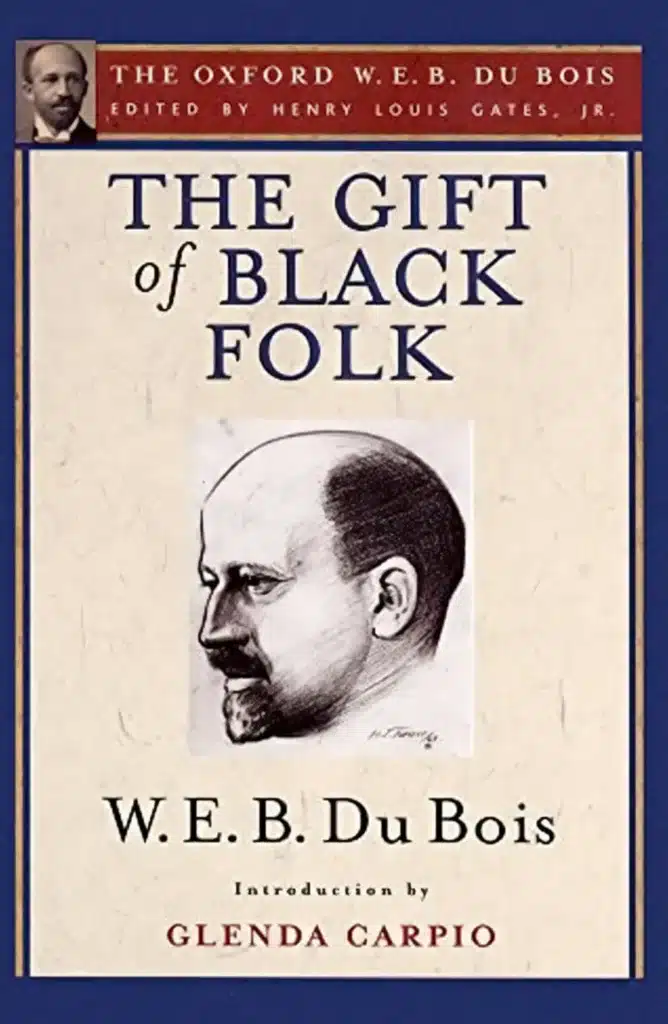
W. E .B. Du Bois’ The Gift of Black Folk reminds us of this side of history. He does not skirt past the ugly scenarios of American history as if it had no bearing on achievements. He does something better: he shows that the contexts themselves provoked an inner impulse to utilize one’s skill, gifts, and intellect for the betterment of mankind. Ensconced in the book’s title, the thrust of The Gift of Black Folk points out that the existence, perseverance, and contributions of black Americans have been a gift to American society. It is not surprising that Du Bois writes alongside his contemporary, Carter G. Woodson, who established the origins of Black History Month, a time dedicated to recognizing the accomplishments of African Americans particularly in an era where such advancements were still suppressed.
But I fear this side of history is getting lost in the present-day discourse regarding black achievement in the United States. With the advent of Black Lives Matter and the 1619 Project, media exposed police shootings, and perpetual chants of prevailing racism, there has been an increasing focus on the lack of achievements in black America as if this country has made no progress in racial equality. Narratives of oppression override the story of advancement. History has reverted from being an educator of America’s path to a tool that bludgeons any contradictions of this narrative. Even the annual celebration of Black History Month has been peppered with the negative side of history rather than what it was intended for.
Du Bois’ work shows that such a focus is not good for society. Yes, we can and should be honest about the country’s history to unravel any repeated patterns. We should be concerned with injustices where they exist. But we do a disservice to both black Americans and society by allowing the noose of history to strangle out what has been accomplished. Moreover, there are more foundational reasons this approach is not beneficial: it robs humanity of the dignity that serves as the basis for its own flourishing.
A Theological Basis
The premise for this argument rests on the Christian framework of creation, specifically the constitution of man and what he was created to do. That man was created in the image of God (Gen. 1:26-27) means that there is something unique about humans that reflects God’s glory and nature. Throughout centuries of the Christian church theologians have provided much commentary on what “image of God” means. For the sake of brevity, the consensus has been that man possesses cognitive ability unlike any other living creature. He was made to be able to think and act in accordance with God’s purposes here on earth. There are also relational qualities of human to God and human to human.
But these qualities have a purpose related to God’s intention for creation found in Gen. 1:28. Man and woman working together are to “be fruitful and multiply and fill the earth and subdue it.” To relegate this mandate to merely procreation of offspring or to agrarian concerns would miss the intention of what this means for the world God created. Humans are meant to make something of their contexts and bring about a fruitfulness that is reflective of God’s grand design for his world that he has given his creatures stewardship over. They are to use whatever rational and relational abilities to produce an environment that provokes flourishing. Some believe that the introduction of sin into the world due to man’s disobedience has canceled this cultural mandate. I do not hold that position. Yes, the annals of history and observance of our present-day point to disruption and distortions. The history of black Americans alone proves this point.
But it is my conviction that the mandate remains and one that permeates our being. Its essence explains why, despite extended oppression and obstacles, there has been a forging ahead by a sizable portion of the black population in America. It explains the thrust to accomplish, break barriers, and override the oppression of the past.
Moreover, this mandate will be optimized when humans have the freedom to cultivate their contexts and make something of their world. The quest for freedom is inextricably linked to the quest for dignity, which is the thrust of what it means to be made in the image of God. Du Bois repeatedly makes this latter point throughout the book: to thrive, one must have access and opportunity for accomplishments. He notes that it was the Negro himself pushed to have the freedom, even during slavery:
It was the rise and growth among the slaves of a determination to be free and to be an active part of American democracy that forced American democracy continually to look into the depths; that held the faces of American thought to the inescapable fact that as long as there was a slave in America, America could not be a free republic; and more than that: as long as there were people in America, slave or free, who could not participate in government and industry and society as free, intelligent human beings, our democracy had failed of its greatest mission.
Indeed, Du Bois would go on to note this quest for freedom would continue post-emancipation to have access to the rights and privileges of citizenship—to have a voice in the political sphere, to have property rights and access to education and particularly economic opportunities:
The action of the American Negro forced the nation into many of these contradictions, and the motives of the Negro were primarily economic. He was trying to achieve economic emancipation. And it is this fact that makes Reconstruction one of the greatest attempts to spread democracy, which the modern world has seen.
It is safe to say that Du Bois did not have a Christian-based creation thesis in mind when explaining how the tenacity and contributions of black Americans made a difference in terms of society’s improvements. Nor do I think he would relate this quest for dignity to Christian doctrine, especially considering the incongruity in its application toward black Americans. In fact, his chapter on the Gift of the Spirit portrays a subtle animosity to the Christian religion even where he acknowledges its fruits. Yet his storytelling throughout The Gift of Black Folk harkens back to the very foundational principles found in Scripture.
Some Specifics from Du Bois
While Du Bois is quite candid about the myriad ways in which this freedom is inhibited and disabled, he looks for its availability where it is found and expounds on notable achievements. What strikes me about this is that he penned The Gift of Black Folk in 1924, a few decades into disabling actions that ended Reconstruction-era progress fueled by a cultural ethos that had little place for recognizing the equality and dignity of black citizens. This was the height of Jim Crow and the pinnacle of Klan activity. Yet, he notes where black people have moved ahead.
His chapter on black labor stood out to me. He could have just told the story about forced labor through enslavement and how slaves were held captive to their masters’ bidding. He does that but takes it a step further—showing how even within limited opportunity and mobility, the enslaved would typically avail themselves to improve their circumstances. Moreover, this labor was a gift to American society:
The Negro still is the mightiest group of labor force in the United States. As this labor grows more intelligent, self-conscious and efficient, it will turn to higher and higher grades of work and it will reinforce the workingman’s point of view.
This is the quest for dignity. He would go on to expound on contributions of inventions, art, and literature that would make American society a better place.
I particularly appreciated the development of educational institutions during the Reconstruction era that spawned a long-standing commitment to access to education even after Reconstruction ended. Indeed, education has long served as a conduit for access among black Americans particularly where restrictions existed. In my own family that hails from Chicago, I recall my grandmother, her sisters, and peers, many of whom were educators themselves, stressing the significance of education for black citizens to gain one’s foot in the world. I heard stories of overt discrimination and limited opportunities for those making their professional life in ‘40s, ‘50s, and ‘60s Chicago. But I also saw black citizens make the most of opportunities and carve a path for themselves that led them past the barriers once erected. This is the legacy of black Americans.
Some Thoughts for Today
I do not want to give the impression that simply noting achievements is sufficient for addressing the concerns of black citizens. Nor would I suggest that all is right with the world sixty years after the Civil Rights Movement. Despite much progress, racist attitudes still exist in pockets of America that would be perfectly content to have society the way it was back in Du Bois’ time.
But I would hope the way Du Bois tells this history encourages us to embrace accomplishments not only from the achievements of America’s black citizens, but also the impact that these gifts have had on society. Yes, we must know the history of this country. Black history is American history. We do no one any favor by skirting its wretched telling. But we also do a disservice when progress is overlooked by focusing on a time past with short-sightedness as if no progress has been made. We should not stifle that quest for dignity with philosophies or policies that undermine freedom to thrive, regardless of race. For when we do, we rob society of the Christian basis for thriving and the need to point back to the Creator.
Lisa Spencer (ThM, Dallas Theological Seminary) is a member of Christ the King Presbyterian Church in Roanoke, VA and serves as Executive Director of Local Colors, a nonprofit organization that celebrates ethnic and cultural heritages from around the globe. She is married to Evan and has two adult children, Priya and Christopher.