

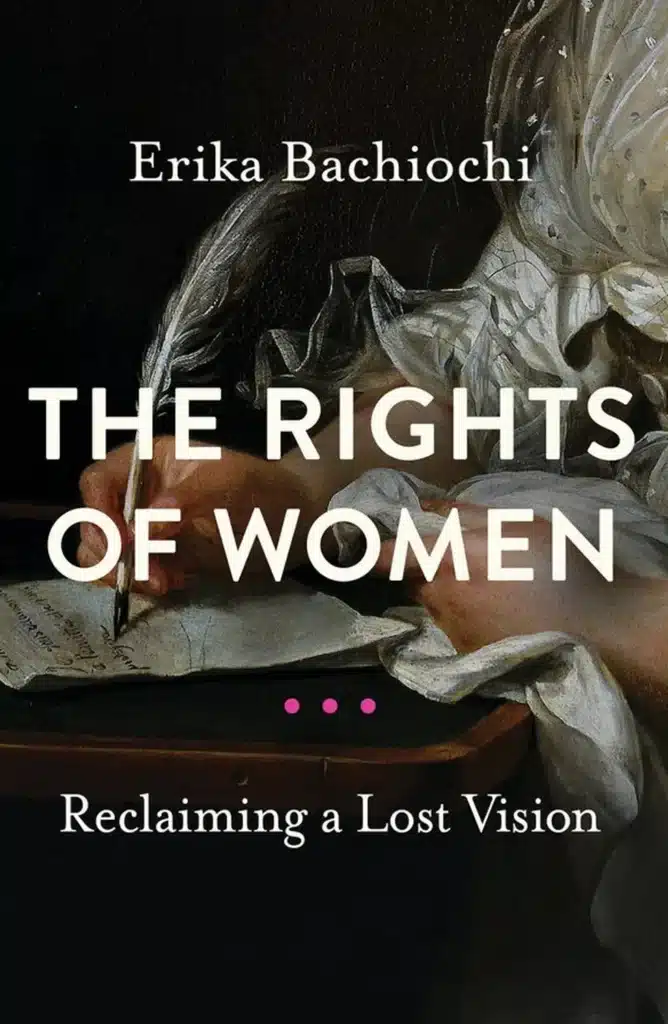
It is well worth reflecting on the various reactions to Erika Bachiochi’s important book. In 2023, I reviewed The Rights of Women for Modern Age, observing that it was a bracing corrective to the contemporary feminist story that the right to abortion is the centerpiece of women’s flourishing. Other reviewers, however, perceived the book as “blaming men” or amazingly, given what Bachiochi actually wrote, as an inadequate portrayal of the different familial roles that men and women play in marriage and childrearing.
These reactions highlight several oddities of our moment. First, they show that a deeply researched book that largely extols tradition can itself be seen as an attack on tradition. Second, they exhibit what I take to be a reactionary impulse on the part of certain conservatives. Such critics imply, and sometimes say outright, that the legal and economic equality of women is a threat to men and to the traditional family. In short, women’s legal equality is a problem; therefore, antidiscrimination law should be rolled back. Third, the more radical and provocative critics of women’s success do not even make arguments at all. They prefer to use memes and disparagement, deploying terms like “gynocracy” and “longhouse.” Sometimes they even write anonymously, which doesn’t seem very manly.
One of Bachiochi’s central arguments is that “men” and “women” are roughly equal in terms of insight, intelligence, and general potential. This does not mean that any particular woman is necessarily the equal of any particular man, or vice versa. It also does not mean that there are no differences between the sexes in terms of interests, tendencies, and aptitudes. Empirical data show that men are more likely to be geniuses and that women incline more toward the caring professions. But this rough equality between groups certainly yields the answer “yes” to Dorothy Sayers’ famous question of whether women are human.
Bachiochi also observes and approves of the fact that men and women have different roles in family life. Unlike progressive feminists who argue for a strict 50/50 division of labor (as if this were even possible), Bachiochi points out that women are especially vulnerable at certain points in their lives. Obviously they need care and help during pregnancy, especially in its later stages. But they also need assistance after giving birth and during the first years of a child’s life, when a mother is her child’s primary caregiver. Even after the baby and toddler years, most mothers still desire deep investment in their children’s lives and may take on significantly more than a strict fifty percent of a child’s care. All of this means that women may opt out of intense participation in the workforce, at least for a time. This opting out accounts for some of the differences in women’s and men’s pay over the course of a lifetime.
There is an important third component of Bachiochi’s argument, which has proven surprisingly controversial, especially among conservative men. It is that men ought to invest fully in their families just as women do, and that they should remain chaste prior to marriage and faithful within it. One of Bachiochi’s primary sources is Mary Wollstonecraft, who wrote that the “want of male chastity” is “the grand source of many of the physical and moral evils that torment mankind.” For Wollstonecraft, this sentiment resulted from painful experience. She herself had entered into several questionable relationships; but she had also been badly treated by men who had not remained faithful to her.
When Wollstonecraft looked out at the world, she saw a double standard: men were free to live public lives and to engage in sexual adventures with few consequences. Women, on the other hand, were encouraged only to make themselves attractive adornments and playthings for those men, not to develop their intellects or moral capacities. Also, if pregnancy should occur, women were frequently left to bear and raise the child alone. In the same vein, once married, wives were expected to shoulder almost all the household duties, while husbands remained free to engage in dalliances and in rich, interesting lives outside the home.
Mainstream contemporary feminism has interpreted Wollstonecraft’s diagnosis in a certain way, which neither Bachiochi nor I would approve. Starting from the sexual asymmetries I have described, contemporary feminists assert that the desired goal is engagement in this male pattern of behavior. To wit: if men can engage in cost-free sex and pursue ambitious careers, then women should do exactly the same things in exactly the same way. The right to abortion is the ultimate stopgap measure for ensuring this equality.
Bachiochi argues, in contrast, that society should recognize and accept the sexual asymmetries between men and women. These asymmetries require men and women to work together toward a shared good, which is companionate marriage and a rich, intentional family life. The difficulty in our age lies in seeing that the rough moral and intellectual equality between men and women does not, and cannot, translate into absolute physical and sexual equality. As long as people form families and have children, women will shoulder a greater burden at the beginning of a child’s life.
So much for the argument of the book, although there is much more contained within its pages. Let me conclude by highlighting a few of the strangest responses to it. Writing in First Things, Matthew Schmitz asserts that Bachiochi “vindicates” women only “by incriminating men” and accuses her of describing men “realistically” so that she can treat women “sentimentally.” Drawing on Coventry Patmore’s poem, “The Angel in the House,” Schmitz claims that Bachiochi sees women as morally pure and unstained by original sin. In an even more critical vein, he implies Bachiochi portrays women as “victims.”
There is only one problem with this interpretation: it is false to the text of the book itself. Nowhere does Bachiochi claim that women are free of fault; indeed, she thinks that women and men alike are subject to original sin. But their temptations are not exactly the same. Women are prone to superficiality, vanity, and moral vacuity; men are more likely to yield to sexual temptations. So far from being “perfect,” women are quite likely to fail at acquiring the very moral seriousness that would benefit them and their children. And instead of portraying women as mere “victims” of men, Bachiochi repeatedly stresses as her ideal the moral equality of men and women in “companionate marriage.” I have looked hard to find the man-bashing that Schmitz reads into this book; it simply isn’t there.
Other critics of the book and of Bachiochi’s project in general have argued that the very fact of women’s equality, and its support in antidiscrimination law, is the real problem. What our society needs is not for women to develop their talents and aptitudes, but to re-adopt the sex roles that governed them throughout most of the twentieth century. “America’s historic sexual constitution,” writes Scott Yenor, “shaped men to be community leaders, responsible providers, and husbands, and encouraged women to prioritize homemaking and motherhood.” In contrast, civil rights law from the 1970s on has “criminalized” the old sexual constitution because it has mandated equal opportunities for men and women. On his telling, employers should be free to pay men (though not women) a “family wage.”
Critics like Yenor are certainly right that there are differences between men and women, and that women desire to care for their children. But this is precisely what Bachiochi also sees. What Bachiochi understands in addition is that although many (most?) women desire motherhood, those same women also desire to be full human beings in their own right: musicians, writers, academics, attorneys, artists, chefs. It is not that women aim merely at some kind of mid-level schoolmarmish careerism, as Yenor asserts; women want to actualize their human potential. In this respect, they really are no different from men.
I have always had the sense that moderate, thoughtful arguments are never given the honor they deserve. Such arguments seem unsatisfactory to opponents at the extremes. Thus progressive feminists will find Bachiochi’s book insufficiently radical; right-wing reactionaries will dislike it for being insufficiently conservative. All of this points to the fact that Bachiochi is onto something quite important. Luckily for the rest of us, Bachiochi lives out the companionate marriage she advocates as a mother to seven children. At the same time, she is actualizing her intellect and talents at the highest level. It would be a loss to everyone if she, and all women, were not free to do so.
Elizabeth Corey (Ph.D., Louisiana State University) is an associate professor of Political Science at Baylor University, in Waco, Texas, where she also serves as director of the Honors Program.