

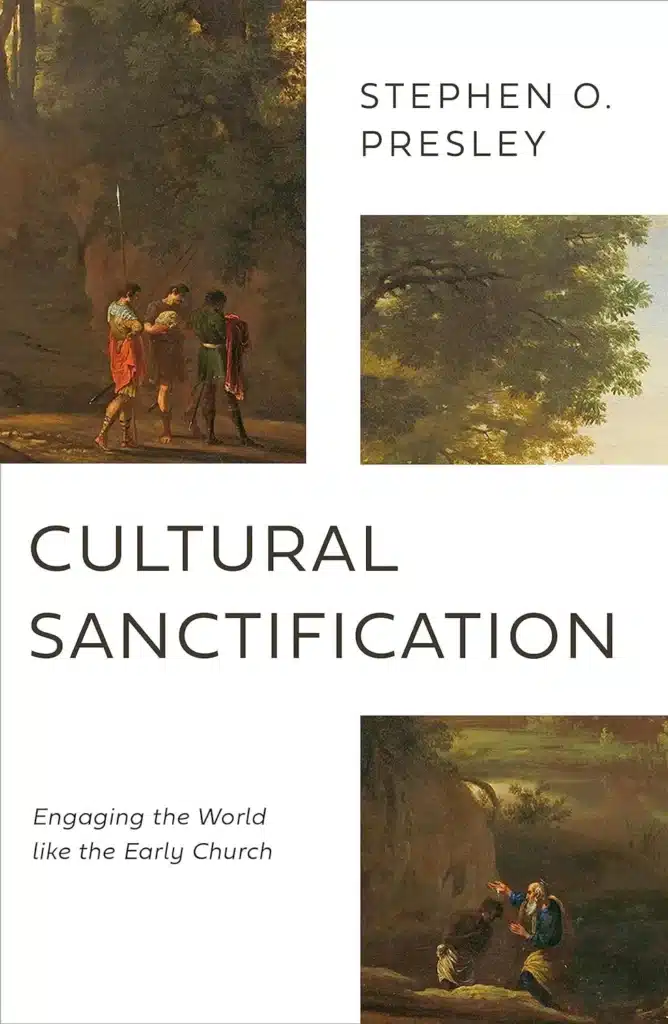
In his famous work, The Idea of a Christian Society, T.S. Eliot characterizes the secular turn of the 20th century as a version of “modern paganism.” Many others have pick up this thesis and made similar comparisons. In my new book, Cultural Sanctification: Engaging the World like the early church, I explain how the early church engaged their pagan neighbors. The excerpt is taken from a chapter that describes one of the more important features: the intellectual response. The early church did not shy away from serious philosophical and theological debate. Instead, drawing upon their classic education, they defended the faith once delivered to the saints. This did not always happen in traditional forms, so the early church had to work “organically” to make their case. I think there are some key lessons we can learn from the early church as we work among the changing intellectual landscape of the modern world.
The early church was hardly the cosmopolitan center of Roman public life. Christians were not the most popular figures, and their communities were often relegated to the cultural sidelines. Theologians like Tertullian remarked that Christians were universally hated and their doctrine and practices largely unknown. In that light, Christians felt compelled to engage the most important intellectual charges and were not shy about responding to leading philosophers, emperors, rhetoricians, and other civic leaders. Scattered across the ancient world, the church undertook organic intellectual interactions with the hope that some of their pagan neighbors might find its arguments convincing and come to respect Christianity. If not, they at least created space for articulating their views and establishing a basis for their theology.
The leading charges against Christianity fell into three broad classifications: Christians undermined society, were anti-intellectual and immoral, and offered no public good. …The first complaint against Christianity constantly charged that it was undermining the stability of state and the rule of law. The classic example occurred in the interchange between Pliny, the governor of Bithynia, and the emperor Trajan. Pliny was a bit perplexed and unsettled by the growing number of Christians in his region, for in his eyes they constituted nothing more than a superstition, a foreign cult begging to be eradicated. In frustration, he wrote Trajan that, though he could not charge them with a crime, their private associations promoted factionalism that grew into political and social unrest. Their gatherings were private, yes, but nonetheless had the public consequence of undermining the Roman gods. If Roman culture was united around the Roman identity, then Christian refusal to capitulate to its ultimate authority was politically subversive.
Second, pagans argued that Christians were morally depraved and so a threat to the public good. Rumors about Christianity were rife in the ancient world, rumors of incest, cannibalism, and other grossly immoral acts. Obviously, these accusations were based upon misconceptions about baptism and the Eucharist as well as perverse understandings of the church as the family of God. Unfounded as these charges were, they percolated down into popular perceptions of Christianity. The Christian retort was, ironically, that pagan im-morality was perverting the culture. Justin Martyr, for example, wrote several works defending the notion that Christians were the best citizens. On several occasions, he debated a Cynic philosopher named Crescens, who thought Christians were “atheists and impious.” Justin claimed that their debates revealed that Crescens, in fact, knew nothing about the doctrines of the church. For Justin, Crescens was no real philosopher but an opportunist who mocked Christianity “to win favor with the deluded mob.”
Third, besides being cast as threats to order and the public good, by the end of the second century, Christians were also scorned as anti-intellectual. Many pagans questioned the theological and moral commitments of Christians and wondered why anyone would find these views convincing. This critique gained traction as Christians became more prominent and their teaching more widely known. Caecilius’s arguments, mentioned above, had already rehearsed this point. Christians had nothing to offer the intellectual community of philosophers and rhetoricians, he argued, because they were unskilled, uneducated, and spoke about things they did not know.
The second-century pagan philosopher Celsus captured many of these points in his scathing work On True Doctrine, one of the earliest intellectual rebukes of Christianity. Celsus wrote to teach Christians “the nature of the doctrines which they affirm, and the source from which they come (Origen, Cels. 1.12), hoping that they thereby would recognize the stupidity of their doctrine and morality, repent of their commitment to the gospel, and affirm their allegiance to Rome and the gods. With rhetorical flourishes and bombastic arguments, Celsus moved from rebuke to rebuke, mocking Christians’ folly all along.
To his credit, Celsus recognized Christianity for what it was: a serious threat to the traditions of the Roman Empire. He focused his fire on social and theological issues. In the first place, he attacked the very basis of the Christian theological method, the authority of divine revelation. “The Greeks,” Celsus wrote, “are better able to judge the value of what the barbarians have discovered, and to establish the doctrines and put them into practice by virtue” (Origen, Cels. 1.2). There were no special divine texts that ought to be privileged above the philosophers, because knowledge came through philosophical inquiry, not revelation. The “barbarians,” whether Christian or Jewish or whomever, must set aside their sacred texts and realize that the Greek mind, especially Plato, provided the basis for truth.
Christians, by contrast, said they followed the “demonstration of the Spirit and of power” (Origen, Cels. 1.2; see 1 Cor 2:4). As Origen later argued, Christians believed that “the gospel has a proof which is peculiar to itself, and which is more divine than a Greek proof based on dialectical argument” (Cels. 1.2). The gospel was the lens that brought clarity to the visible world and all it entailed. This epistemological difference marked the dividing line between Origen and Celsus; the two were operating under different intellectual paradigms. Just as socially the church lived on the margins of the culture, so the reigning philosophical ideas presented challenges for Christians’ theological method. Christians needed to learn to navigate among these competing authorities and, like Octavius in the story above, use the pagans’ own sources against them. …
Any number of Christian intellectuals emerged in the first few centuries of the church to defend the faith over against reigning philosophical ideas. Theophilus of Antioch, Justin Martyr, and Origen are outstanding examples. They exemplify a key moment in the church’s intellectual history. At least part of the growth of the early church can be attributed to these Christian teachers who worked against the grain of the philosophical discourse to defend the apostolic testimony. They had to prove themselves against the special contempt that Celsus, among others, held for them as deceivers of the gullible.
Thus, the early church’s cultural engagement required theological education and discipleship to marshal a chorus of voices ready to provide the populace with a compelling Christian vision. Put more broadly, since the church then lived on the margins of the culture, Christian intellectuals organically emerged from the worshiping community to cast a vision of Christian doctrine that could compete with the Romans’. A church that existed as a marginalized community needs Christians with rigorous theological and intellectual arguments to challenge the very basic assumptions of the surrounding culture. “From the very beginning, the church has nurtured a lively intellectual life,” historian Robert Wilken tells us. In some ways, it does not matter whether the arguments are intellectually satisfying to everyone, especially not to those in power who will probably reject the ideas anyway. The arguments need to offer a basic vision of the spiritual life that is ultimately more satisfying.
Early Christians, being outside the important institutions and centers of cultural creation, had to find alternative fertile ground where they could grow. That is, to use Fernando Rebaque’s terms, they had to be “organic” intellectuals opposed to the dominant “traditional” type. The traditional intellectual in the ancient world, says Rebaque, “is an ‘employee’ of the socially dominant group, someone who functions to maintain its social hegemony and political power through the creation of social and ‘spontaneous’ consensus, to legitimate its rule and to discipline the groups that disagree with this power.” These thinkers sought to maintain their cultural influence and assumed that their ideals are “natural, immutable and everlasting.” Theirs was a work of preservation insulated from outside influences.
By contrast, Rebaque says, Christians were “organic intellectuals . . . created and established by a social group in order to achieve homogeneity and consciousness within economic, social, cultural and political fields.” Organic intellectuals are often connected with emerging social movements, and any group that wants to increase its social standing “must assimilate and conquer the ideology of traditional intellectuals.” The strategy of assimilating and conquering the ideologies of the competition, comprise the aim of early Christian apologists in response to the prevailing intellectual world.
Rebaque uses Justin Martyr as an example of an organic intellectual from the middle of the second century. Justin hosted a Christian school in his home in Rome, gathering around himself a group of students to prepare them to address the culture of their day. He composed texts that aided the construction of the Christian identity (Treatise against Heresies) and defended Christianity against pagan and Jewish outsiders (1–2 Apology and Dialogue with Trypho). Celsus may have written his critique in response to Justin’s works and, if so, may have been aware of Justin’s conversion narrative. Justin’s conversion, however, was much more than a report of an experience with God; it was a pointed critique of the major philosophical schools of his time and an exaltation of Christian doctrine above their arguments.
People like Justin were not given scholarships to major academic institutions, nor were they sought out for their intellectual capabilities. The community of Christian intellectuals developed out of the need to defend the faith and prepare the faithful for a wide range of apologetic or evangelistic encounters. No doubt, the academic environment in the modern world is complicated and fraught with challenges, but the same fundamental point remains: the church needs intellectuals willing to address the prevailing issues of the day. Today universities, think tanks, and research centers are the hubs of the intellectual life. Traditional intellectuals are the major influencers in these institutions and are often antagonistic to Christianity. In the coming years, Christians will need to think carefully about education and the choice between building new institutions and redeeming old ones. At what point do we cut our losses and start new educational initiatives where the Christian intellectual life can thrive? Where can we best prepare men and women for service in the church and world? Should we choose to remain in the ruins of Christian institutions and continue to work to redeem them? No kind of general rule fits either of these scenarios, and I think a good mixture of both will probably be involved. But we can trust that, just as organic intellectuals in the ancient world tilled the fertile soil where they found it, many more will do so today. Either way, the challenge that lies before us now is learning to cultivate the Christian intellectual life from a position of the margins of the culture. As with Felix, Octavius, and Caecilius walking along the road, casual meetings of the minds will happen every day among Christians who live their lives faithfully in a pagan world.
Excerpted from Cultural Sanctification: Engaging the World like the Early Church by Stephen O. Presley ©2024 (Wm. B. Eerdmans Publishing Co.). Reprinted by permission of the publisher.