
The United States has a long history of anti-Catholicism. In 1835, the Rev. Lyman Beecher, a Congregationalist minister, wrote in “A Plea for the West,” for example:
It is to the political claims and character of the Catholic religion, and its church and state alliance with the political and ecclesiastical governments of Europe hostile to liberty, and the tendency upon our republic institutions of flooding the nation suddenly with emigrations of this description, on whom for many years European influence may be exerted with such ease, and certainty, and power, that we call the attention of the people of this nation.
One hundred and twenty years later, Paul Blanshard, also then a Congregationalist minister, sounded the same alarms in American Freedom and Catholic Power, positing that the first two objectives of a Catholic majority in America would be to declare, “The United States is a Catholic Republic, and the Catholic Apostolic and Roman religion is the sole religion of the nation” and, next, to declare:
The authority of the Roman Catholic Church is the most exalted of all authorities; nor can it be looked upon as inferior to the power of the United States government, or in any manner dependent upon it, since the Catholic Church as such is a sovereign power.
A combination of things prompted such fears among American Protestants and secularists. First was the Protestant conflict with the Catholic Church in Europe, accounts of which had been passed down primarily through the tradition of Anglo-American Protestant accounts of Spanish and Portuguese inquisition, as well as Queen Mary Tudor, whose short, tumultuous reign had seen the execution of many Protestants dramatically accounted for in Foxe’s Book of Martyrs. The second was the writing and actions of nineteenth-century popes, who, in the view of American Protestant observers, condemned religious toleration, popular sovereignty, and rights of conscience. Finally, more secular-leaning Americans saw the Catholic Church as an agent of superstition by seeking to control educational institutions in Europe and set boundaries around scientific research.
American Catholics in Response
American Catholic leaders desperately sought to demonstrate their commitment to republican government and religious pluralism. During the American Revolution, the wealthy Catholics of the Carroll family threw their fortune behind the patriots in the hope that an independent America would provide them and other Catholics with greater religious liberty than under the Protestant establishment imposed in Maryland after 1689. During the early 1800s, Archbishop “Dagger” John Hughes of New York battled against the New York Protestant majority to carve out a place in public life for the Irish migrants washing up on American shores fleeing persecution in their homeland. Later in the 1800s, Catholic converts Orestes Brownson and Servant of God Isaac Hecker sought to illustrate how Catholics could easily integrate republican government into their religious tradition and portrayed Catholic Americans as loyal citizens. During the twentieth century Venerable Archbishop Fulton J. Sheen, Fr. John Courtney Murray, and Fr. Richard John Neuhaus insisted on the Catholic commitment to religious liberty against communism and secularization at home and abroad. The Second Vatican Council of the 1960s officially condemned efforts to use state power to coerce religious beliefs in Dignitatis Humanae and made a specific statement calling for the protection of the Jews in Nostra Aetate. These conciliar declarations closed the door on the fears Protestant Americans had long held.
By the end of the Cold War, American Catholics had reached an uneasy position of public acceptability through clerical leadership, especially under Pope St. John Paul the Great, as well as the real sacrifices made by ordinary Catholics in wars defending America abroad and in their commitment to civil rights at home. The fears of Beecher and Blanshard seemed paranoid. Beecher had suspected that the Austro-Hungarian Empire would make a power grab against American positions in the West, something that proved ridiculous in hindsight. Blanshard eventually came out as an atheist, discrediting himself, and his argument that Catholicism and communism were linked proved risible. American Catholics, many believed, were simply living out their faith within a pluralist society with no priests secretly plotting to undermine the republic.
During the past twenty years, however, American politics has shifted from a presumption of religious liberty to that of secular state coercion that pushes out public declarations of faith—not merely among Catholics but of all religious peoples. Decisions like Lemon v. Kurtzman effectively secularized public institutions, and religious arguments against abortion, same-sex marriage, and other social issues were discarded as inherently bigoted and inadmissible. Just as the Catholic Church had officially relinquished any claim to state authority, secular liberals insisted on their monopoly of it. In response, some American Catholics today have sought to introduce to America the very Catholic Church that Beecher and Blanshard wrongly believed threatened America. These Catholics are called “neo-integralists.”
They are “neo-integralists” in that they aim to resuscitate a failed political project of integralism in which the Catholic Church became a party to right-wing authoritarian governments of the early twentieth century, such as in Spain, Portugal, Austria, Brazil, Argentina, and Croatia. Their aim is to end the “liberalism” of America today and replace it with a confessionally Catholic authoritarian state in which the Church wields indirect political power. Baptized non-Catholics, meaning Protestants, would have no rights and liberties except those tolerated by this regime. Jews and Muslims, being unbaptized, would not be subject to religious coercion, but they would also be considered non-citizens and subject to state discretionary power over where they could live.
Such a position sounds marginal, but it most certainly is not. Rather, prominent Catholic intellectuals propound these views. The Ralph S. Tyler, Jr. Professor of Constitutional Law at Harvard Law School, Adrian Vermeule, is the movement’s chief proponent. His fellow travelers include University of Notre Dame political theorist Patrick J. Deneen, Catholic University of American theologian Chad C. Pecknold, co-founder and editor of Compact Sohrab Ahmari, and former University of Dallas political science professor Gladden Pappin, who is now president of the Hungarian Institute of International Affairs. They command a large audience of bright, ambitious Catholic students who hope to work through integralist-controlled elite institutions and insinuate themselves into American conservatism to build bridges with European reactionary parties to develop an informal, international front against liberalism and emphatically for the political institutionalization of Catholicism.
An Analytical Engagement
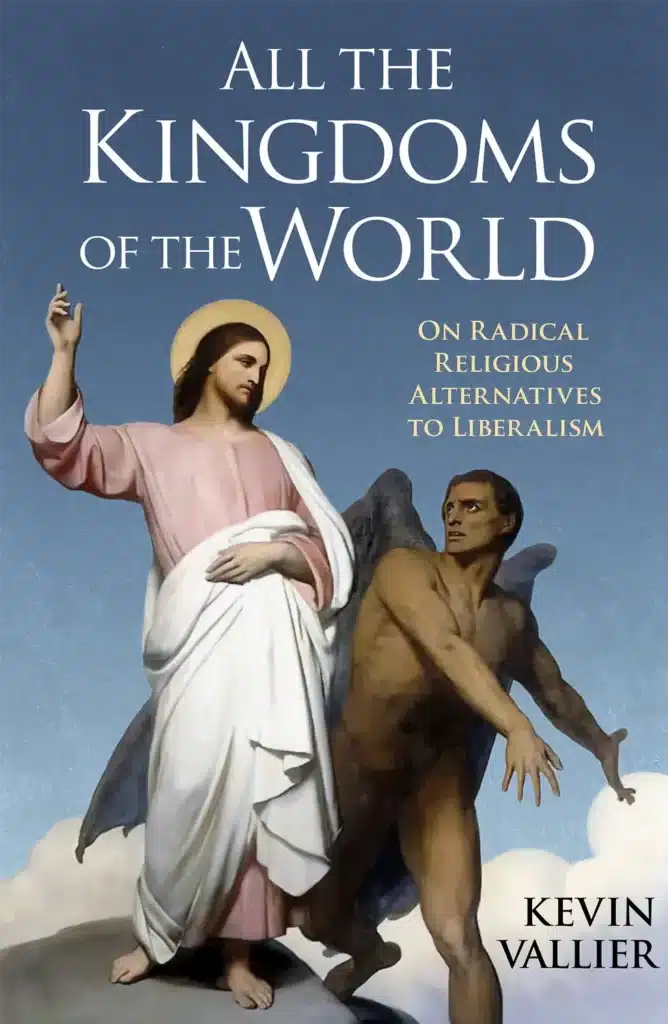
Such a challenge has become credible enough to earn serious, scholarly attention from a leading scholar in political theology, Kevin Vallier, in his book All the Kingdoms of the Word: On Radical Religious Alternatives to Liberalism. Vallier is not only a leading scholar in the subject but also an Orthodox Christian convert. This position means that he has a stake in preserving a modus vivendi among Christians but also less intensity on the turf wars that have defined Catholics, Protestants, and secular liberals. Moreover, Vallier is also a classical liberal, believing that individuals have inalienable rights against government power. The method Vallier brings to the book is called the “analytical tradition,” a primarily Anglo-American approach of applying formal logic to political theories to test them for soundness.
The result is a book that is rich both in argumentation and in narrative. Vallier is a gifted stylist, meaning that his analytical arguments are not bogged down with the technical language that lesser analytical theorists often deploy. The secret to Vallier’s writing is that he keeps the argument grounded in the contemporary situation. The opening chapters of the book chronicle the development of neo-integralism during the 2010s from the work of a quiet English philosopher Thomas Pink and the somewhat oblivious essays of Austrian-American monk Fr. Edmund Waldstein at his blog The Josias. As Vallier details, Waldstein read Pink’s articles defending the indirect authority of the Church over states even after Dignitatis Humanae, leading him to write at The Josias. Vermeule converted to Catholicism and introduced some of his previous influences into neo-integralist thought with right-wing authoritarian political theorists like Spanish absolute monarchist Juan Donoso Cortés, French anti-Semite Louis Veuillot, and especially Nazi crown jurist Carl Schmitt.
Vallier posits that the two schools never completely jelled. The earlier, more theologically inclined neo-integralists had less interest in a political program, preferring to focus their argumentation on combating the theological “liberalism” of post-conciliar Catholicism. Vallier even argues that figures like Schmitt have little relationship to the integralist tradition. On this matter, Vallier is (regrettably) wrong.
Cortés, Veuilott, and Schmitt were European conservatives, who differ quite considerably in their assumptions from Anglo-American conservatives. Rather, they had a dim view of the public and saw a powerful, centralized political sovereign as necessary to prevent the civil war caused by radicals of the French Revolution, socialists of the 1848 revolts, and communists afterwards. In this respect, they are all students of the first of this school, Joseph de Maistre, whose vehement opposition to the French Revolution came with a defense of the Catholic Church. However, Maistre did not deploy traditional Catholic political thought of natural law and popular sovereignty; instead, he considered these approaches ineffective when dealing with political disorder of the scale found in nineteenth-century Europe. Because of this history, European conservatism has focused much less on a positive theory of constitutional regimes and more on defeating enemies. For Maistre, these were radicals. For Cortés, socialists. For Veuillot and Maurras, Jews and Freemasons. For Schmitt, Jews. Defeat of these enemies required a disciplined social order of a united Catholic Church and state; anything less would fail. Reactionary Catholic clergy were happy to provide theological cover, with Fr. Félix Sardà y Salvany publishing an anti-Semitic Spanish newspaper during the turn of the twentieth century and publicly respected Fr. Julio Meinvielle pushing against Catholic personalist defenses of religious liberty because he believed the Jews were a uniquely evil people, as he explained in his insane 1936 book El judío en el misterio de la historia.
Vallier spends much of the rest of book detailing the arguments against the neo-integralist program, drawing specifically from Vermeule’s work but also from Waldstein and other authors, such as Fr. Thomas Crean’s and Alan Fimister’s Integralism: A Manual of Political Philosophy. Vallier shows incredible care in providing the best possible cases for a Catholic integralist state in each chapter, a process he calls “steel-manning” (in contrast to “straw-manning” wherein an author deploys weaker characterizations of arguments). Vallier does this to show good faith to honest neo-integralist readers but also to defend himself from the considerable social media presence neo-integralists have on the website X (formerly Twitter), where figures like Vermeule and Ahmari heap scorn on any of their detractors. To that end, he seems to steer the reader to favoring the moderate politics but reactionary theology of Pink over the radical politics and reactionary theology of Vermeule. The move is not persuasive, however, as what differentiates the two is more a matter of temperament than anything else. Moving the reader to prefer Pink merely ignores what, for many, is the real attraction to neo-integralism, namely its radical politics.
Three Main Arguments
The three arguments Vallier deploys against neo-integralism are the transition, stability, and justice arguments. The transition argument posits that there is no moral method from moving from a liberal regime to a neo-integralist one. The problems with transition include failures of leadership, internal resistance among “heretics,” and the pacification of rival centers of power within the regime.
Vallier also disagrees that a Catholic integralist state could last, since its internally contradictory commitments and claims to legitimacy could not hold together. Such polities decompose into either increasingly tolerant religiously pluralistic states or double down on violence to preserve the old order. These arguments are rather technical and include graphs intended to illustrate relationships. Neo-integralists have heaped scorn on the graphs as if they do not model anything, but such a view only illustrates that they have not read the book and wish to discourage others from doing so.
Finally, the problem of justice extends to how neo-integralists believe they should treat non-Catholics and unbaptized. This chapter poses an interesting problem for neo-integralists, namely that the unbaptized seem to have an easier life in an integralist regime than the baptized who dissent from the Church and state. While baptism confers citizenship under integralism, citizenship also entails greater exposure to state coercion because the Church can claim indirect authority over a baptized person. A dissenting person might opt to avoid baptism to remain immunized from such exposure, thus revealing how neo-integralists unintentionally create incentives for people to avoid becoming Catholics.
It is incredibly difficult to convey the care and complexity of Vallier’s arguments in his book. They are examples of a good faith effort to understand yet refute the neo-integralist position. As someone who has long been arguing with neo-integralists before Vallier’s book appeared, however, I found some of the arguments beside the point. The gambit of the book is to illustrate to readers that Vallier has better arguments than neo-integralists, as if to bait neo-integralists into a disputation. Refusal to engage exposes neo-integralists as knaves or fools, and those with neo-integralist sympathies can look on at them in disgust or at worst side with Pink but not Vermeule.
This strategy misunderstands how neo-integralists operate. Their purpose is not to construct the best argument for the best regime but to confer a sense of purpose on unhappy, often fearful, conservative Catholics facing an increasingly hostile political environment. Neo-integralism arms them with a sense of purpose and superiority over secular liberals, and one can see this in the convivial mutual appreciation of Deneen, Vermeule, Pappin, and Pecknold, while imitators like those at The American Postliberal aim to spread the message to even younger, even more online conservative Catholics. To argue sincerely against their positions is merely to invite the scorn that builds even more the bonds of brotherly affection that neo-integralists use to form networks among isolated, young, and mostly male Catholics. In short, when Vallier insists he has won the debate, the neo-integralists make fun of him online. Yes, Vallier actually wins the debate—but what else does that win him?
Deneen has called for “Machiavellian means to Aristotelian ends.” This position amounts to using arbitrary coercion or deliberate subversion to make men virtuous. This is ludicrous. It is ludicrous because effects depend on their causes, and there is no moral improvement in arbitrary suffering of injustice. As Vallier points out, “As the church advocates more coercion, it risks more significant harm, and in such cases, states may dispute church authority. States with that much capacity will ignore the church” because the state has no interest in arbitrary harm of its citizens that has no sign of their moral improvement. It is also evil because, ss Leo Strauss said, Machiavelli was a teacher of evil. Strauss observed in his close reading of Machiavelli’s texts:
Machiavelli goes on to say that if a man desires to seize authority in a republic and to impress his evil form on a republic, he must have at his disposal a matter which little by little, from generation to generation has become disordered, or a matter which has been disordered by time; for since all things of the world, and therefore in particular mixed bodies, have a limited life span, they necessarily become disordered by the mere passing of time.
Those neo-integralists who agree with Deneen are teachers of evil by exploiting the present “disorder” of republican government to advocate for their “postliberal order” like the older integralists of the late 1890s through the 1930s. Not all neo-integralists are on board with this approach. Many are serious and decent scholars. However, neo-integralists cannot ignore or escape their past. They must confront it. Historically, integralists have associated with absolute monarchy, right-wing authoritarians, and fascist dictatorships. The original integralist theologians espoused paranoid conspiracies about Jews and Freemasons to justify a state of emergency to install these regimes. The neo-integralists Vallier confronts refuse to confront these issues but rather cite the very same figures to advocate for absolute, arbitrary government rooted in paranoid conspiracy. If decent neo-integralists wish to distinguish themselves from figures like Vermeule or Deneen, they must reckon with the enormity of King St. Louis IX’s crimes against French Jews and Schmitt’s obsessive demand to purge Germany of the “Jewish spirit.” Failing this, one can only conclude that neo-integralism is an evil teaching and must be shunned.
Vallier’s book is an incredible service for those who want to understand why neo-integralism is bad political philosophy. I do not think anyone could have written this book better than he did. However, I am left wondering if this was the book necessary for the moment. I somehow doubt it, but I am grateful to have read it all the same.
James M. Patterson is Associate Professor of Politics at Ave Maria University and Contributing Editor at Law & Liberty. He is also the President of the Ciceronian Society, a Research Fellow at the Center for Religion, Culture, and Democracy, a Fellow at the Institute of Human Ecology and IHEVoices, and the author of Religion in the Public Square: Sheen, King, Falwell (University of Pennsylvania, 2019).