
What is conservatism? This question has served as a catchy title of books, articles, conferences, and break-out sessions for many years. Conservative is sometimes a moniker that people use to locate themselves on the political spectrum. It is also, however, a pejorative term used by many on the left to describe a group of people deemed undesirable, or dare we say, deplorable. John Stuart Mill, for example, famously described the Conservative Party in Great Britain as “the stupidest party” in 1861, and while Mill was not offering a blanket description of all conservatives, political liberals may find themselves tempted to smile at Mill’s snarky remark. The use of the term conservative is used all the time to describe a person or an idea representing a policy position associated with right-wing politics, but still, the question of what conservatism actually is remains vexing to many. Conservatism is as ambiguous a term as ever, being used as if it had a simple and universally agreed-upon meaning, and yet, continuing to be elusive, as evidenced by the failure of so many to fully understand it.
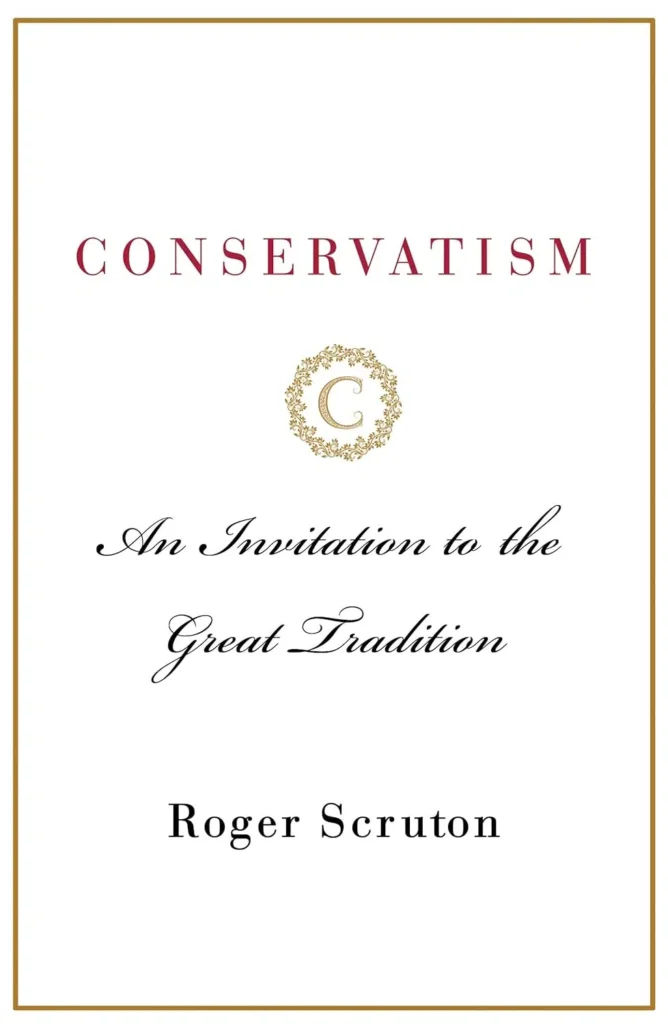
In Conservatism: An Invitation to the Great Tradition, Roger Scruton sheds light on what conservatives have believed and how conservatives have lived in the modern West. The subtitle casts the book as an invitation to tradition. As such, Scruton introduces his audience to the history of the conservative tradition. Conservatism is, in short, a realistic appeal to experience, custom, time-tested values, and the inheritance of our forefathers and mothers, which emerged as the medieval orientation toward the past gave way to modernity, as modern thinkers reacted with an innovative orientation toward the future at the outset of the Enlightenment. Scruton offers us an overview of the career of conservative ideas from the 1500s to the present, and argues that conservatism remains the antidote to utopian and nihilistic trends that threaten the best of the Western inheritance in the future.
Sir Roger Scruton (1944–2020) earned his PhD in philosophy from Cambridge University in 1972 after completing a dissertation on aesthetics. During his writing career, he wrote more than fifty books on the topics of art, music, architecture, politics, and conservatism. Some of his more recent works on conservatism include The Soul of the World (2014), How to be a Conservative (2014), On Human Nature (2017), and Conservatism: Ideas in Profile (2017). In 2019, he collaborated with BBC on the production of a documentary entitled “Why Beauty Matters,” which is still available to view on Vimeo. Scruton was one of the most important conservative thinkers, and there exist few figures today whose insight, care, and perspective can compare with Scruton’s. He is an impeccably trustworthy authority on the subject of conservatism, in America, Britain, and Europe.
In the preface, Scruton poses the guiding question of the book—“why don’t democracies constantly collapse, as people refuse to be governed by those they never voted for?” The context of the question is situated in the wake of the 2016 American presidential election, which resulted in Donald Trump’s electoral victory over Democratic nominee Hillary Clinton. After all the caterwauling from the left about Trump’s unforeseen rise to the presidency, most voters who rejected Trump at the polls returned to their daily routines, tacitly accepting the results of the election. This was also the case in 2008 and 2012 after Barack Obama won the presidential contests of those years, defeating Republicans John McCain and Mitt Romney respectively. Scruton asks after the 2016 election: “Why do the protests of disenchanted voters crying ‘not my president’ peter out, and why has there been after all no mass exodus of liberals to Canada?” The answer to the question, from the conservative point of view, gives profound insight into the conservative disposition as it has developed since the dawn of modernity. Conservatism is pre-political. Most people associate conservatism with a particular set of political ideologies and policy positions, but before addressing any political question, conservatism pertains to human existence as a whole. Specifically, Scruton writes that conservatives “believe that the human individual is an artifact, brought into being by the customs and institutions of society, and that true liberty arises only from a culture of obedience, in which law and community are shared assets maintained for the common good.” In other words, conservatism is an attitude predicated on the human condition. Human beings, while flawed, are capable of good. Their existence is based on community, beginning with the family and radiating out to the nation-state. Within community, humans find order in an even exchange between privileges and responsibilities, as well as a balancing between private and public goods. We come to know and understand the meaning of freedom, obligation, law, and human flourishing by the handing down of an inheritance of time-tested customs and traditions from our ancestors. Scruton says, “conservative thinking . . . has been about our whole way of being, as heirs to a great civilization and a many-layered bequest of laws, institutions and high culture.” Furthermore, it is our task in the present to leave a free civilization to our descendants.
Scruton divides the book into six chapters, first taking the reader through proto-conservatism in the years prior to Edmund Burke. Burke (1729–1797) marks the beginning of modern conservatism, but Scruton demonstrates that conservative ideas were present in the writing of figures such as Richard Hooker (1554–1600), James Harrington (1611–1677), John Locke (1632–1704), Baron de Montesquieu (1689–1755), David Hume (1711–1776), and Samuel Johnson (1709–1784). Each of these figures worked within a political culture that was slowly drifting away from religious moorings and toward secular models such as social contract theory. Both liberals and conservatives valued freedom during this time, but liberals placed liberty prior to order, whereas conservatives saw order as necessary for liberty. This division would characterize the divide between liberals and conservatives until the middle of the twentieth century.
The growth of philosophical conservatism, the subject of the second chapter, begins with Burke’s response to the French Revolution in his celebrated 1790 book, Reflections on the Revolution in France. On both sides of the Atlantic, philosophical conservatism flourished as a response to both the American and French Revolutions. Scruton identifies Thomas Jefferson (1743–1826) as an important American conservative. In the British conservative tradition, Scruton considers Adam Smith (1723–1790) alongside Burke as essential representatives. Burke, Smith, and Jefferson all stressed that localism, attachment to the land, and loyalty to social membership were necessary to liberty.
In chapter 3, Scruton shifts the scene from Britain and America to Continental Europe, particularly France and Germany. Considering the political thought of Georg Wilhelm Friedrich Hegel (1770–1831), Scruton notes the fundamental difference between liberals and conservatives. “Liberals naturally rebel, conservatives naturally obey. Destroy the culture of obedience, conservatives believe, so that rights are declared but duties forgotten, and the result is the totalitarian terror that followed the French Revolution.” Hegel’s conservatism is predicated on the necessity of balance between rights and duties to freedom. French conservatism is represented in the thought of figures such as Joseph de Maistre (1753–1821), Francois Rene de Chateaubriand (1768–1848), and Alexis de Tocqueville (1805–1859). French conservatism, much more diverse than German, sprang from royalist (Maistre), romantic (Chateaubriand), and liberal (Tocqueville) soils.
Scruton’s chapter on cultural conservatism introduces the reader to the inner life of the conservative. Through the imagination of Samuel Coleridge (1772–1834), we see how conservatism stressed the necessity of what Scruton calls “social feeling” and the “deeper unspoken instincts of the people.” John Ruskin (1819–1900) emphasized the need for traditional aesthetics as representative of spiritual and moral order that were being sacrificed in the Industrial Revolution. In similar fashion, Matthew Arnold (1822–1888) looked to the contribution of the Christian faith to civilization, especially in the Gothic cathedrals. Arnold’s call to heed the tradition of faith as applied to culture was in contrast to the nineteenth century stress on progress, commercialization, and industrialization that turned a blind eye to tradition. In America, the Southern agrarians, Richard Weaver, and Leo Strauss also looked to past tradition in aesthetics—poetry, literature, and the classics—as the preserving agents of civilization.
By the twentieth century, socialism became the great threat to civilization, especially through the power of the modern state. Whereas liberals and conservatives had historically differed over the relationship between order and liberty, with the rise of socialism they disagreed about the extent that the state should exert its power over the citizens. Liberals of the twentieth century would place great faith in the state to right wrongs, while conservatives (being more consistent with classical liberals) saw themselves as champions of individual liberty in defiance of tyrannous state coercion. Figures including Jacques Maritain (1882–1973), Jose Ortega y Gasset (1883–1955), Friedrich von Hayek (1899–1992), Whittaker Chambers (1901–1961), Michael Oakeshott (1901–1990), and Simone Weil (1909–1943) each defended the rights of the individual over the power of the state.
In the final chapter, Scruton considers the challenges conservatives face in the present, and will likely face in the future. Militant Islam, open borders, and the growing power of the state represent some of the salient challenges for conservatives. Additionally, conservatives face the dehumanizing power of a culture obsessed with consumerism, technology, and ignorance of tradition. Scruton, in analyzing the thought of Samuel Huntington (1927–2008), wrote, “We must rediscover what we are and what we stand for, and having rediscovered it, be prepared to fight for it. That is now, as it has ever been, the conservative message.”
Scruton is an indispensable political and cultural thinker for the twenty-first century. In about 150 pages, he condenses the history of conservatism going back nearly five hundred years, and in doing so, gives us the essential characteristics of the tradition. Those essentials include localism, veneration of tradition, emphasis on human dignity, pursuit of ordered liberty, the necessity of religion to a virtuous society, fraternity over equality, and the importance of the imagination in aesthetics. Conservatism is a book that should be read by everyone and should inform the decisions of every citizen in every Western country, no matter their political loyalty.
No book, however, is perfect. Scruton gives too much credit to Jefferson as an American conservative, and not nearly enough attention to his contemporary and rival, John Adams. Furthermore, while Jefferson did have ideas that mapped him as a conservative thinker, his optimistic view of human nature (in contrast with Adams’ more realistic view) disqualifies him as a consistent conservative. Scruton’s treatment of Hegel as a conservative fails in that he does not distinguish Hegel’s understanding of freedom from that of Locke. Hegel distanced himself from Locke in defining freedom, casting Lockean freedom as subjective, or pertaining only to the individual. But objective freedom was an expression of the universal, in which the individual citizens are merged together in the whole of the nation. Thus, freedom for Hegel had no individual manifestation. Scruton, however, did not draw attention to these important distinctions. His treatment of Hegel as a conservative relies heavily on the idea of freedom. But as Hegel’s idea of freedom is more consistent with totalitarianism than with liberalism, it is doubtful whether Hegel should be considered as a conservative in the same family as Burke, Tocqueville, Coleridge, or even Jefferson.
These quibbles aside, Scruton’s Conservatism is a must-read for anyone interested in the necessity for active citizenship in the twenty-first century. That is, this book is a must-read for everyone.
John D. Wilsey
Research Fellow
Center for Religion, Culture, and Democracy