
We live at an important time in the history of the post-war conservative movement. Issues that were for years undiscussable have appeared at the top of the agenda, and demographic and strategic changes have redrawn the map of the world. The internet and the social media have disrupted the political process, bypassing the official filters in order to go straight to the target, which is a one-click response on a smartphone. In these circumstances we should not be surprised if people previously unimaginable as the holders of high office suddenly emerge at the top. Nor should we be surprised if the separation of powers has become the antagonism of powers, with the branches of government competing for the high ground of political influence.
Neither liberals nor conservatives were prepared for this, though it has given a new lease of life to the liberal worldview, with the media and the universities united against the ‘populism’ that has swept away the checks and balances of the political process. In this new situation conservatism inevitably has a beleaguered air, as the institutions, procedures and values on which it has relied one by one vanish into air. It is the right time, therefore, to look seriously at the past of conservatism, and to explore what its philosophical thinkers have been saying all along. As I explain in this book, conservatism emerged at the Enlightenment as a necessary counter to the excesses of liberal individualism, and its arguments are as valid and relevant today as they were when they first began to take shape in the seventeenth century.
It is undeniable, however, that conservatives have not, in recent times, always been clear as to the source of their beliefs, or the goals for which they should be striving. When I first became conscious of my own political leanings, conservatism defined itself in terms of the worldwide confrontation between freedom and totalitarianism. Of course there were nuances, disputes and alliances. Traditional conservatives and free-market libertarians were often at loggerheads, and there was and remains a deep dispute on the conservative side as to whether the sphere of culture is or is not a concern of government. Still, it was undeniable to anyone who had experience of both sides that this worldwide conflict existed, and that conservatism ended with the defence of free societies against the totalitarian project, even if it didn’t begin there. Seeing things that way had the advantage of presenting conservatism as an international cause, something grander and more intimately connected with the future of mankind than the local attachments from which ordinary conservative sentiments tend to grow.
However, conservatism is not, by nature, an international cause. It takes its character from local questions, and the loves and suspicions that thrive in specific places and times. For conservatives all disputes over law, liberty and justice are addressed to a historic and existing community. The root of politics, they believe, is settlement – the motive in human beings that binds them to the place, the customs, the history and the people that are theirs. The language of politics is spoken in the first-person plural and the duty of the politician is to maintain that first-person plural in being. Without it law becomes an alien imposition, not ours but theirs, like the laws imposed by a conquering power, or those, as we have experiences in Britain, imposed by a treaty made years ago in a vanished situation by people long since dead. Conservatives are not reactionaries. As Burke said, ‘we must reform in order to conserve’, or, in more modern idiom: we must adapt. But we adapt to change in the name of continuity, in order to conserve what we are and what we have. The need to see things in this way is as strong today as it was at the American Founding, and the recent presidential election gave vivid proof that the question who we are now occupies the centre of political thinking.
Those who describe themselves as liberals tend to react to this question with suspicion. Identities, they argue, shift and morph. The ‘we’ of politics is never stable, and all boundaries are in essence negotiable. Hence there is only one cogent reaction to the global forces that impinge on us, which is to open our political thinking to the wider world. For liberals it is not the specifics of our local history and acquired obligations that should govern our political behaviour, but the universal ideals of the Enlightenment.
The conservative response to the liberal individualism of the Enlightenment has been to insist on the contingent and attached nature of the human individual. In our present circumstances this means insisting that governments are elected by a specific people in a specific place, and must meet the people’s needs, including the most important of their needs, which is the need to trust their neighbours. That is why in the current debates, conservatives are emphasizing the defence of the homeland, the maintenance of national borders, and the unity and integrity of the nation. And this is also a point of tension in conservatism, today as it has been in the past, since belief in a free economy and free trade inevitably clashes with local attachments and community protection.
In modern conditions, in which governments rarely enjoy a majority vote, most of us are living under a government of which we don’t approve. We accept to be ruled by laws and decisions made by politicians with whom we disagree, and whom we perhaps deeply dislike. How is that possible? Why don’t democracies constantly collapse, as people refuse to be governed by those they never voted for? Why do the protests of disenchanted voters crying ‘not my president!’ peter out, and why has there been after all no mass exodus of liberals to Canada?
The answer, conservatives argue, is that political communities, democracies included, are held together by something stronger than politics…
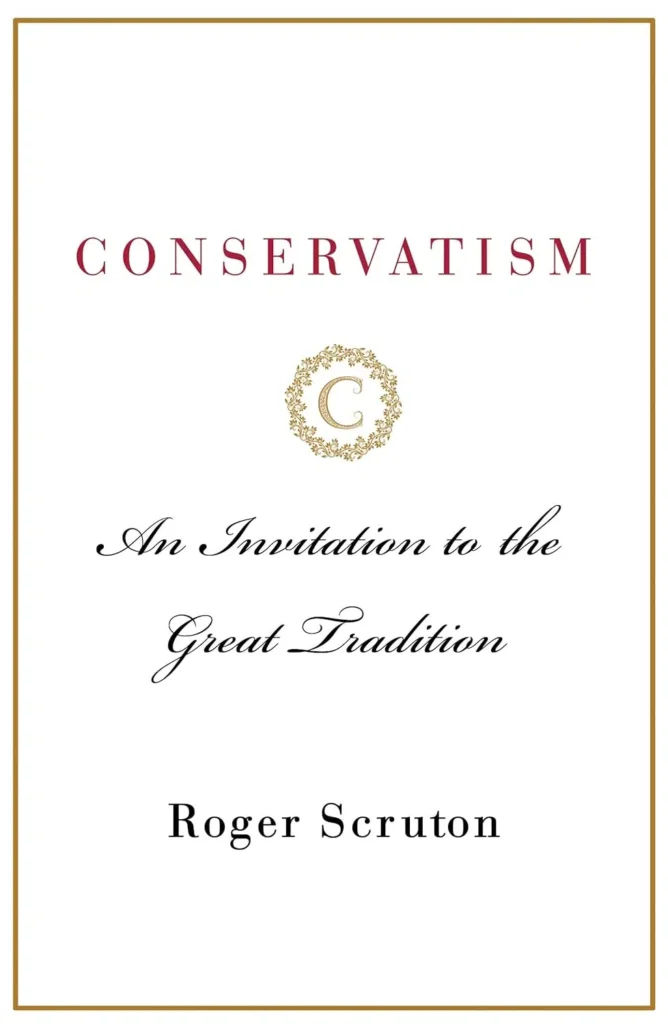
Read more in Conservatism: An Introduction to the Great Tradition by Roger Scruton.