
The argument that this book puts forth is not revolutionary, but it is a thesis still largely inaccessible (or unknown) to evangelical Protestant intellectuals, laypeople, and pastors in a scholarly form. What this volume proposes is that the United States Constitution’s disestablishment did not secularize society, nor did it remove institutional Christianity from the civic, state educational, or political spheres. That occurred nearly a century later. Likewise, the Constitution did not create a unitary social or semi-sacralized Christian nation as some conservative evangelicals and neo-theocrats argue. Instead, the Constitution enacted a religious order designed to perpetuate the civil building blocks of liberal society informed by the English Whig and later late eighteenth-century American republican tradition. This order was liberal in its views on establishmentarianism and at the same time conservative on its conceptualization of Christianity’s place in the civil and social orders and in its intellectual influences.
This book posits that the Early Republic United States, a period that broadly extends from 1790 co 1860, in fact remained committed to disestablishment while simultaneously protecting and even perpetuating institutional—usually but not always Protestant—Christianity through federal and state courts, state colleges and institutions, state legislatures, and executive proclamations from governors and presidents, and through state cooperation with religious institutions and Protestant divines. These were nor attempts to create a pseudo-state church, precisely because most politicians, Protestant intellectuals, and ministers did not believe char Protestant Christianity needed a state church or churches to maintain its institutional position in the American civil, political, and social order. Almost every major Protestant denomination and intellectual rejected the perceived Erastianism of historic Protestant and Roman Catholic Christianity and affirmed federal disestablishment. Disestablishment disconnected church and state, but it did not separate them from their mutual purpose of creating and upholding a moral order committed to historically Christian conceptions of virtue. Christians in the United States historically believed that their faith had a necessary and salutary effect on law, politics, and society chat deserved to be preserved and perpetuated by the civil magistrate. This did not preclude a belief in religious liberty.
This book is not meant to address controversies over contemporary Christian engagement in politics, nor is it intended to be a blueprint for liturgical, theological, or social action. The point of this work is not to call into question the liberal order. Nor is it to answer the question of how, at the chronological apex of the cultural and social Christian nation, cultural Christianity became so obviously a chief conduit for social progressivism. Rather, the point is to argue that the foundations of the United States were committed to liberalism and not secularism and to provide an accurate and scholarly picture of the United States religious settlement in the Early Republic for Christian scholars, ministers, and interested laypeople. Disestablishment was, and is, the law of the land, and it has served the United States and Christianity well. What disestablishment means and meant, however, remains a source of confusion and controversy for evangelical Protestants even in the early twenty-first century. But it hasn’t always been that way.
Protestants in the Early Republic affirmed disestablishment, but generally broke with Jefferson and Madison, who sought to remove institutional religion’s influence. Simultaneously Protestants believed that disestablishment was good, and that only a society of pious Christians could properly create a disestablishmentarian order and make it work. Christianity, in their minds, was a necessary foundation for disestablishment.
Miles Smith IV (Ph.D., Texas Christian University) is assistant professor of history at Hillsdale College.
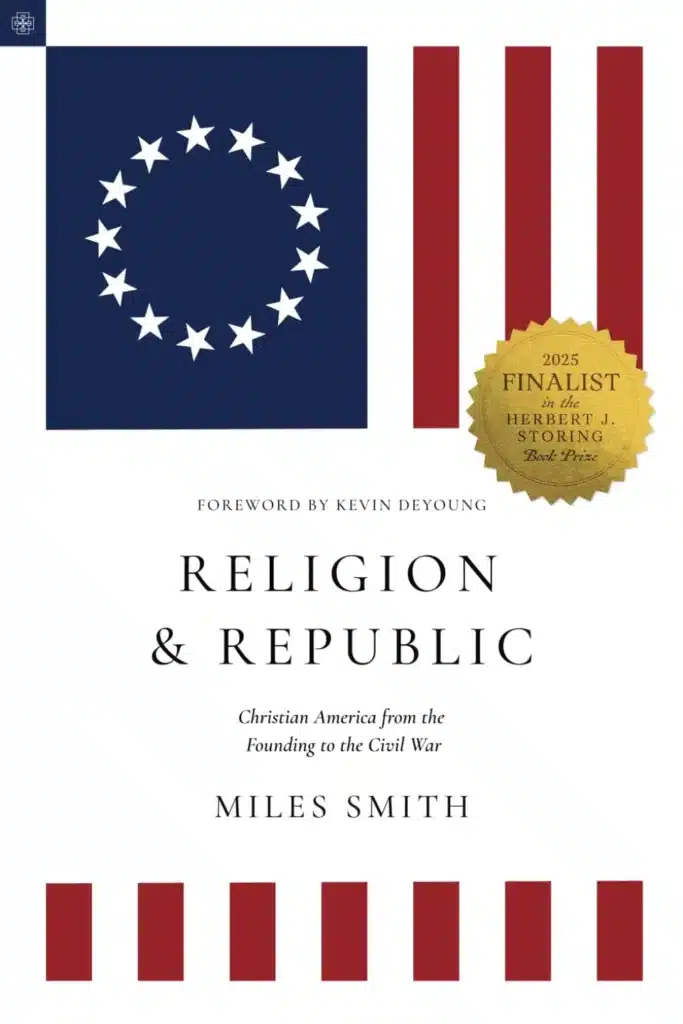
Read more in Religion & Republic: Christian America from the Founding to the Civil War (Davenant Press, 2024).