

Unlike the three men who wrote The Federalist under the pseudonym Publius, Anti-Federalists lacked a single vision or coherent strategy. Some opposed the Constitution because they said it would promote oligarchy by the Senate; others because they feared executive tyranny. Others worried most about majoritarian democracy. Richard Henry Lee held all these positions, just at different times. Practically speaking, those from populous states predicted the Constitution would diminish their state’s importance, while those from smaller states were afraid of getting bullied by Virginia, New York, or Pennsylvania.
How, then, should we understand the Anti-Federalist approach to religion and constitutionalism? As it turns out, place and regional experience hold the key to understanding Anti-Federalist opinions when it comes to religion and the Constitution. Region tended to matter more than church, ecclesial community, or sect.
New England
Many Congregationalist-run towns in Massachusetts criticized the proscription of religious tests in Article VI of the Constitution. In so doing, they employed familiar anti-Catholic themes while calling for “religious qualifications for federal office.” For Middlesex County, the problem was that the lack of a religious test meant “Atheists Deists Papists or abettors of any false religion” might hold office. “Any denomination of Protestants” would be fine, but the line had to be drawn somewhere.
This rhetoric came from non-Congregationalists in Massachusetts as well. Baptist Amos Singletary, who had not always fared well at the hands of Puritan Congregationalists, imitated them in this one instance. Singletary wanted to believe Christians would be the ones wielding power, but he opposed ratification because it made “a papist or an infidel” equal under the law to a Protestant. As another Massachusetts Anti-Federalist put it, atheists lacked the virtue needed for self-government while Catholics could not be trusted because they “acknowledge a foreign head, who can relieve them from the obligation of an oath.”
Elsewhere in New England, Anti-Federalists also employed anti-Catholic rhetoric to oppose the Constitution. In nearby New Hampshire, an Anti-Federalist predicted that without a religious test, Americans “may have a Papist, a Mohomatan, a Deist, yea an Atheist at the helm of Government.”
As with the later heyday of U.S. anti-Catholicism during the 1830s-1850s, these New England Protestants feared persecution by Catholics. More importantly, they did not believe Catholics could contribute to or live under a republican form of government. As Pauline Maier puts it in Ratification: The People Debate the Constitution, especially for these New Englanders, “freedom of religion demanded freedom from Catholic domination.” And that freedom, they thought, required dominating Catholics.
Maier calls the promotion of a religious test in the name of liberty “paradoxical,” coming as it did amid the liberal spirit of the 1780s that followed the Revolutionary War. Yet this is not as “paradoxical” as it would seem at first glance. Regional experience, culture, and collective memory matter, and these New Englanders were the heirs of the religious controversies that accompanied the great Puritan migration, the English Civil War of the 1640s-1650s, and the overthrow of James II in 1689.
During the reign of King Charles I in the 1620s, Parliament had tried to force Catholics and Puritans to conform to the Church of England, which was headed by Charles. Non-separatist Puritans fled to New England for civil and religious freedom between 1630 and the late 1640s. There, they established self-governing congregations that were deeply entangled with civil government. They did so despite being in the minority. Only the godly who had won approval by the elders and had been baptized could serve in civil office. This culture was most deeply rooted in Massachusetts and Connecticut.
The complexity of the English Civil War cannot be revisited here, but suffice it to say that Puritans triumphed, Charles I lost his head, and shortly after Oliver Cromwell’s death in 1658, England returned to monarchy under King Charles II. But when Charles II suspended Parliament, it responded by passing the first of the Test Acts, which allowed only Anglicans to hold civil office or military commissions. If you wanted to serve the king, you had to belong to the church he headed. This political and religious turmoil culminated in the so-called “Glorious Revolution” and civil warfare of 1688–1691 that overthrew Charles II’s successor, King James II. Parliament replaced the Catholic, James, with the Dutch Protestant, William of Orange.
King William kept the Test Act, issued a Toleration Act, and, at the urging of the same parliament that had placed him on the throne, agreed to the English Bill of Rights. William’s Toleration Act tolerated all Trinitarian Christians except Catholics. Unitarians and Jews did not make the cut, and only members of the Church of England held full political rights.
Only in 1708 did non-Puritans earn the right even to worship in Connecticut. It was not until 1727 that non-Congregationalists were allowed to pay taxes to support their own churches rather than Congregationalist ones. For New England Anti-Federalists, the Test Acts were more than just a century-old historical event; they were a model.
Pennsylvania
It is quite telling that in the anti-Catholic rhetoric of Massachusetts, there also was criticism of Pennsylvania. Pennsylvania had long had a “here comes everybody” approach to religion and citizenship. James Winthrop of Massachusetts, writing as “Agrippa,” said that “Pennsylvania in the course of a century has acquired her present extent and population at the expense of religion and good morals.” Those “eastern states” with religious tests, however, “have preserved their religion and morals.” For Anti-Federalists, Pennsylvania thus became the counterexample to the Federalist claim that religious liberty and prosperity were linked.
It is unsurprising that the clearest representatives of the middle ground of the debate came from the one state with the greatest degree of religious freedom, Pennsylvania. Perhaps the best known among them is Samuel Bryan, who wrote as Centinel. It was against Bryan that John Jay wrote Federalist No. 2 and James Madison wrote Federalist No. 10 and No. 51. In Centinel No. 1 Bryan’s chief concerns are the size and diversity of the country, along with a lack of any protection for freedom of the press. He makes no meaningful mention of religion.
It was actually the Federalists of Pennsylvania who brought religion into the debate, in the person of Benjamin Rush. Rush was a strong supporter of the Constitution. But as he later told John Adams, repeating what he had said in defense of the Constitution at the Pennsylvania ratifying convention, “Many pious people wish the name of the Supreme Being had been introduced somewhere in the new Constitution. Perhaps an acknowledgement may be made of his goodness or of his providence in the proposed amendments.”
As it turns out, Rush’s middling position closely matched that of Anti-Federalists from the Southern States.
Maryland, Virginia, and North Carolina
One thing we see as we head farther South is that the opposition to the Constitution on account of the lack of a religion test became much less anti-Catholic.
This lack of anti-Catholicism is notable because we see it even in Maryland, which had been founded as a haven for Catholics and which boasted the first toleration act of any of the colonies, an act that preceded England’s own Toleration Act by over fifty years. Yet for Maryland, the consequence of James II’s overthrow in 1689 had been a Protestant rebellion against their Catholic rulers. Protestant settlers had expelled Lord Baltimore’s Catholic appointees, outlawed Catholic education and public Mass, and taxed Catholics at a higher rate than Protestants. Even so, by the time of the Constitutional Convention in 1787, Catholics were allowed to hold public office in Maryland.
Residual anti-Catholicism seems to have played no role in the opinion of Maryland’s leading Anti-Federalist, Luther Martin. It is worth noting, however, that Martin was born in New Jersey; he had even helped draft the New Jersey plan at the Constitutional Convention. Like one of the authors of the Virginia Plan, James Madison, he also was a Princeton graduate. Unlike Madison, however, Martin graduated prior to the arrival of John Witherspoon in 1766. That same year, Martin left New Jersey for Maryland. He soon left Maryland to study law in Virginia, returning in 1772. Just six years later he became the newly independent state’s attorney general.
Martin’s Anti-Federalism centered on the Constitution’s lack of a Bill of Rights and the lack of presidential term limits. But he is best known for calling the Constitution “godless” because, unlike the Articles of Confederation, it did not mention God. As Martin, an occasional attendee at Anglican services, told the Maryland legislature in 1788, “in a Christian country it would be at least decent to hold out some distinction between the professors of Christianity and downright infidelity or paganism.”
In next-door Virginia, religious liberty had reigned for a long time, mostly by default. In Virginia, settlements had been so spread out in the 1600s that half of the Anglican parishes lacked ministers, and it was difficult to get to church on Sunday even if one tried. This had made government coercion impossible. Nevertheless, there was an established church, and it was the Church of England.
By the 1750s, the Anglican gentry did not get along well with the Presbyterians and Baptists on the Appalachian frontier. Baptists and Presbyterians criticized the gentry as vice-ridden men and women, and the gentry sought legislative means to limit their critics’ civil and religious freedom.
Interestingly, among the new state constitutions approved during the Revolutionary War, only Virginia’s lacked a clear religious test. But this did not preclude tax-funded aid to churches or, in the case of the Virginia legislature, tinkering with the Book of Common Prayer. Thus, establishment became the core of the fight in the 1780s during the Confederation period, as future Anti-Federalist Patrick Henry paired off against one of the chief writers of The Federalist, James Madison.
The Virginia Statute for Religious Freedom, written by Thomas Jefferson, dated to 1777—one year after Jefferson had helped draft Virginia’s new constitution, in which he had tried to include a strong portion on religious liberty. When finally approved in 1786, the statute led to a dispute between those like Henry, who wanted to impose religious taxation in the name of the common good and to pay Christian teachers, and those like Madison, who wanted no state establishment of religion at all. Like elsewhere in the new American states, religious pluralism and religious liberty did not necessarily mean the lack of an established Church or the abolition of religious taxation.
In Virginia, the divisions were not sectarian so much as Christian believers vs. unbelievers. This mirrored North Carolina, where Anti-Federalists lambasted “the exclusion of religious tests” as “dangerous and impolitic” because “Pagans, Deists and Mohammedans might obtain office among us.” Notably absent from this list were Catholics.
Considering this, it is easier to understand Martin’s objection to the Constitution. What he found to be immoderate was that while some at the Constitutional Convention had indeed voiced fear about Catholics, Jews, Muslims, heathens, and deists, delegates had ignored the more significant middle ground containing those interested in distinguishing between “the professors of Christianity and downright infidelity or paganism.” Proponents viewed this as a non-sectarian religious test. For Martin and some North Carolinians then, the problem with Article VI was that it ignored the prudent middle ground and thus enabled the triumph of extreme secularism.
Conclusion
Anti-Federalists had many, sometimes conflicting, reasons for opposing the Constitution. These ranged from practical concerns about distance and proper representation to concerns about state sovereignty, oligarchy, monarchy, and too much democracy. When religion entered opposition arguments, it centered on Article VI. In New England, prohibition of a religious test presaged a Catholic takeover. In Pennsylvania, Maryland, and Virginia, Anti-Federalists worried more about the loss of public morality because of the lack of any mention of God at all. In all cases, whether to have a religious test was itself a test as to whether the United States government would protect or endanger religious liberty.
Religious liberty as the American revolutionaries knew it was a state with an established church where other religions enjoyed various degrees of legal toleration. Religious tests were normative, even if perfunctory in places like Virginia. In New York, subsidiarity reigned, and every locale could choose which church got tax support. Even colonial Pennsylvania, which lacked religious taxation and an established church, still had a religious test for public office. After the Revolutionary War, this test remained but was broadened to include those who believed in God and acknowledged the Bible’s divine origin.
For some Anti-Federalists, putting religious freedom into the Bill of Rights involved not so much preventing the establishment of a national church as it did limiting Catholic religious freedom and barring suspect, non-Protestant groups from participating in the new constitutional order. This was meant to weaken the prohibition against religious tests.
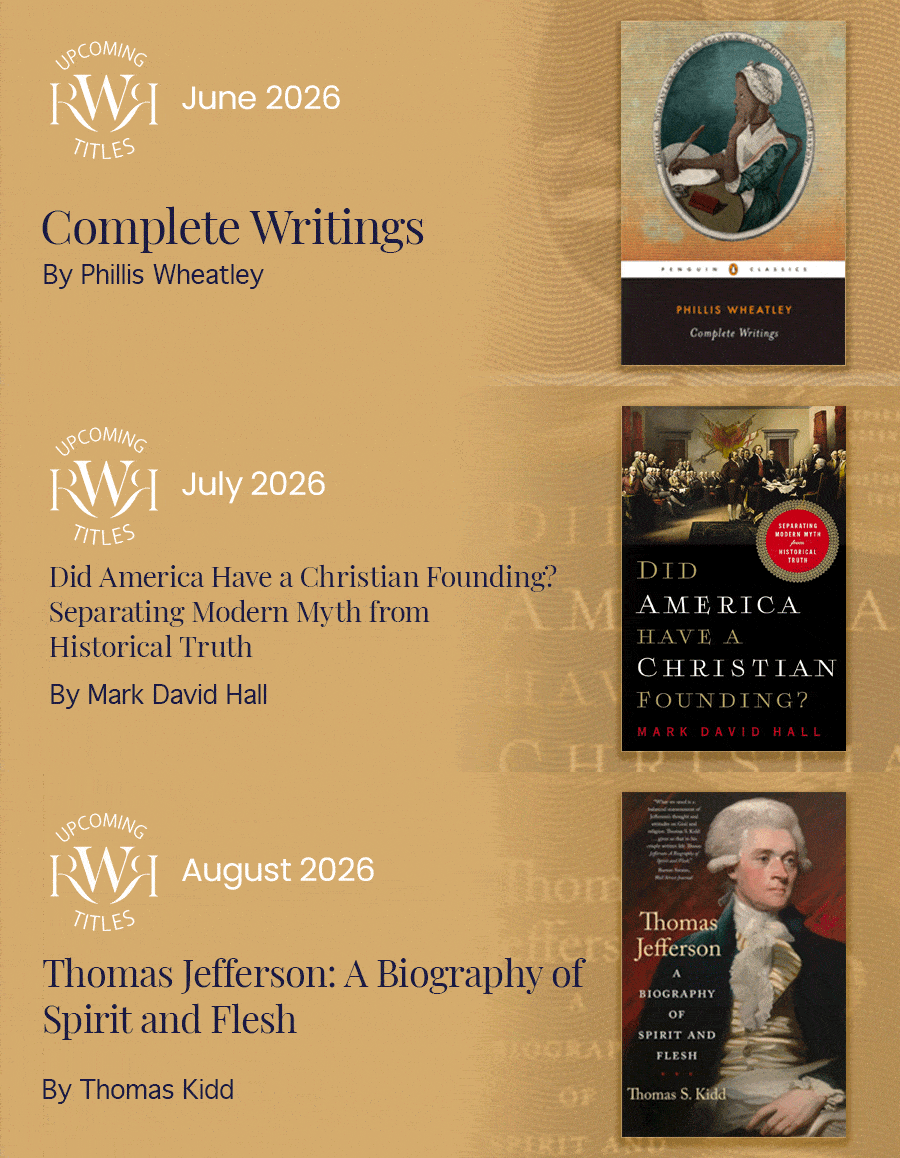
In God of Liberty Thomas Kidd argues that the “framers intended to create neither a specifically Christian government nor a ‘godless Constitution.’ Instead, led by James Madison, they established a new government committed to maintaining public virtue.” Nearly all recognized that an established national church would sow discord, corruption, and sectarian rivalry. As Kidd notes, George Washington believed that the Constitution would allow the U.S. government to “encourage moral public behavior” while staying out of theological and ecclesiastical disputes and leaving it to religious leaders to “steward the religious lives of Americans.”
It is in this sense, then, that the Anti-Federalists failed the religion test, for it was freedom of religion that would form the bedrock of virtue in the new country, not the government or state-established churches.
John C. Pinheiro (Ph.D., University of Tennessee) is director of research at Acton Institute. He was professor of history at Aquinas College and his newest book, edited with Dylan Pahman, is The Christian Roots of American Liberty (Acton Institute, 2026). Among his books and articles are the award-winning Missionaries of Republicanism: A Religious History of the Mexican-American War (Oxford, 2014) and The American Experiment in Ordered Liberty (Acton Institute, 2019). He is on X as @DrJohnPinheiro.