
In his fascinating new book, The Idea Machine, longtime publishing executive and man of letters Joel J. Miller explores the history of a uniquely formative cultural phenomenon. The subtitle, How Books Built Our World and Shape Our Future, captures the main argument. Books have, in many ways, made civilization possible. And while books have helped us to get where we are, they also represent hope for a better tomorrow.
This central insight—the culturally significant power of books—animates the Reading Wheel Review (RWR). Thus, at the launch of the publication’s third year, it seems appropriate both to look back at the founding vision for the RWR and to look forward as we begin a year-long exploration that centers on the semiquincentennial of America’s founding in 1776.
Trey Dimsdale put it this way in his inaugural missive for the RWR:
Books are the means that have preserved wisdom from and information about prior generations. They’ve conveyed information about scientific discoveries between disparate communities. And, in cases like Uncle Tom’s Cabin and To Kill a Mockingbird, texts have inspired many to act to rectify grave injustices. Books present, among other things, a threat to regimes that seek to control the thoughts of their citizens.
Miller concurs. In his history of the book as an “idea machine,” Miller notes a number of significant instances where the conservative insight that “ideas have consequences” played out, including, for instance, the moral pedagogy in Harriet Beecher Stowe’s novel, Uncle Tom’s Cabin. Fiction, and perhaps particularly novels, have a way of forming consciences in ways that prose does not. “Novels,” writes Miller, “provide temporary leave of our specificity, an escape from the enclosed space of ourselves, the prison of our peculiar psychology. Literature brings us into the lives of others.” The great scholar and apologist C. S. Lewis knew this as well. One of the reasons that Lewis penned books like the Chronicles of Narnia and the Ransom trilogy was because of the literature’s potential to convince, convict, and convert audiences whose ears had grown dumb to straightforward argument, explication, and advocacy.
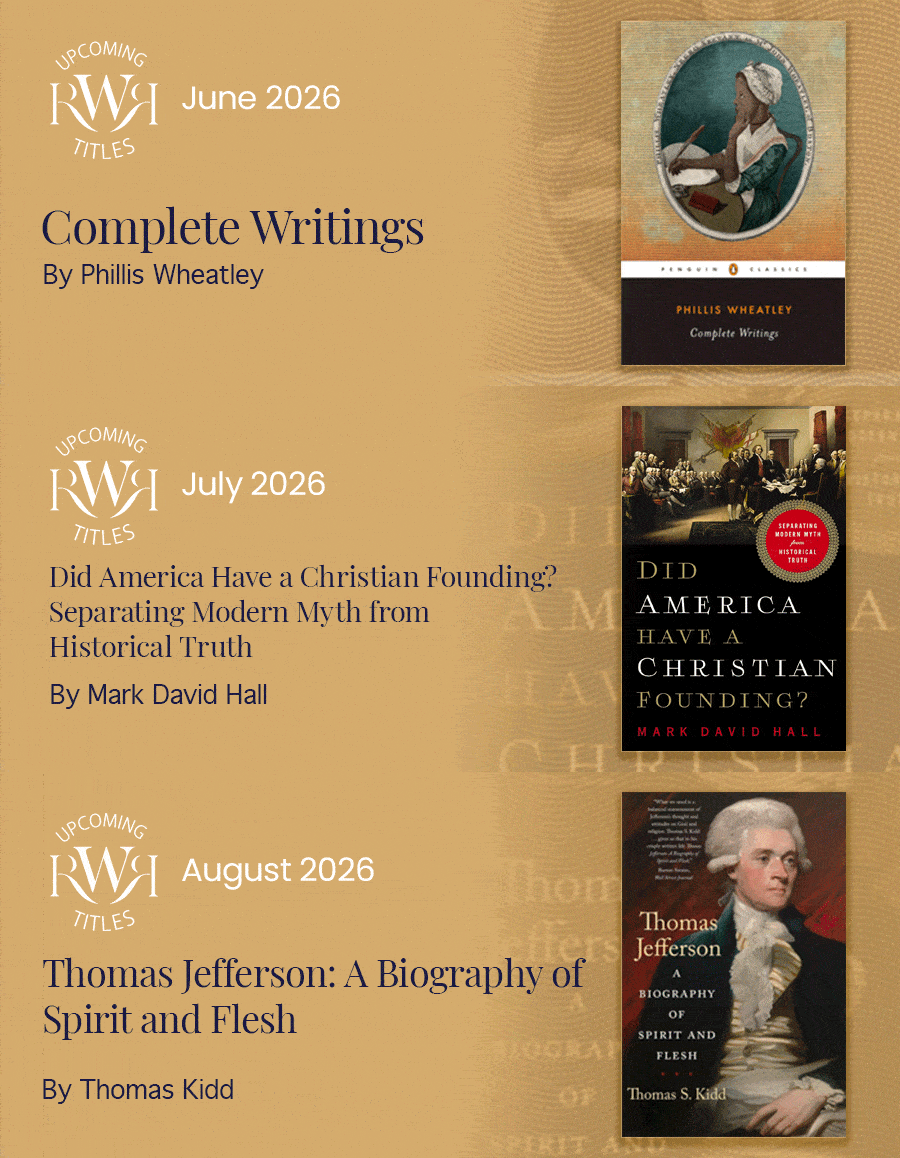
Miller traces the development of the written word from the ancient world to contemporary times, with stops, sidetracks, and recursions along the way. One of his stops is eighteenth-century America, which saw the growth of a robust book trade and a literate colonial culture. Indeed, argues Miller, the American Revolution was in many ways a direct product of a literary society. Pointing in particular to Thomas Jefferson’s self-confessed “malady of Bibliomanie,” Miller observes that “Jefferson represents an extreme form of a common type among the founding generation: the intellectually curious whose knowledge of the world was informed by gallons of ink.”
Indeed, we will begin 2026 with an examination of the Founding Fathers’ engagement with one book in particular: The Bible. In 1925, on the 150th anniversary of the outbreak of conflict at Lexington and Concord, President Calvin Coolidge said of the founding generation’s knowledge of Scripture:
They knew the Book. They were profoundly familiar with it, and eminently capable in the exposition of all its justifications for rebellion. To them, the record of the exodus from Egypt was indeed an inspired precedent. They knew what arguments from holy writ would most powerfully influence their people. It required no great stretch of logical processes to demonstrate that the children of Israel, making bricks without straw in Egypt, had their modern counterpart in the people of the colonies, enduring the imposition of taxation without representation!
Miller’s fascinating chronicle of the book traces the development of different technologies and inflection points—from the invention of paper to the printing press and beyond—but he does overlook one particular technology that was put to use by Jefferson himself: the revolving book stand, a variant of what is sometimes called a book wheel or a reading wheel.
If, as the Preacher proclaimed, “Of the making of many books there is no end” (Ecclesiastes 12:12), then as both the number of books and one’s appetite for them grow in tandem, it becomes necessary to find ways to grapple with the challenge of access to this information. Miller highlights libraries and catalogs of various kinds as important innovations in this regard. But reading wheels were an early invention that responded to the deluge of text made possible through the advent of movable type and the printing press. The sixteenth-century Italian engineer Agostino Ramelli is often credited with the wheel’s invention. But by the end of the eighteenth century different versions had been created for use in America.
None other than Thomas Jefferson had a version of the reading wheel, one which rotated horizontally, in his possession. The Thomas Jefferson Foundation shows what the stand would have looked like at work in Jefferson’s office, part of a set of devices and technologies centered around accessing information in various codices in an efficient fashion. As the narrative at the Monticello site describes it,
Thomas Jefferson improved on the standard two-sided stand with lecterns, commonly used for reading, by designing a five-sided version. This unique cube-shaped example sat on an adjustable tripod base which allowed Jefferson to work standing and seated. The original base, which has not been located, has been replaced by a reproduction. The lectern rotates, providing easy access to documents arranged on any of its raised surfaces. Jefferson used it in conjunction with his writing table and revolving armchair, akin to a modern office grouping.
You can even purchase a replica from Monticello. Linda August of the Library Company of Philadelphia examines the use of standing desks by both Jefferson and John Dickinson, dubbed the “Penman of the Revolution” due to his prolific writing.
As Miller concludes,
While the founders and their peers may have fought on any number of issues, they possessed more in common than their differences might suggest. Jefferson, Madison, Adams, Franklin, Washington, and Hamilton, along with Benjamin Rush, Samuel Adams, Thomas Paine, Patrick Henry, George Mason,and the rest, shared patterns of thought shaped by English history and transatlantic Enlightenment, what Forrest McDonald called “a common matrix of ideas” access through “the printed word.”
And now, two and a half centuries later, it is worth considering whether the book as a technology might help us to recover and restore the founding principles of America, even as the book helped to first form those principles themselves. It is also worth asking whether technological developments in the meantime, especially the recent advent of artificial intelligence and digital media, present new challenges and opportunities for a fruitful harvest of the past.
Miller himself is agnostic about whether large language models (LLMs) and other AI technology will enhance or degrade the connection to the past that has characterized the era of analog text. In a way, Miller closes where he opens, invoking the Socratic story of the exchange between the inventor of printed text and a critic, who argues that the written word will introduce “forgetfulness in the learners’ souls.” That hasn’t proven true in the case of the book; why should it necessarily be true in the case of hypertext?
And yet something does seem different about the new division of labor that we seem to be experiencing with the latest digital tools. As Miller also notes, technologies have inherent bias: “They suggest some uses more than others.” And digital texts might well be different enough from analog texts to at least suggest—if not prod us toward—radically different uses.
Analog text has some distinct advantages over digital tech. Printed text is stable in a way that hypertext is not. We retain information from physical books in a way that we do not with digital texts. In our day, however, reading wheels have largely been replaced by doomscrolling. And the resulting revolution may be far different and far more radical than the original version declared so eloquently in 1776.
On a somewhat different occasion, but one no less marked by social upheaval, discontent, and anxiety than our own age, Pope Leo XIII gave sage guidance: “When a society is perishing, the wholesome advice to give to those who would restore it is to call it to the principles from which it sprang.” To call us back to our founding principles, we must know what those principles are. In knowing them better, we can thus recognize what counts as restoration and renewal and what counts as destruction and corruption. “To fall away from its primal constitution implies disease; to go back to it, recovery,” contends Leo. And just as this is true for any human order, so is it true for the United States of America.
We must work to recover and recommit to our primal constitution, in both its written and unwritten form. The Reading Wheel Review is grounded in the contention that books are an indispensable aid to these efforts, and we look forward to an edifying and formative year commemorating the United States’ semiquincentennial in 2026.
Jordan J. Ballor (Dr. theol., University of Zurich; Ph.D., Calvin Theological Seminary) is executive director of First Liberty’s Center for Religion, Culture & Democracy and publisher of the Reading Wheel Review.