

For a decade in the mid-third century AD, the church at Carthage, the most prominent see in Roman North Africa, was pastored by a new convert, Cyprian. A rhetoric teacher before his conversion, Cyprian loved books and was a Roman intellectual par excellence. He also was an eager writer, leaving us a veritable library of treatises, homilies, and letters. And as this body of work shows, he loved one book most fervently: the Bible. His love for Scripture is impossible to miss when reading any of his writings, because it permeates every paragraph, thought strand, piece of advice. This love for the Scripture was so natural to Cyprian, because it was the very lens through which he viewed the world. Through his love of Scripture and his love of God, Cyprian also loved the people he pastored. It would be a good meme to popularize for Christians today: be more like Cyprian.
In sharp contrast to Cyprian’s perspective on the Bible, sometimes when reading modern biblical scholars’ work, I cannot help but wonder: Why do you research something you so clearly despise? It seems surprising to me that some would spend an entire career—their brief time in this mortal coil—trying to disprove the claims of the Bible, arguing that the text we have is utterly inaccurate or maybe the Bible as we have it is just the product of some power-plays among multiple groups that each had their own Bible, and the loudest ones eventually won, but so what. Maybe, these scholars contend, we should be speaking of “Ancient Christianities,” rather than just one Christianity. Or perhaps, even if the Bible is accurate, we should be angry about the inequitable process whereby it was written down. Inspired by these studies, other readers then proceed to re-read the Bible in their own image—thence the rise of such subfields as “Queer Bible Hermeneutics,” which bring forth extraordinary new discoveries about the Bible. Of course, they are extraordinary because they have nothing to do with the original text.
These studies also commit the number one sin in historical research—they fail to listen to primary sources. Consider this modern analogy. What if you came into a meeting with witnesses of a particular event that you did not attend, and instead of listening to the witnesses’ perspective, you proceeded to loudly talk over the witnesses the entire time, presenting your own theories of the event in question—and then you published your reflections as the definitive account of that event, relegating the actual witnesses to the obscurity of a brief footnote? This would be akin to what the modern discipline of biblical studies seems to have become at its worst, interpreting the Bible through the lens of (post)modernity and ignoring how the earliest readers of the Bible read their book or thought of their faith.
I should be clear: not all biblical studies scholars are like this, and the discipline at its best has much to offer for Christians trying to learn to be more faithful and accurate readers of the Bible. Still, the disregard for the truth by extremes in the field should give us pause. Such biblical analyses are immensely impractical and unhelpful for the people in the pews.
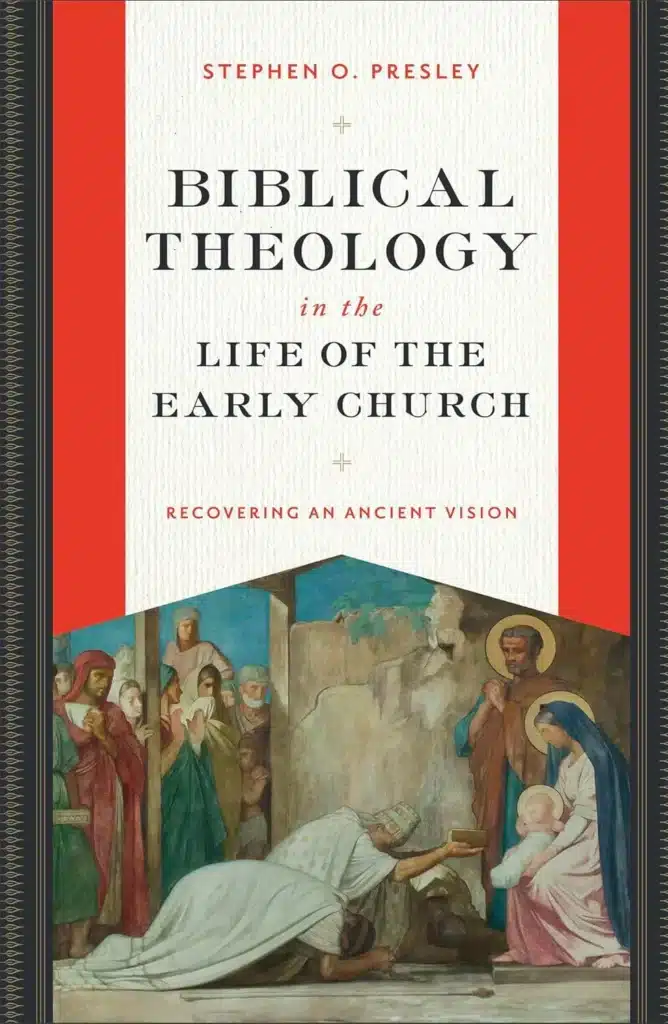
In his new book, Biblical Theology in the Life of the Early Church, Stephen O. Presley presents a historically rooted alternative to these unfortunate recent trends (whose approach to the Bible he memorably likens to IKEA furniture assembly). Presley’s book is both faithful to our historical sources and immensely practical for Christians today. As it happens, we do have plenty of sources for how the early church read the Bible—and so, there is no reason for us to invent new systems of reading the Bible whole cloth. We need, rather, to listen more carefully to the cloud of older witnesses, who had a healthy and vibrant “ecclesial biblical theology.” With this goal in mind, Presley focuses on church fathers like Irenaeus, Gregory of Nyssa, Ambrose, Augustine, and many others who wrote a lot about their love of the Bible and wrote even more about living as Christians in a world hostile to their beliefs.
What’s at stake for us today, when we listen carefully to the early Christians? For starters, a recovery of a distinctly Christian and biblical view of reality: “The fathers show us that the unity of Scripture makes sense only to those who participate in it. Ancient Christians do not merely theorize; they practice their biblical theology. They read Scripture as a sacramental guide on the journey of salvation.” Related to this is a genuine and fundamental love of Scripture—a recognition of its goodness, beauty, and truth. In a world where increasingly more people struggle to read books at all, and biblical literacy has declined even in churches, understanding why the Bible matters is inextricably connected to building a healthy faith and a love for the church.
In other words, understanding how early Christians interacted with the Bible, incorporating it into their daily lives and framework of thought as the very air they breathed, should enrich our own reading of the Bible as not just a duty but a true gift. As Presley puts it: “The early church’s social imaginary was framed in the rule of faith. It was a theological vision that imagined the relations between God, creation, and humanity. The fathers began with metaphysics, and that vision put every other intellectual inquiry (epistemology, ethics, aesthetics) in its proper place.”
Presley focuses specifically on the church fathers, most of whom were ordained to pastoral office. But there are no less significant implications of his study for people in the pews, ancient and modern. And so, building on Presley’s framework of early Christian love for the Scriptures in forming their “social imaginary,” I would like now to consider in brief two examples of believers who were not pastors, but whose deep love for the Bible and its overall story informed their writing, their everyday lives, and ultimately their love for God and his church.
Tertullian’s Biblical Studies
I bet you’re shocked to see me start with Tertullian here. We rightly include him among the church fathers, and Presley devotes significant attention to Tertullian’s Prescription against Heretics. But I think we too easily forget sometimes that this renowned church father was not a pastor. He was, rather, an intellectual lay Christian, who was passionate about the faith and wanted to live a deep life of the mind that would bring him closer to God.
It was with this goal in mind that Tertullian wrote, among his many other works, a treatise on the Lord’s Prayer. It is a moving commentary that is well worth reading. What I find especially striking is Tertullian’s taking of the prayer and its exhortation as directly applicable to all believers. Going through the prayer clause-by-clause, he keeps coming back to its application to all Christians as members of one body, the church. In the process, he cites or subtly refers to not only the Gospels (which we would expect), but also portions of Genesis, Exodus, 2 Kings, Psalms, Proverbs, Isaiah, Daniel, Jonah, Acts, 1 Corinthians, 1 Peter, Ephesians, both 1 and 2 Timothy, and Revelation.
This may not be a complete list, but you get the idea. The citations and quotations, moreover, are not the sort one would bring up from cursory reading. They indicate how well versed with the Bible as a whole Tertullian was. Ancient readers, even when relying on written documents, were still living in a world influenced by oral culture, a world in which many others around them did not know how to read. And so, they often had a much better memory than we do. The “gold standard” of education in Tertullian’s day still involved memorization of vast quantities of Greek and Latin poetry, such as Homer and Vergil. Tertullian had clearly absorbed significant portions of the Bible as well, and it is likely that at least some quotations he includes in this treatise came to his mind from memory.
This work is a fascinating glimpse into Tertullian’s thought process. He saw the Bible as a single whole, Scripture informing Scripture, and therefore requiring these cross-references throughout. Moreover, he had no doubts at all that the Bible as a whole—and the Lord’s Prayer in particular—applied to all Christians and was therefore important to understand. He concludes the treatise with a reflection on the incredible power of prayer—because Christ himself prayed too.
Reading this treatise, it is clear that for Tertullian reading the Bible was a way to know God more intimately, and he was excited to share his findings with others. Tertullian, as he grew in his faith, had an increasingly one-sided view of the world. He could only see it through the words of his Lord and Savior.
Proba’s Vergilian Cento as an Example of Systematic Theology
Tertullian was one-of-a-kind in some ways, but we know of many other intellectual lay readers of the Bible in the early church, and some of their writings survive. Indeed, it is important to remember that women were among these readers too.
In the mid-fourth century AD, an aristocratic Roman woman, Faltonia Betitia Proba, experienced a dramatic conversion to Christ. She then converted her husband and sons. Once converted, she decided to employ her considerable literary learning for the sake of telling others about her faith. And so, she wrote a work that is de facto a systematic theology of the Bible, telling the story of the entire Bible from creation to the arrival of the Holy Spirit, showing how everything points to Christ. But she didn’t just write a narrative of the subject. Rather, she composed a Vergilian Cento: a poem in 694 verses, all of them taken from the work of Vergil. Half of the poem tells the story of the Old Testament, and half of it is devoted to the New Testament.
To put it another way, Proba saw the echoes of the gospel in Vergil and recognized the value of telling the story of the Bible as a whole to Romans who may have been unfamiliar with it but were familiar with Vergil (as everyone was). We do not know if Proba’s poem converted anyone, but considering that she had managed to convert her husband and sons, it appears that she could be a persuasive evangelist. At any rate, her poem was popular with later Roman emperors, showing its distinct appeal to Christian readers.
The existence of this remarkable work is a striking example of the “social imaginary” that Presley describes and that Bible reading instilled in the early church. A lover of pagan poetry before conversion, Proba was eager afterwards to bring that poetry in subservience to Christ and the story of Scriptures. True, we may quibble over the literary merits of such work—it really is a pastiche of verses from another poet, arranged to tell the story of Scriptures, but still in total copyright cringe mode! But there is no question that the poem reflects a delight in God’s story that became the defining feature of Proba’s life and thought after conversion.
Faithful Readers in the Pews
Presley extends a call that is simple: as Christians, we are direct spiritual descendants of the earliest believers. And so, it makes sense for us to learn to think about the Bible through their eyes, to the extent that we can. The fruit of faith that their love for Scripture brought in their lives and in the explosive growth of the early church speaks volumes.
But there is an additional implication of Presley’s study, which I endeavored to bring to the fore in my two examples of early Christian readers who were not engaged in pastoral roles. The vast majority of Christians in every period of the history of the church are called to be sheep rather than pastors. But the call to know the Bible deeply—to absorb its beauty and its call to faith into every fiber of our being—applies to shepherds and their flock alike. And, as Presley puts it, “To discern the spiritual sense, the Christian exegete should adopt a way of reading that explains how the Scriptures point to Christ.” It goes without saying that every pastor should be such an exegete, but it is appropriate to remember that every Christian in the pews should heed this call too.
The call to love God with all our mind is for us all. And a key part of actively living that call lies in the faithful reading of Scriptures. We are living in an age of many crises—political, social, intellectual, cultural. All of them, though, are theological too. Being faithful readers of the Bible will equip us all, believers in the pews and pastors alike, to do what the earliest Christians sought to do as they were living amidst similar crises of their own age: to know that this world is not our home, to find comfort and encouragement in God’s word and his church, and to be salt and light to others all around.
Nadya Williams (PhD, Princeton University) is books editor at Mere Orthodoxy and 2025 Public Life Fellow at the Center for Christianity and Public Life. She is the author of Cultural Christians in the Early Church (Zondervan Academic, 2023), Mothers, Children and the Body Politic (IVP Academic, 2024), and Christians Reading Classics (Zondervan Academic, forthcoming Nov. 2025).