

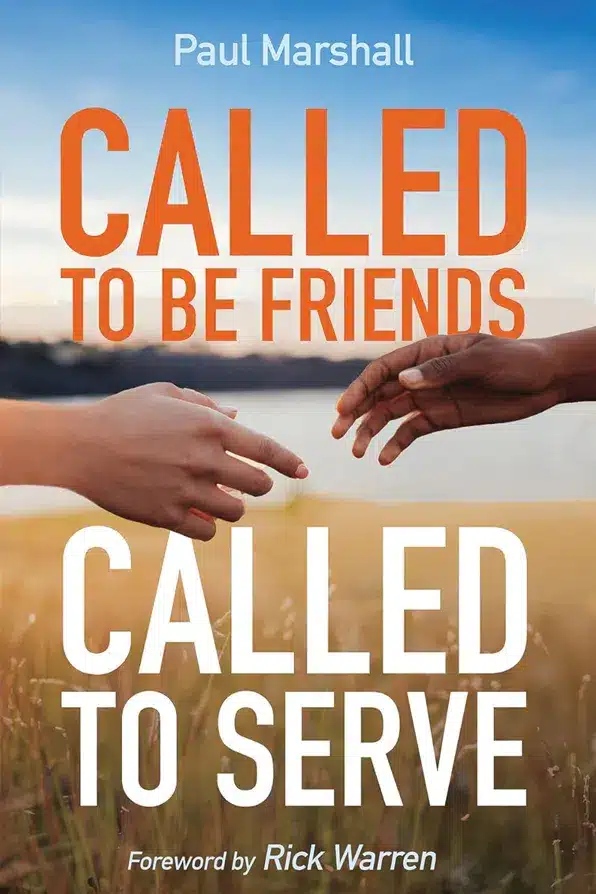
How does one of the richest white men in America become a lifelong friend with one of the poorest African American men in America? John Perkins barely survived his infancy, being nursed by his mother as she died of malnutrition in the South. Howard Ahmanson Jr., the sole heir to a massive inheritance, grew up in Southern California in a home filled with priceless artwork and resources most only imagine. Perkins’ heritage was a family of bootleggers and gamblers. He grew up facing racism and his life’s mission was to address that issue. Ahmanson faced his own struggles of being betrayed by family members and being involuntarily committed to a psychiatric clinic halfway across the country. As Paul Marshall says in Called to Be Friends, Called to Serve, “Howard was not raised in a racist cage, but a golden cage.”
Their unlikely friendship was essential for addressing complex social problems. Perkins taught Ahmanson the depths of problems facing the poor and downtrodden. Ahmanson was eager to learn from Perkins, while inviting Perkins to learn more about economics and the dangers of government programs. Over time, they challenged and encouraged one another on how to pursue long-term solutions for the poor and downtrodden. They loved each other well, through hard conversations and difficult times.
Without friendship, our solutions are prone to simplistic and naïve oversights. Though economics includes great theories of banking, trading, and monetary systems, friendship is the true sine qua non of economics. Only in relationships and in community are we able to understand the complex needs of our fellow man and to ensure that our intentions match the results. Too much of the Western world has lost sight of this simple truth anchored in the Judeo-Christian ethic. We have lost the personal amidst the data analytics and statistics.
The story of the friendship between Perkins and Ahmanson echoes what Ian McGilchrist concluded in his book The Master and His Emissary: Everything is relational. From the way we do science to the way we create art to the way we relate to the world, we are relational beings. Period. To be sane is to understand and embrace this understanding of the world.
Thankfully for Christians, this confirms what we already believe and have professed with our lips in worship. It is a reminder of Jesus’ declaration of the two greatest commandments—to love God and to love our neighbor. But we must not forget that Jesus proclaims, “All the Law and the Prophets hang on these two commandments” (Matthew 22:40). Everything we are called to do bursts forth from this call of love. As Perkins wrote in A Quiet Revolution in 1976, “The will of God is to love Him in a way that leaves no room for idols and to love our neighbor in a way that liberates him from poverty and oppression, either spiritual or physical.”
Naturally, this echoes the essence of the Ten Commandments we share with our Jewish neighbors. The first four commandments begin with our relationship with God and our work, and then the remaining commandments address how we treat our neighbors with love and respect. I rarely hear rabbis or pastors mention it, but those commandments also begin to give us an economic model that assumes private property. This implication emerges as it forbids stealing the property of our neighbor. Indeed, the relational aspect of basic society is inescapable. The limitations of stealing property, spouses, animals, and reputation (false witness) are all anchored in a relational ontology for life in civilization. Ethics and economics are wedded from the beginning in the context of a relationship, because God is a relational God. Ian McGilchrist is not a Christian, but his conclusion, if followed, should lead him to this relational God.
Seeing eye to eye, and face to face, with compassion and love for the other is the only proper starting point. We must stop labeling and therefore dismissing the full humanity of our neighbor. Such categorization of our fellow man leads to dehumanization. If we are to live as God would have us to live, we must insist on relationships of depth and love for one another. Our culture wars will not end as long as the labels remain primary.
The Hebrew University professor, Martin Buber, demonstrated so elegantly in I and Thou how we are made for deeply personal relationships. We want to be seen and known by someone we trust. Healthy families and societies are built on this foundation, and this is what Perkins and Ahmanson understood intuitively. As I have seen in pastoral ministry, each person has their own story of which we know very little. Our labels and assumptions often stunt our compassion and hobble our ability for meaningful relationships. I have friends who can barely pay their rent, and I have friends who manage billions of dollars. They all have wounds, fears, and stories of loss. Called to Be Friends reminds us of this truth. We should not put either man in a box because of their poverty or their privilege—we should love them both equally, as we learn their stories. Then we can learn from them in a way that honors them, and join arms with them in addressing poverty and racism.
The academy is in desperate need of this wisdom. For far too long, academic traditions have celebrated the ability to isolate, investigate, and define their expertise independently of relationships and other disciplines. Economics has suffered from this vacuous predisposition. As we emerge from the twentieth century and behold the failure of modernism to bring hope and meaning to our lives, we are invited to return to what is essential in life and in our Christian faith: Love of our brother and our neighbor, no matter how different we look, walk, talk, or spend our money. But even more, we are reminded to break down our theories until they make sense in light of the gospel. We cannot afford to repeat the sins of compartmentalization we have inherited from our predecessors.
The church has its own desperate need for this wisdom. One of Ahmanson’s wonderful “Howardisms,” as his friends call them, is his frustration over “Great Commission Utilitarianism.” Much of the Christian community has focused almost exclusively on evangelism and, therefore, reduced everything else in life to a utility for sharing the gospel. In this narrow view of life, art becomes propaganda, education becomes dogma, deep thinking about complex issues becomes too burdensome to pursue, and the concerns of the downtrodden and poor are never fully addressed. It is the reason Christians have failed to think more carefully about politics, economics, justice, media, and the arts over the last century. We forgot to see and address the needs of the whole person. The time is now to correct this blind spot, which exists particularly among protestant evangelicals. We need to broaden the scope of our vision, even as we take time to get to know and love our neighbor more personally. It is time for Christians to wake up from this Great Commission Utilitarianism mindset and regain the Kuyperian (biblical) view that all of life matters to God.
Ahmanson and Perkins took time to learn about one another. They relinquished the right to assume and to put the other in a box. Instead, they chose to love one another, as they sought to love Christ with their very lives. This is the way forward. It is the way to honor God, to pursue justice, to love well, and to be humble in the process.
Our culture yearns for something more than what academics, philosophers, and economists have provided. We need our imagination sparked. Our culture is longing for men and women in media and the arts to create films, novels, and virtual experiences that remind us that everything is anchored in relationships. We need to expose the lie that we will be free when we escape our traditions, our family, our culture, or even our biology.
The solutions are not found in escape, but in relationship. Our society, and much of the developed world, is hungry for true friendships and more meaningful relationships.
We need songs to awaken our hearts. We need novels to develop our imagination, and we need all the arts to speak to our culture in ways that politicians and academics never will. We need a renaissance, one built upon a view of a relational God who calls us to love our neighbor in every facet of society.
Our culture is tired of dystopian art and media merely reflecting the ills of society. We long for justice and human flourishing, but we need to know what it looks like. We need more stories like the relationship between Amanson and Perkins to be made into art that forms the moral imagination of our society. From fine art to video games, we need diversity defined by the gospel, and justice and love defined by God’s character. If we are going to resist the Great Commission Utilitarianism, we must imagine and address how the gospel transforms every inch of society.
The Rev. Joel Pelsue (MDiv, Reformed Theological Seminary) is the cofounder and president/CEO of Arts and Entertainment Ministries, which empowers mainstream artists and creative professionals to embody the transformative power of the gospel in the art world and entertainment industry.