

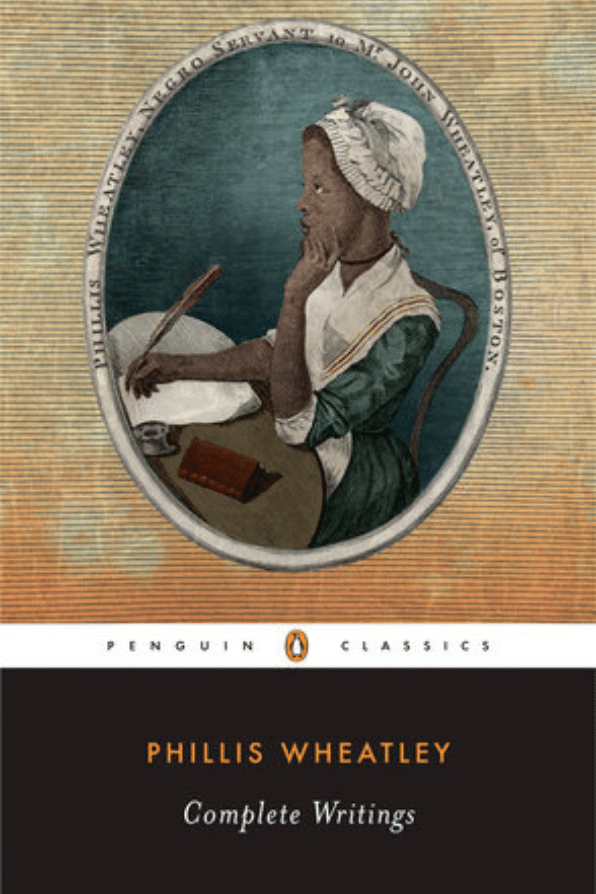
Do words make anything happen? This sort of question—frequently posed of poetry, and posited more widely in disciplines within the arts and letters—can, for the purposes of this essay, be boiled down to: what in the world does literary creativity do?
Yes, poetry may stir the heart and engage the mind, but does it change humans? Their actions? The course of history? The writings of Phillis Wheatley Peters (ca 1753-1784) would seem to resound affirmatively—and not only because she believed God created the whole world with five utterances of “Let there be.” (Those words did something!) The correspondence between Wheatley’s words and the results on culture and democracy in the British colonies and the emerging United States of America flows through a non-linear and zigzag telling; nonetheless, many scholars, such as Honorée Fanonne Jeffers, believe “Wheatley was important in dispelling derisive eighteenth-century notions about black humanity.”
In the crude telling of Frederic May Holland’s history of Frederick Douglass (1818-1895), subtitled The Colored Orator, written and published while the nineteenth-century abolitionist was yet alive, the slave master forbids the seven-year-old enslaved Douglass from learning to read. The master’s claim was that literacy “would spoil any n——.” Once Douglass, the future emancipator of letters, learned this, Holland tells us, “he made up his mind to get all he could.” Wheatley was a similar age (likely about eight years old) when she was enslaved and transported from west Africa on the ship called the Phillis, arriving at the Boston harbor in 1761 where, shortly thereafter, she was sold to the Wheatley family.
The institution of slavery in the United States of America, ranging from 1619 to 1865, was not an unvaryingly homogenous experience. For example, there are distinctions worth noting between the differing enslavements endured by Douglass and Wheatley. At least two noteworthy nuances should be offered. First, the definition of race and blackness was more unfavorable in Douglass’ nineteenth century than in Wheatley’s eighteenth century. Considerable scholarly work has traced the rise of polygenism, romantic nationalism, and scientific racism which led to an elevation of structures and practices of racial prejudice in the nineteenth and twentieth centuries. Second, the domestic servitude of Wheatley’s Northern city of Boston was often less brutalizing than the chattel enslavement of Douglass’s Maryland, rooted as it was in the Southern plantation system supporting the economies of tobacco, sugar, rice and cotton.
What Wheatley and Douglass shared was their deployment of a literary response to racism, their deft mastery of rhetoric, their strategic resistance that used the King’s English to appeal to the consciences of earthly monarchs and a prayerful appeal to the Monarch who superseded all: “ARISE, my soul, on wings enraptur’d, rise / To praise the monarch of the earth and skies” (Wheatley, “On the Works of Providence”).
Unlike Douglass, Wheatley carried, besides race and social status, the third burden of gender. Just like Douglass, she carried herself in a manner that was charismatic, eloquent, educated, and courageous. Assuming a prophetic voice, she granted herself the authority to compose a poetic entreaty to the students of Harvard, the premiere institution of higher education in the U.S., “To the University of Cambridge.” As Vincent Carretta summarizes in his biography of Wheatley, “Audaciously, the teenaged, enslaved, female, and formerly pagan poet of African descent assumes a voice that transcends the ‘privileges’ of those who are reputedly her superiors in age, status, abilities, authority, race, and gender.”
Religion
Certainly, the faith of John and Susannah Wheatley was a motivating force and factor in their tutelage of Phillis. The First Great Awakening (1730-1755) had stirred personal conversation and revivalist religious experience. The Wheatleys were respected members of their Congregationalist parish. Theirs was not a pathological benevolence; their actions were not motivated by condescending patronage. Neither was Phillis an experiment in whether enslaved persons could learn. The Wheatleys willingly taught Phillis to read the scriptures and the classics, to write, and to poeticize; moreover, she herself was a precociously eager participant. To quote W.E.B. Du Bois, “Religion in the United States was not simply brought to the Negro by the missionaries.” While she may not have been fully familiar with the Old Testament Exodus narratives or with the gospel stories of Jesus Christ as articulated in the New Testament, the biographer Carretta notes that she would have known of an omniscient and benevolent deity who did not endorse slavery but endued within her a yearning for freedom.
Wheatley’s February 1774 letter to the Native American minister, Rev. Samson Occom, exemplifies her ability to grab attention with both time-honored nobility and biting incisiveness. Here, her soaring lyrical abilities combine with searing prophetic sarcasm:
for in every human Breast, God has implanted a Principle, which we call Love of Freedom; it is impatient of Oppression, and pants for Deliverance; and by the Leave of our Modern Egyptians I will assert, that the same Principle lives in us.
These words soar also in terms of their content. The “Principle” all humanity exhibits is a genetic, theological anthropology that predisposed it to embrace the Christian story of redemption: “For freedom Christ has set us free” (Galatians 5:1). But that very natural human condition exposes, in her words, a “strange absurdity”: that freedom-seeking colonists hold slaves in bondage! A key phrase is “by the Leave of our Modern Egyptians.” Here, with a wry tone, “by the Leave” means “by their indulgence” or “according to their permission.” She draws the analogy of a common humanity, “in every human Breast,” to underscore the hypocrisy of slave-holding “Modern Egyptians,” slave-holders seeking freedom.
Culture
Wheatley confessed an earthy Christianity which took seriously not only the claims of religion, but also the historical theatre of its incarnation, the locus of its praxis, and the planetary and peopled dimensions for faith active in love. This faith, as it is classically understood and articulated in Joseph Sittler’s The Ecology of Faith, “is not naked, it is historically embodied.… And culture is the name for that ecological matrix in which the embodied will and deed from above addresses the embodied hearer at every point along history’s river.”
Being transported to the new world meant (quoting Du Bois again), “transplanting to the United States a certain spiritual entity, and an unbreakable set of world-old beliefs, manners, morals, superstitions and religious observances.” Upon surviving the horrific weeks-long crossing of the Atlantic, the infamous Middle Passage, Wheatley arrived in Boston in 1761. Amazingly, it was a mere twelve years later, as a twenty-year-old, that her book of poetry arrived in the U.S. aboard the Dartmouth from London, where it was set and printed—the first book of published poetry by a person of African descent living in what would become the United States. Titled Poems on Various Subjects, Religious and Moral, it adheres to a classic style, akin to Alexander Pope. Even though Wheatley wrote in standard idiom, as a black woman she may have been unable to find a U.S.-based publisher. I adore how undaunted and slightly saucy she was in “On Being Brought from Africa to America”:
‘Twas mercy brought me from my Pagan land,
Taught my benighted soul to understand
That there’s a God, that there’s a Saviour too:
Once I redemption neither sought nor knew.
Some view our sable race with scornful eye,
“Their colour is a diabolic die.”
Remember, Christians, Negroes, black as Cain,
May be refin’d, and join th’ angelic train.
We would recognize the names of the most earliest commentators regarding her work and its cultural impact: George Washington, John Hancock, Massachusetts Governor Thomas Hutchinson, Benjamin Franklin, Thomas Jefferson. (Indeed, Henry Louis Gates’ The Trials of Phillis brings many of these discussions together in one work.) Her words were animating and attracted attention. Dana Gioia describes how this happens:
When a piece of writing gains enough notoriety to create controversy, the responses it generates often have little to do with the original text. The work has somehow struck a nerve, usually by examining an issue others have obscured or ignored.… The culture is now at work, and the author has become only one of the spectators.
Democracy
Wheatley carried a religion from Africa that intersected with and was redefined by Calvinist, evangelical Christianity in the U.S. Wheatley imprinted her vocation as a public intellectual upon the overall emancipatory ferment of this emerging nation—one, in 2026, now celebrating its semiquincentennial. While her rhetoric was revolutionary, her prescription and protest do not include overturning existing functional society in order to fix it. Too often, governments rise or fall, unravel or spiral, oxygenize or suffocate as they negotiate human rights. Doom can ensue under the pressure of a rights-based regulatory bureaucracy where obligation, mutuality, and reciprocal duty are under-developed or isolated from the culture of a common humanity.
Among Africans of Wheatley’s Boston, the impulse for freedom which predominated appealed typically not to special rights for a group or for individuals, but to natural law and divine law (emanating from the Judeo-Christian imago dei ethos) which enshrined justice for all. As Carretta notes, “The Americans can’t make law to enslave the Africans without contradicting the law of God and the law of Great-Britain.”
In The Intellectual Origins of American Slavery, John Samuel Harpham articulates how Aristotle’s approach to human enslavement in his Politics shaped the natural-law tradition; Harpham shows how Aristotle promulgated slavery for persons who were naturally predetermined to be ruled, no matter their legal status. In contrast, Justinian’s Institutes, emerging from the legal theory of the Roman Empire’s Corpus Juris Civilis, claimed that universal freedom was the default human condition, but this could be justifiably obviated by certain circumstances of life—like being a prisoner of war (a conceivably better outcome in contrast, for example, to being killed) or by voluntarily selling oneself into slavery. The Justinian approach, prevailing at this time in Britain and its colonies, Carretta notes, led Wheatley and others of African descent in Boston to invoke “natural rights and Christian morality to petition the government of Massachusetts for their freedom.” These early voices shaped the growing abolitionist movement.
Conclusion
The litmus test for the durability and integrity of a democracy—or a religious tradition, for that matter—is, according to Jordan J. Ballor, “How are those who are the most conspicuously different from the dominant culture treated?” The two extremes of error in treatment conducted by the dominant culture are to be wrongly dismissive of conspicuous difference that is, in fact, constructive; or to be wrongly permissive of conspicuous difference that is, in fact, destructive. Wheatley becomes a primary candidate for this test because she was both “conspicuously different” as a woman and an enslaved laborer from Africa, yet her writings were constructive, grounded in a religious faith and poetic culture that shone with luminous intellectuality and necessary social criticism. She was conspicuously different in variables that do not constitute the core of who humans are; yet her poetry serves as an entrance into a common woundedness and beautiful ontology, a view of the human person more essentially common than the accidental externalities of identity. Her literary quality communicates her culture, transcending stereotypes that would become in the following centuries (such as buffoon-like deployments of dialect or the performative nature of minstrelsy). She took language to be a craft with serious purpose. Episodically, she throve; mostly, she struggled. As such, Carretta explains, “Wheatley’s poetry continued to be used by black as well as white antebellum American abolitionists as evidence for the humanity, equality, and literary talents of people of African descent.”
The literature of Phillis Wheatley Peters constitutes a public expression of the humanities suturing up an otherwise dehumanized brokenness in order to make at least two things happen: 1) she draws together disparate and conspicuously different persons with enduring human ties and 2) she calls forth that which is most primordially virtuous in humans in a manner that humanizes all who dare to read her. Because her work and her words do something, they shall endure.
John Arthur Nunes (Ph.D., Lutheran School of Theology at Chicago) is the president of California Lutheran University. In addition to his time there, he has served for more than thirty years as a leader of academic institutions and nonprofit organizations, including as president of Concordia College–New York, as the president and CEO of Lutheran World Relief, and currently as a senior fellow at First Liberty’s Center for Religion, Culture & Democracy.