
A professor who was present at the 1978 Harvard University commencement when Aleksandr Solzhenitsyn delivered his famous address, “A World Split Apart,” described the response from the audience as “stunned silence followed by seething anger.” Such a reception was reflective of Solzhenitsyn’s chief frustration with Western audiences. They read his work through an ideological lens that transformed any critique of the Soviet Union into an affirmation of the West. In a world divided by an iron curtain and living in the shadow of the threat of nuclear war there was little space among the intelligentsia to entertain the type of critique offered in that Harvard speech. The world was divided—East vs. West, Right vs. Left, Republican vs. Democrat, Conservative vs. Labor.
Like Solzhenitsyn, the work of the late Sir Roger Scruton (1944–2020) has been subject to much ideological interpretation. Sir Roger did not write and speak as an outsider to the West or to politics; he had close relationships with several political figures and did explicitly comment on contemporary political and social issues. But he was not an ideologue. He was principled in the articulation of his ideas even when they did not toe the line of a particular party platform or political agenda.
Sir Roger identified the moment when he realized that he was a conservative in an interview recounted in his obituary in The Daily Telegraph. His realization came in 1968 in Paris while watching his peers riot and clash with police. As they overturned cars and tore up cobblestones from the street to throw at police, Scruton “suddenly realized [he] was on the other side.” The rioters were “an unruly mob of self-indulgent middle-class hooligans” only able to defend their actions with “ludicrous Marxist gobbledegook.” He committed himself to find “a way back to the defence of western civilization” with a conviction that he wanted to “conserve things rather than pull them down.” For the next 52 years Sir Roger charted that path boldly and faithfully.
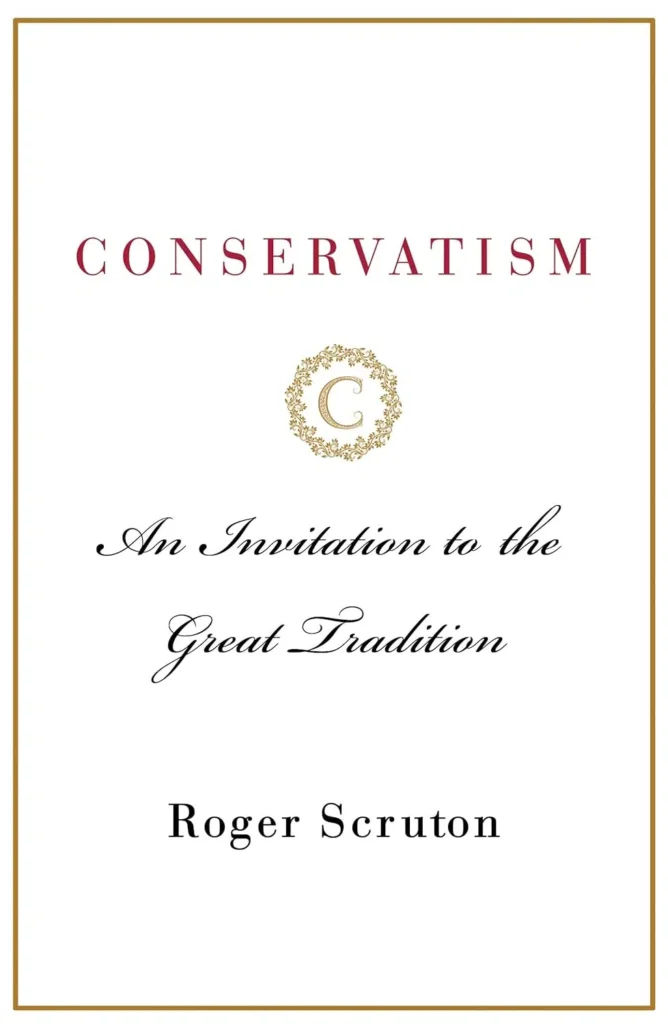
It is for this reason that one of Sir Roger’s last books, Conservatism: An Invitation to the Great Tradition, has been selected as the subject of the very first edition of the Reading Wheel Review (RWR). Some of Scruton’s earlier works have proven to be quite influential. And there are others that present more intricate or novel arguments. A relatively recent work, Conservatism is, by contrast, profound in its simplicity and straightforwardness. The RWR editorial team knew that the strategic selection of the first book was important for two reasons. First, it would offer the opportunity to set the tone for the publication. Not every book featured in subsequent editions will fall into the same genre as this book, but each will be engaged fairly, on its own terms with proper consideration for its context and the goals of its author. Second, it provides an opportunity to illuminate the way that the values, mission, and vision of the CRCD have taken shape. While firmly and unapologetically conservative, the CRCD strives just like Sir Roger not to be ideologically driven.
This book serves these purposes well. I often describe the CRCD’s work as “civilization-affirming.” The CRCD owes much of the conceptual architecture of our animating commitments to Sir Roger, a philosopher who dedicated his life and career to finding “a way back to the defence of western civilization.” We seek to be fellow travelers on that same path with the same ideals and goals in mind. So much good can be done by recognizing the wisdom of those who have come before, valuing tradition, and conserving the good in our collective inheritance while seeking to adapt and apply it to the present. Further, this book embodies the ethos of conservatism in its arguments and its temperament. This essay will not recount the substance of every chapter, but rather will focus on these aspects of Conservatism: An Invitation to the Great Tradition.
An Invitation, Not a Manifesto
Even the most unsympathetic reader of The Communist Manifesto by Marx and Engels will notice the earnest tone of the work. This seriousness is manifest in the authors’ observations about society, their confidence in their own diagnoses of its problems, and the urgency of the need to immediately execute the revolution that is, in their view, inevitable.
There are no conservative manifestos, however. Such would be a contradiction in terms, if not also in spirit. Sir Roger has explicitly written an invitation to “well-meaning liberals to take a look at what [conservative] arguments really are.” In that sense, this book is something more of an apologetic in the classical sense of the word. It clarifies what it means to be conservative and seeks to shed the baggage that the term has acquired through political and ideological appropriation.
Conservatism is, properly understood, a disposition rather than an ideology. It provides a unique way to understand “disputes over law, liberty, and justice” as being grounded in “historic and existing communities.” Conservatives are concerned with the substance of social cohesion—that which “binds them to the place, the customs, the history, and the people that are theirs.” Sir Roger notes that political language that is not “spoken in the first-person plural (i.e. ‘we’)” creates law that is “an alien imposition” and undermines legitimacy whether that law is imposed by a distant elite ruling class or a conquering power. For the conservative, our existing institutions are repositories of wisdom that already contain the clues that we need to settle our disputes and construct the rules and customs that govern our shared life together.
Conservatism, then, does not need a manifesto. True conservatives do not seek to lock society into obsolete ways of doing things, but merely caution that we risk unraveling the entire tapestry when we indiscriminately tug at loose threads.
Tradition, Not Innovation
It is an easy thing for a mind steeped in the modern conception of the individual as the arbiter of all things to believe that he or we sit atop history as the culmination of all that has come before. But traditions are not things that culminate. They are, rather, inherited. A family tradition may have a starting point in a log cabin with no electricity and involve speaking or singing in an immigrant tongue. When the children in those log cabins have children and grandchildren and great-grandchildren, that tradition is passed down to families only distantly related to one another who have adapted or abandoned aspects of the tradition, who observe them in suburbs and cities, and use the language of the assimilated culture to speak or sing. In this way subsequent generations participate in a tradition that evolves and adapts over time. The immigrant grandparents in the log cabin never envisioned the ways that it might evolve, and the grandchildren who inherit them have never intended to innovate or reinvent those traditions. Traditions may die, but they never take on an ultimate form. They only evolve and adapt.
Conservatism does not seek to innovate, only to adapt. In fact, like its cousin, liberalism, conservatism is a reaction to a political innovation. Chapter 1 of this book traces what Scruton calls the “pre-history” of modern conservatism through the thought of key thinkers like Hobbes, Hooker, Blackstone, Burke, Hume, and Locke. While there are examples that precede it, the seventeenth century saw a clear shift from an understanding of sovereignty that emanated from a monarch to the people to a “bottom up” understanding of popular sovereignty. It was not the king that legitimized the rights of the people, but the people who legitimized the power of the king. Liberalism’s response to this innovation was (and remains) an enthusiastic, “Yes!” Conservatism’s response was (and remains), “Yes, but…”
As a tradition conservatism is, therefore, a forward-looking and humble posture toward the future. Edmund Burke famously wrote that “we must reform in order to conserve,” a sentiment explicitly invoked by Scruton. The conservative does not desire the world to be stuck perpetually in an arbitrary point in time, whether it is the idyllic 1950s of Leave It to Beaver, the perceived height of U.S. stature abroad under Ronald Reagan, or the Christendom of medieval popes. Rather, conservatism looks with humility to the past to solve contemporary problems in such a way that respects the reality that future generations will be best situated to solve the problems posed by their own evolving contexts. The “we” of legitimate political discourse cannot include those who do not yet exist, so solutions that unnecessarily bind the options of generations yet to come are not conservative and represent the prospective imposition of an alien law on the future. In this way conservatives value the inherited tradition as temporary caretakers who are soon to pass it along to their own children.
Modern Conservatism
The final chapter of Conservatism has proven to be controversial, with the New York Times going as far as to accuse Sir Roger of using the anxieties harbored by racists to convert them to a conservative perspective. This is not, however, a fair reading of this chapter. In these pages he engages with contemporary challenges to a conservative posture, some of which present threats to Western civilization itself.
First, Scruton addresses the rise of a broad demand for “political correctness,” which has almost certainly intensified since the book was published in 2017. He himself suffered the consequences of a sensitive culture only willing to entertain a certain orthodoxy. He was summarily sacked in November 2018 from an unpaid government appointment because of an interview that was unfairly edited to present an inaccurate picture of his comments. After a recording of the entire interview was released, apologies from journalists and politicians followed, but in a less sensitive climate he merely would have been able to correct the account and not been the victim of unconsidered, reactionary virtue-signaling.
Second, while Scruton does not use the term, he discusses what some refer to as market fundamentalism. Because those on the political right are historically champions of the free market, including most notably Margaret Thatcher in the British context, it is easy to dismiss conservatism with the same arguments one can use to dismiss market fundamentalism. But Scruton was not an enemy of markets, per se—he was just primarily interested in more fundamental things. “The market economy [is] a good thing but [isn’t] the foundation of social order and should be heavily qualified by all the traditions that enable people to live with each other rather than just compete,” he once said. A merger of conservatism and liberalism in the latter half of the twentieth century has meant that each has lost its distinctiveness and opened this new singular, often politicized position to the critiques of each distinct position.
And finally, what attracted the most ire from some is the discussion of the threat posed by radical Islam. It is important to note that the examples that Scruton employs are examples of Islamists rather than the followers of Islam more broadly. But even so, the truth is that it is an historical reality that the West and the Muslim world are indeed two different civilizations, and a citizen of one entering the other must be cognizant of this reality. Nowhere does he argue (in this book or anywhere else) that Western citizens must be Christians or those who come from outside of the West must convert. On the contrary, only when conservatism is understood to be an ideology rather than a disposition can this possibly be true. Every civilization has unique institutions formed by a unique history, religion, experience, and, well, tradition. To tug on the loose threads of any civilization imperils the entire tapestry. Every member of a society, whether native or new, should remember that. And Islamists represent a unique group that is focused on purposefully tugging on—if not violently pulling down—those threads.
Conservatism is in many ways a perfect bookend to the life and work of Sir Roger Scruton. Clear, readable, interesting, and wide-ranging, it is reflective of the qualities that made Sir Roger himself so unique. It is with these considerations in mind that this first month features engagement with this extraordinary book by such an extraordinary thinker, an entirely fitting opening to the larger endeavor of the Reading Wheel Review.