
Some evolutionary biologists make the observation that natural selection continues in the contemporary world. Yes, the evolutionary process whereby those more fit in a particular environment pass on their genes and those less fit do not continues to shape our species. The reasoning is simple: in the contemporary world, as throughout history, there are those who reproduce and those who do not. Once upon a time, whether one’s immune system could survive the latest plague or whether one could outrun the saber-toothed tiger determined fitness to pass on genes. That’s logical enough. What about in modern society? Few of us need to worry about surviving such things to pass on our genes. I disposed of a nasty bout of pneumonia last summer with a single round of antibiotics. What determines “fitness” in a society with advanced medical technology and a great deal of wealth protecting us from the common natural deaths that picked off our ancestors and, indeed, ensured that a great many humans from previous generations never became anyone’s ancestors? What is the process of selection taking place today that separates the fit from the unfit?
Evolutionary biologists may not have an answer, but Catherine Pakaluk does. In a word, the answer is love. Love for life for the sake of life. Love for persons for the sake of persons. Loving for the sake of loving. All this bound up with a willingness to die to oneself. If this sounds like Christian language, it is. It is also the language mothers of many children use to describe their experience bringing lives into the contemporary world in defiance of a culture that looks askance at such decisions, encouraging in ways large and small a choice for infertility.
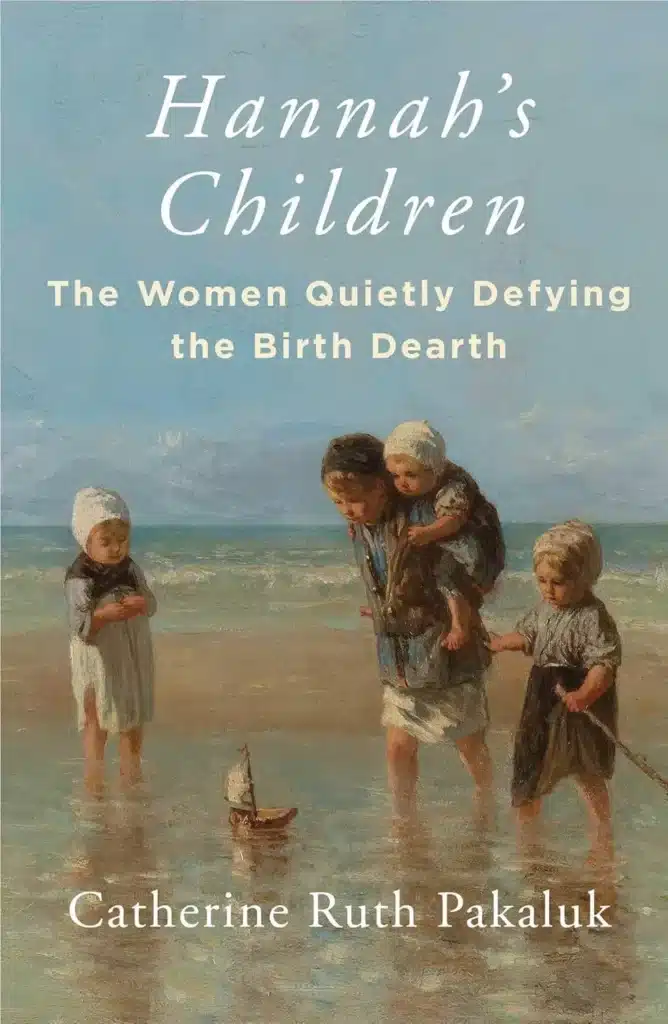
Reading Pakaluk’s book Hannah’s Children: The Women Quietly Defying the Birth Dearth, I did not expect my thoughts to drift to Darwinian metaphors. Language suffused with life-affirming overtones of Christian charity does not jive with the cold calculus of Darwinian evolution, but here we are. Today, the fittest among us in a purely Darwinian sense are the ones who live out the spirit and letter of Scripture, even those who are not religious (as at least one of the women in Pakaluk’s book are not).
Pakaluk’s tale begins with the problem of the birth dearth. For centuries, population growth has been cast as a problem. Malthus and his followers worried constantly that a fixed food supply would fail to feed the growing masses resulting in fierce competition for scarce resources thus threatening hard won human civilization. What’s missed in this discussion is human capital. Human beings do not just consume resources; we also produce them. The scare-mongering continued even as the catastrophes failed to materialize, resulting in public policies and propaganda campaigns aimed explicitly at discouraging reproduction. This continued through the latter half of the twentieth century even as fertility rates indicated that a birth dearth was not only on the horizon, but had already arrived. Population would continue to grow, of course, as more persons were added to the total and fewer died thanks to the aid of modern medicine, like my own round of antibiotics. We may only now be seeing a birth dearth of civilization-threatening proportions, but we propagandized generations to believe that the primary civilizational threat is—wait for it—children.
No better time than Advent to contemplate that doozy.
What of those who failed to imbibe the propaganda? Pakaluk interviews some fifty-five mothers who have given birth to five or more children, putting them in the top five percent of mothers. Her goal is simple: to determine why. Why, when all social, cultural, and economic pressure is toward fewer children, do these one-in-twenty choose to produce more lives rather than fewer? The answer lies in that of perspective. These women do not view the world through the self. They do not value personal autonomy. Make no mistake, they know the value of personal autonomy. Like anything, you value something when you lose it. It’s not that personal autonomy doesn’t matter. It’s that these women believe other things matter more. Rather than fitting children into the narrative of self, they fit their selves into the “greater narrative of childbearing.” Pakaluk writes that the mothers “spoke of self-sacrifice but not of losing themselves. My subjects believe they have found themselves in having children.” One extraordinary mother responds to questions of her loss of autonomy, “Since autonomy is not my primary value, it doesn’t matter. People are actually my primary value. Persons are my primary value, and I have a home rich with persons.”
Pakaluk knows of what she speaks. She is the mother of eight, most of whom were born by the time she finished her PhD at Harvard. She is now a professor at the Busch School of Business at the Catholic University of America. Pakaluk knows the challenge that children pose to career accomplishments and the joy they bring, and not just to mothers. But let’s start there.
Social scientists and social activists have puzzled over the paradox of female happiness. To the degree that women achieved their liberation from home and childbearing, the shackles of nature and tradition shorn off, their collective happiness declined. Today the happiest women are married mothers, the ones that are supposed to be the most miserable according to the narrative we’ve been peddled. It’s almost as if modern ideologies, contemporary “-isms” of all sorts, fail to capture the true nature of human experience. It’s almost as if tradition, religion, and old prescription are better guides to human wellbeing than the ideological fads of the hour—or the century.
If only someone had warned us!
The extraordinary women Pakaluk interviews find themselves in their children, but not in a possessive sense. If being the mother of many teaches one anything, it is to find oneself by losing oneself. One mother says, “Do I feel like my children are my accomplishments? I more feel like they are who they are.” Persons are what matter, and not only to their mothers.
An important finding, but one that Pakaluk did not expect and did not design her study questions to understand, is the healing power of children. A non-negligible number of women described episodes where a new child brought profound healing. One family had an eight-year-old suffering from crippling depression. Therapy and medication availed little. Then the new baby arrived. Everyone had to take turns holding and otherwise caring for the baby. That practice of holding new life in his hands brought that little boy profound meaning and mental healing and his depression receded.
Another woman described how her husband lost his dad and job in rapid succession, profound life-altering losses that like an anchor bore him down into the depths of depression. Their daughter was born and, in her words, she handed him their daughter—and he never put her down. Grief both personal and professional melted at the touch of a child. Pakaluk explains, “Children give love, but they also call forth love, and the latter is the greater gift.” You give up much when you have children, but they give it back, with interest. Bypassing childbearing is a poor life investment in terms of personal fulfillment and happiness.
This lesson is one we should, but don’t, teach our young people, depressed and anxious as they are, claiming their lives feel meaningless. A baby makes life meaningful. Babies are helpless and must be cared for or they will literally die. What could be more meaningful than engaging in that care? Few young people grow up in a house with siblings young enough that they remember having a baby in the house and taking responsibility for it. No doubt the reasons for the mental struggles of our young are legion. One effective treatment might be the very thing we have spent generations eschewing: the burdens and blessings of children.
Perhaps the means of our salvation coming as it did in the form of a child ought to have been a hint at the significance of children to our own wellbeing. Leave it to us moderns to get that lesson exactly backwards.
This relates to one of Pakaluk’s more profound points, but one that might be lost on the casual reader. Children are a way, perhaps the primary way, to lock one’s self into the great chain of infinity, as one mother calls it. Pakaluk writes, “This expansion has somehow opened [mothers] to receive gifts of love and sacrifice from their own ancestors, gifts whose meaning had remained inaccessible until unlocked by their own choice to participate with those ancestors in reaching toward the infinite.” You don’t realize what your parents did for you, not really, until you do those things for your own children. Then you realize what your parents, grandparents, great-grandparents, great-great-grandparents et al. did to bring you into the world, to make you what you are. You will only really realize this in full when you join that “great chain of infinity.”
Nonetheless, there is no getting around that children are enormously expensive. I don’t mean that in a consumerist sense. I mean they are expensive in terms of opportunity costs. No government subsidy is going to make up for that. Children are expensive compared to an abortion. Abortion policy makes the calculation clear. If children can be disposed of so cheaply, how valuable can they really be? The policy of abortion on demand contributes to a culture of death. This is key to Pakaluk’s point: What sort of people are we? What do we value? Do we value persons? Do we value human life, as do the women Pakaluk interviewed? I mean this in the concrete sense. Do we value actual human beings who we bring into the world through our actions and then spend decades pouring ourselves into to develop their potentiality into actuality?
On the whole, the answer is clearly no. We are not a people who value life, the substance of persons, in this way. We value our autonomy, fleeting pleasures, experiences worthy of an Instagram post, entirely inappropriate to most moments of parenting. To the extent this indictment is true, we are a civilization that deserves to pass into a historical curiosity.
The sort of society represented by these women—and their husbands—is the sort that deserves to survive. It is one that values life in its promise and potentiality and brings it into being. It is not mere childbearing that defines these women. It is devoting their lives to having many children. Quantity has a quality all its own. Something about the insistence on more is transformational. For these women, raising children is not a brief period of sleepless nights that mercifully passes. It is instead who they are, beings who sacrifice over and over for years and then decades. The sort of people who raise many children—and are raised with many siblings—are the sort of people who embody virtue in a concrete sense because the opportunity to practice virtues is persistent in their lives. In what other activity besides parenting do you get the opportunity to be shaped into a self-sacrificing and other-regarding being? Where do you learn to value life as you do in the presence of children?
Consider the salutary effects on society of a people so raised. Pakaluk explains, “Raising children results in profoundly altered attitudes, behaviors, and loves. It would be reasonable to expect those alterations to spill over into other areas of life, from work to church, politics, and community.” The concrete experience of raising children and of being a sibling to many others instills virtues that are hard to come by being raised in any other way. “The testimonies in this volume suggest that a lack of fraternity and sorority—the state of growing up without a brother or a sister—matters more for the character of the nation than ideas left to us in dusty books,” observes Pakaluk.
What does this mean for public policy? Not much. The problem isn’t one of policy. It certainly is true that policies can make families harder or easier and our society, as Tim Carney has shown, has made having children harder in every way. That is simply the downstream effects of the colossal cultural problem that Pakaluk illuminates. They are symptoms of disordered priorities rather than the cause of our social disease. We, as a society, dislike children, thus we deprioritize them and their parents in policies. We prioritize single adults and their ability to have a comfortable life of fleeting pleasures, assuaging their depression and anxiety with pills and therapy and social media and constant affirmation that their poor life investments are worthwhile. This is true culturally in how we treat career accomplishments. These women report that despite that great joy they derive from their decision to have many children, they feel betrayed in some way, invisible, because their careers inevitably take a hit.
Shame on us. It says nothing good about our society that their decisions are treated as poor ones and they are made to feel invisible. The raised eyebrow, the rude comment, the whispers of irresponsibility are directed toward the mothers of many. Choose against life, choose to live for yourself, and you will be praised for your independence and autonomy. Choose life, choose to die to yourself, and society will shunt you aside.
This is an important book, but it is incomplete. This isn’t criticism of Pakaluk’s research. The book is about the women defying the birth dearth and we get a complete picture of them. Rather, Pakaluk’s insightful discussion calls forth a legion of other books to expound upon the implications of her findings and argument. Hannah’s Children reorients our thinking in politics and society and makes obsolete many works of political and social theory, both liberal and postliberal. New works must be crafted upon the paradigm shift we discover in Hannah’s Children.
Even so, I will not say that this book is the most important thing Pakaluk will do, although the insights are keen and the implications profound. That would be to sell her short. I do think it may be the ninth most important thing she will do.
At some distant age when some future iterations of the genetic scientist ponder reasons for the genetic bottleneck of our civilizational period, I hope they will have access to Pakaluk’s book. The answer to who the fittest are in this civilizational period is found therein.
Luke C. Sheahan (PhD, Catholic University of America) is Assistant Professor of Political Science at Duquesne University, a Senior Affiliate in the Program for Research on Religion and Urban Civil Society (PRRUCS) at the University of Pennsylvania, and Editor of The University Bookman. He is author of Why Associations Matter: The Case for First Amendment Pluralism (2020) and editor of International Comparative Approaches to Free Speech and Open Inquiry (2022).