
I love American history. My interest was sparked in elementary school by reading biographies of great leaders. Surveys of American history assigned in high school and college classes threatened to detract from this love, but it was resurrected by books written by academic and popular authors that helped me better appreciate our nation’s compelling story.
In college and graduate school, I earned degrees in politics, but almost all my research projects were historical in nature (see, for instance, my dissertation and first book: The Political and Legal Philosophy of James Wilson: 1742-1798). Writing about the American Founding and religious liberty/church-state relations in the United States has given me the excuse to read numerous books and articles written by historians. Some works are more interesting than others, of course, but on balance they encouraged me to learn more about American history.
The Problem
I have never taught an American history survey course and cannot claim to have carefully considered the various survey texts available for high school or college teachers. However, several projects led me to dive into them for limited purposes, such as examining how they treat the American Founding, the development of religious liberty, and disestablishment. I was unimpressed by what I read. Most surveys seem designed to make American history uninteresting, unappealing, or both. Many are written by multiple authors and thus resemble committee reports—a genre that is seldom inspiring. And none of the sole-authored ones I consulted were eloquently written. (My foray into history texts occurred before the publication of Thomas Kidd’s American History, and I have not had a chance to consult it. Kidd is a fine writer, so his survey may well be an exception to this generalization.)
Although not a traditional history text, Howard Zinn’s A People’s History of the United States is a partial exception to this rule. Written in accessible prose and driven by a strong thesis, the work is not boring. But its ideological bias is as evident as that of the New York Times’s 1619 Project. Both projects offer an unremittingly negative account of our nation’s history. Although not as obviously biased, the American history surveys I consulted generally portrayed the United States in unflattering ways.
For instance, according to these texts, the American Puritans came to America for religious liberty but immediately persecuted those with whom they disagreed and relished hanging witches and Quakers. Similarly, the Founders wrote wonderful words about liberty and equality, but they owned slaves and made no effort to “remember the ladies.” Industrialization provided great opportunities for a handful of greedy capitalists, but most workers suffered tremendously. There is some truth to each of these claims, but unqualified, they leave readers with a depressing account of our nation’s story.
As suggested earlier, these texts simultaneously bore students and teach them to dislike (or even hate) the United States. It is perhaps no accident that the number of college students majoring in history has declined from roughly 45,000 in 1971 to 23,000 in 2019, and that the percentage of Americans who are very proud of being American has plummeted from 77 percent in 1976 to 33 percent in 2006. Clearly, something needs to be done.
Part of a Solution
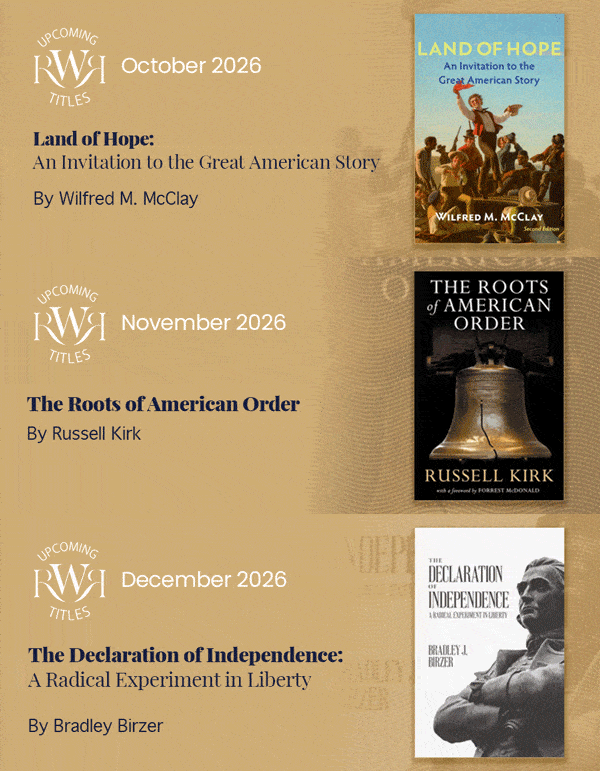
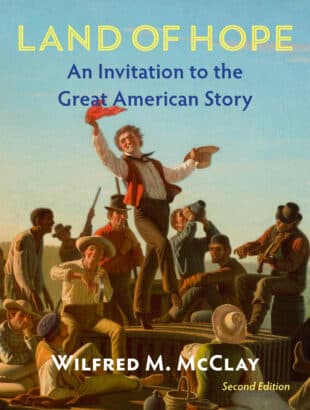
Wilfred McClay’s Land of Hope: An Invitation to the Great American Story offers an important corrective to common surveys. It does so not by showing where these surveys go wrong, but by telling the nation’s story in a responsible, winsome manner. Originally published in 2019, a beautiful, richly illustrated second edition of the book was published in September 2026. I’ll make a few comments about the new edition, but this review essay is of the first edition.
Professor McClay makes no secret of his objective in writing this book. On the very first page, he informs readers that it means to offer to American readers, young and old alike, an accurate, responsible, coherent, persuasive, and inspiring narrative account of their own country—an account that will inform and deepen their sense of the land they inhabit and equip them for the privileges and responsibilities of citizenship.
Because he hopes to better prepare Americans for the duties of citizenship, McClay emphasizes the political history of the United States. He acknowledges that other types of history are valuable and interesting, but he points out, reasonably enough, that “one cannot do everything all at once.” Indeed, even telling the political history of the United States in the first edition’s 433 pages is a daunting task, but it is one that he successfully accomplishes.
A major strength of the work is that it is eloquently written. McClay is a master of the written (and spoken) word. He offers a narrative that is clear, crisp, and compelling. The book is a joy to read, something I cannot say about any of the overviews of American history that I have consulted over the years.
Particularly refreshing is the text’s balanced account of American history. McClay does not neglect the darker side of our country’s past. For instance, he offers a fair account of the introduction of slavery into the American colonies, the inability of the Founders to abolish it, the strife it caused in antebellum America, and its role in sparking the Civil War. But neither does he paint America an overwhelmingly racist country whose Founders were simply hypocrites.
Critically important and as promised by the title, McClay tells the story of America and makes clear that it is one of hope. America was not and cannot be a perfect nation, but it is a land where countless people have immigrated to pursue dreams of religious liberty, political freedom, economic success, and the like. Many of these individuals came here voluntarily, but even those here before European settlers arrived or those brought here involuntarily have been incorporated into the nation’s narrative and many have benefited as the United States has better guaranteed the majestic promises of the Declaration of Independence.
How to Study History
Woven throughout Land of Hope are helpful observations about how we should study history. He notes, for instance, that we naturally tend to think about the past as leading to “the grim terminus toward which we know it is leading.” But [t]hat habit of mind should be resisted if we are truly to enter into the spirit of the past and to grasp the nature of historical change. History is only very rarely the story of inevitabilities, and it almost never appears in that form to its participants.
Likewise, he cautions readers to resist the temptation to make facile moral judgments of the past and instead to “draw back and look at matters as broadly and historically as we can and to reserve our moral judgments.” And he offers important cautions about “the problems inherent in creating a reliable account of current history.”
McClay’s comments on how to study history are never pedantic, and they do not detract from his narrative of the United States. But they help give students the tools necessary to be good, life-long students of America’s story.
Second Edition: An Excellent Update
If I had only read the first edition of Land of Hope, I would have no hesitation in strongly recommending it to students and adults alike who desire a fair, accurate, and eloquent account of American history. But the second edition improves on the first by an order of magnitude. The difference is not in the text itself, which McClay notes “has been only slightly changed.” Instead, improvements include the addition of numerous works of art, illustrations, and photographs; a helpful timeline; and well-chosen primary sources interspersed in each chapter. The second edition, now 803 pages long, is a beautiful book, and the additions make it a more enjoyable read and will be appreciated by anyone using the book in a classroom.
The United States is facing a crisis of historical ignorance and civic illiteracy. Land of Hope will not solve these problems, but it is an important tool that may be profitably employed by parents, teachers, civic leaders, and others committed to our nation’s success.
Mark David Hall (Ph.D., University of Virginia) is a professor in Regent University’s Robertson school of Government, a senior research fellow at First Liberty’s Center for Religion, Culture & Democracy, and director of the CRCD’s Religious Liberty in the States project. He is also affiliate faculty at George Fox University, senior fellow at Emory University’s Center for the Study of Law and Religion, and senior fellow at Baylor University’s Institute for the Studies of Religion.