
I look back with gratitude at the season of life that followed graduate school. These were years that found me, somewhat unexpectedly, doing criminal justice research in Washington, D.C. During this season two things occurred that changed my way of thinking forever. One was ecumenical; I refer here to the utter joy of meeting a wide range of both Catholics and Protestants working on Capitol Hill who took their faith seriously in the context of doing policy work and government service. The other was ethical; it concerned my exposure to Catholic social thought and the importance of natural law.
These also were years in the late pontificate of John Paul II, who – so it seemed – was regularly publishing a major encyclical on an important cultural topic. Doubtless, I was one of many theologically orthodox Protestants who at the time were being challenged and nourished by John Paul’s writings – notably Centesimus Annus (1990), Veritatis Splendor (1993), Ut Unum Sint (1995), Evangelium Vitae (1995), and the pontiff’s final work, Fides et Ratio (1998). As I wrestled, both personally and in my work, with the moral-philosophical foundations of justice, I came to realize the centrality of natural law moral reasoning. And I was forced to wonder why Protestants – both revisionist as well as orthodox types – for the most part either rejected the natural law or were deeply suspicious thereof.1
One of those important works that helped propel my thinking in the right direction was Hadley Arkes’ First Things: An Inquiry into the First Principles of Morals and Justice, published in 1986 when Arkes was a professor of jurisprudence and political science at Amherst College. Arkes seemed to have this wonderfully provocative way of examining law, legal practice, legal culture, and the wider culture. First Things – all 432 pages of it – was divided into two parts: (1) The Groundwork of Moral Judgment and (2) Cases and Applications. What inspired me, a poor soul with zero background in law and legal history, was Part 1 of the treatise. And here Arkes did not disappoint.
Part 1 of the book creatively examines the human capacity to make moral judgments. Arkes develops his reasoning in much the same way as C.S. Lewis would have, though with greater legal sophistication. Here I have in mind the opening essay in Mere Christianity, “Right and Wrong as a Clue to the Meaning of the Universe,” wherein Lewis, in his singular way, prods the reader to ponder why it is that every person – everyone everywhere – reacts negatively when injustice pays us a personal visit. Why is it, Lewis asked, that every person alive flinches when injustice intrudes on them at the personal level? It is almost as if a “law” exists in the universe, Lewis observed. And, of course, there is. Which for Lewis is but a small step to the obvious (moral) conclusion: if there is a moral “law” in the universe, there must be a moral “Lawgiver.” Indeed.
Here Arkes is at his best when he is speaking of “necessary truths” and the reality of a moral universe inhabited by all. As well as when he is deconstructing – then demolishing – arguments that, in protest of a moral public square, are proffered by the cynic, the skeptic, the postmodernist, the relativist, even – at times – the serious (though seriously deficient) Christian who prefers a private faith. For Arkes, as for Lewis, moral propositions are universal, and thus categorical, in nature. That is, right and wrong, good and evil, justice and injustice are binding for all, regardless of social-cultural location or placement in human history. Which, thankfully, removes the subjective character of our lives as we inhabit the public square.
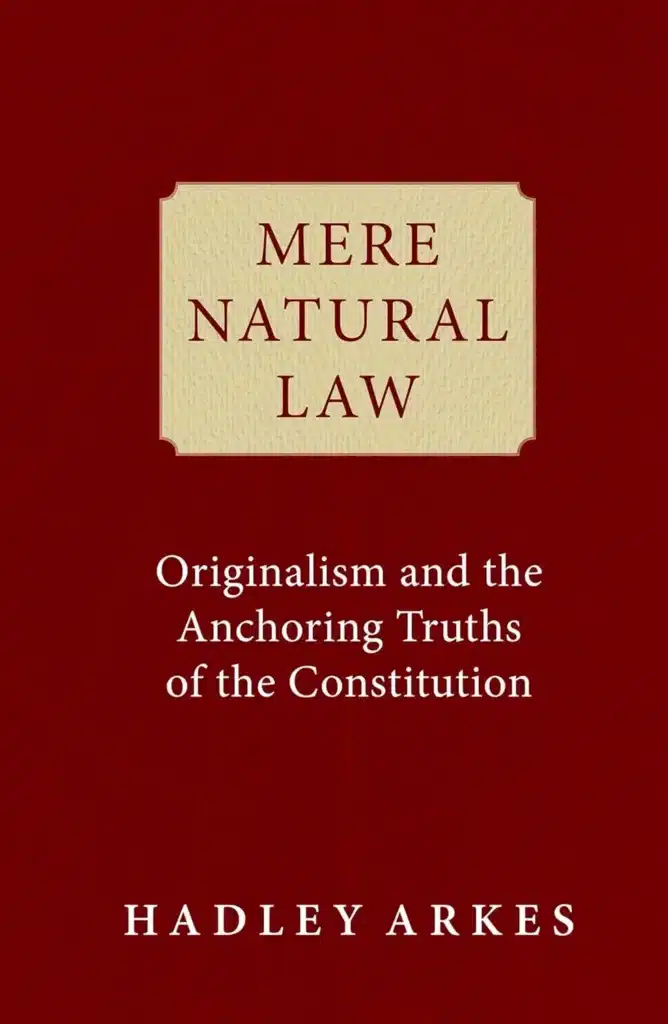
Arkes’ most recent book, Mere Natural Law, continues the project of seeking to recover truths that have been thought to anchor the American political and constitutional order. His deep appreciation for natural law reasoning among the American founders and framers is a necessary tonic against the moral amnesia that afflicts Americans of all ages. Arkes is adept in reminding us that neither those of us as American citizens nor those who are elected or appointed to public office can act as if law and social-public policy are morally neutral. Mere Natural Law rehearses the social and cultural obstacles that confront us in the third decade of the 21st century – the natural law challenge – while arguing that these obstacles, whether in the form of “rights” wrongly construed, legal distortions, the devaluing of human personhood, perversions of “free speech,” or simple moral confusion, suggest that the present time is indeed ripe – ripe for a natural law moment.
This “moment,” alas, confirms itself in our day through disquieting developments in American society. The threatening nature of these social-cultural currents exercises a “darkening” (Arkes’ term) influence on the broader political climate, particularly as it concerns religious freedom and what the founders understood to be the sacred rights of conscience. Indeed, as Arkes emphasizes, laws and policy that protect the freedom of religious conviction flow out of the very ground in which natural law reasoning is nourished. Religious liberty then, as it turns out, is not merely a Catholic or Christian or Jewish or Muslim issue; it is an issue of human dignity and personhood, one that even seeks to protect those who do not share any “religious” conviction.
This, of course, illustrates why abortion, sexuality, euthanasia/physician-assisted suicide, and criminal violence, to cite but several moral matters that bedevil American society so ferociously in our day, are not mere “religious” issues. They have to do with human design and hence in their essence are moral issues – issues which are qualified by knowable truths needing to be affirmed in the public square. For this reason, in the opening line of John Paul II’s final encyclical, Fides et Ratio, the former pontiff stresses that faith and reason, working together, are “like two wings on which the human spirit rises to the contemplation of truth; and God has placed in the human heart a desire to know the truth – in a word, to know himself – so that, by knowing and loving God, men and women may also come to the fullness of truth about themselves.”2 These two “wings” confirm the presence and operation of the natural law, the law “written on the heart” (Rom. 2:14-15).
To illustrate: we observe in St. Paul a most lucid demonstration of what John Paul was suggesting. In the brief but tantalizing portrait offered by St. Luke in Acts 17, we are witnesses to the “apostle to the Gentiles” as he models early Christian interaction with the assumptions at work in first-century Athenian culture. Here, in the Socratic mold, the apostle is dialoguing initially with philosophers in the agora, the marketplace, and thereafter addresses the Council of the Areopagus, a presidium of Athens’ leaders who governed social, educational, and political matters. What is significant is the manner in which the apostle engages his learned and predominately Stoic audience. He appeals to nature in contending for the Creator God who has made himself known. And he exploits broadly Stoic themes – among these, cosmic unity, divine kinship, and divine offspring – while utilizing a word-play on “knowledge” (gnōsis), which is not incidental in light of the Stoic primacy of “knowing” as the foundation of the moral life.3
To observe that St. Paul is accommodating himself by employing common moral categories between Stoics (along with Epicureans) and Christians is not to deny the radical difference between the two. It is only to point out that the Christian message will look for moral common ground, furnished often through natural law reasoning, as Christians seek to build bridges to the pagan or secular mind. It is worth noting that the apostle does not cite the Hebrew scriptures in the Areopagus speech; rather, “general revelation” and natural law reasoning serve as a means of bridge-building and an introduction to “special revelation” and the God-man, Jesus Christ. Christian truth is disclosed by the “apostle to the Gentiles” by means of reason and revelation. God has made himself known to all, and for this knowledge all will be held accountable.4
But we return to the matter of religious freedom – a matter that Arkes, quite properly, has raised.5 Simply put, religious freedom is in trouble. Serious trouble. The very freedom to express ultimate convictions – to affirm what is true, definitive, and binding for all time and all people – is under assault, and that assault is evidenced both at home and abroad. And despite the failure – unwillingness? – of the broadcast and print media to report such, rarely a day goes by without some form of intimidation and violence against religious minorities around the globe. More and more, the U.S. and Western nations are a part of that story. Ours is a world, in the words of Benedict XVI, “marked by persecution, discrimination, terrible acts of violence and religious intolerance.”6 Such is true in the global context, and increasingly so in the Western context.
Not for nothing has religious freedom been called the “first freedom.” And while government in sich has no religious identity, as the American founders knew, that is not to contend that government has no religious significance, or that it plays no role in helping to preserve religious freedom. It is noteworthy that, only thirty years after Thomas Jefferson had served as a foreign minister in France, Alexis de Tocqueville, upon visiting the young republic, did not describe the relationship between religion and the state as a “wall” – much less a “high” and “impregnable” wall that came to be the adopted Supreme Court metaphor in the 20th century. Rather, his report, as we have it in Democracy in America, understands this relationship to be interactive and protective of the sacred rights of conscience, which in many respects for Tocqueville made the American experiment in ordered liberty unique. The more appropriate metaphor, at most, might be that of a “fence,” given the provisions of the First Amendment.7
If religious freedom is conceived as the pursuit of what is true, and if natural law serves as a mirror of “self-evident” truth, then protecting the most basic human “good” enables human beings to flourish, and this we call “justice.” When and where this moral task is neglected or denied, “civil society” (at least as we have known it) collapses and a soft form of totalitarianism has already taken hold.
Historically, renewed interest in natural law often emerges in periods of social and/or global chaos. If that be true, then we live in a “natural law moment.”
J. Daryl Charles (PhD, Westminster Theological Seminary) is a senior fellow at the Center for Religion, Culture & Democracy. He is also a 2024/25 visiting Elshtain fellow, Institute on Religion and Democracy, and serves as a contributing editor of Providence: A Journal of Christianity and American Foreign Policy and of Touchstone. He is author or editor of twenty-four books, including Retrieving the Natural Law (2008), Natural Law and Religious Freedom (2018), and, most recently, The Idea and Significance of Natural Law: Fifty Questions and Answers (2025).
1 In the modern era both religiously minded and secular types have tended to reject natural law thinking. Unhappily, this has been pronounced among Protestants – until of late, that is. While there is no full-scale “revival” of natural law thinking occurring across the board among Protestants, there has been something of a renewal in some circles, as the number of books published on the topic in the last two decades would suggest. For a discussion of this Protestant phenomenon, with attention drawn to the magisterial Reformers (all of whom affirmed the natural law), see Chapter Four (“Natural Law and the Protestant Prejudice”) in J. Daryl Charles, Retrieving the Natural Law: A Return to Moral First Things (Grand Rapids and Cambridge, UK: Eerdmans, 2008), 111-55.
2 John Paul II, Fides et Ratio, encyclical letter, September 14, 1998; accessible at https://www.vatican.va/content/john-paul-ii/en/encyclicals/documents/hf_jp-ii_enc_14091998_fides-e t-ratio.html.
3 See esp. Acts 17: 22-31.
4 It is important to state what natural law can and can’t do. It does not tell us about all of moral reality; it does, however, offer a minimum of knowledge: do good and avoid doing evil. The “Golden Rule” – Do to others as you would have them do to you and Don’t do to other what you would not want done to you – is but one clear expression of natural law moral reasoning. No one, anywhere, does not believe the “Golden Rule.”
5 See chapter 9, “Recasting Religious Freedom.”
6 Benedict XVI, Religious Freedom, the Path to Peace (January 1, 2011) no. 1; accessible at https://www.vatican.va/content/benedict-xvi/en/messages/peace/documents/hf_ben-xvi_mes_201012 08_xliv-world-day-peace.html#:~:text=Religious%20freedom%2C%20the%20path%20to%20peace,-15. &text=Peace%20is%20a%20gift%20of,deceptive%20ploys%20or%20clever%20manipulation.
7 As someone has said, “Good fences make good neighbors.”