

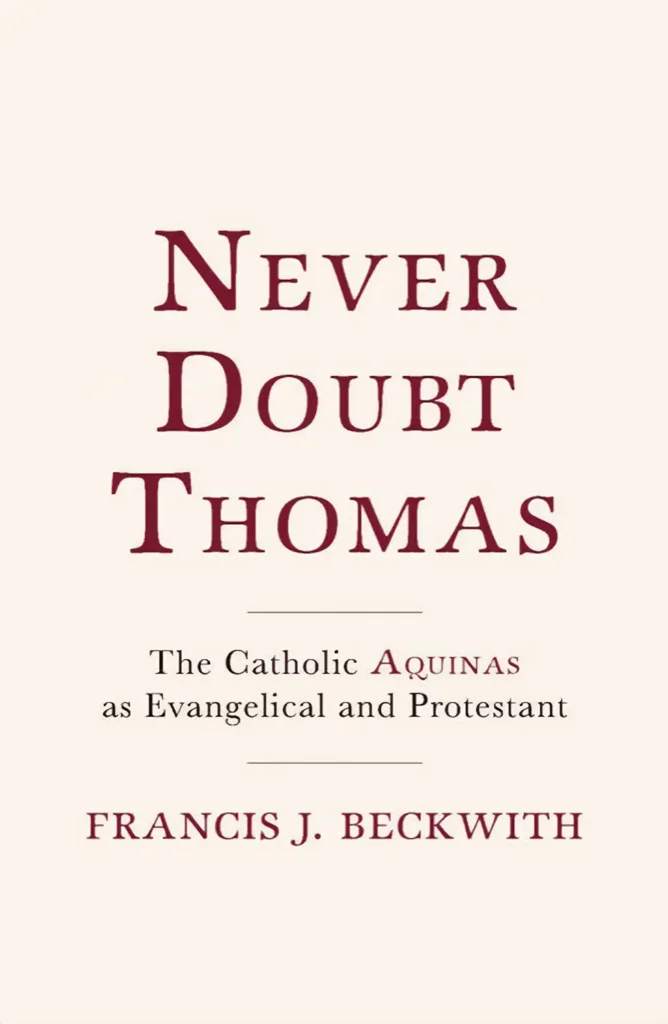
In Never Doubt Thomas, Francis Beckwith expands the field of scholarly study concerning the reception of the work of St. Thomas Aquinas. Beckwith’s book is particularly valuable because he looks beyond the more traditional Thomists to focus on a specific subset of evangelical scholars who are seeking to incorporate the insights of St. Thomas within their own philosophical and theological traditions. In his book, Beckwith considers how the writings of Thomas have informed their arguments on contemporary questions related to natural law, intelligent design, justification, and the identity of God as discerned or revealed within the great monotheistic traditions. Although Beckwith challenges the accuracy of some of these scholars’ appropriation of Thomas (especially when they read too much through the lens of certain Protestant theological presuppositions), he provides a valuable service by bringing more contemporary evangelical uses of Aquinas (both their strengths and weaknesses) into the broader Thomistic discourse. In doing this, Beckwith expands yet further what it means to consider Aquinas as the Doctor Communis and how engagement with his writings from a variety of perspectives can contribute to what Fr. Thomas Joseph White, OP, describes in the foreword as “engaged living Thomism.”
In this essay, I will consider other voices involved in a similar project of retrieval and development. It would be impossible to capture the breadth of St. Thomas’s impact in an entire series, let alone a single essay. Rather, I will briefly describe some other significant retrievals of St. Thomas related to seminal questions in ethics: natural law, virtues, politics, and social ethics. I will focus specifically on instances when St. Thomas served as an important resource for theologians and philosophers confronting dramatic change. I will not be evaluating the accuracy of these retrievals relative to the work of Thomas himself. Rather in these examples, I will focus on how in reaction to the work of St. Thomas Aquinas we may discern not only something about Thomas, but also some insights into the challenges of each age—especially as we consider the questions related to the worth and value of the human person. Perhaps part of the importance of “The Common Doctor” is how his writings can illuminate our own hopes and concerns.
St. Thomas and the Age of Exploration
One of the most significant centers focused on intentional retrieval of the thought of St. Thomas in the sixteenth century was the school of Salamanca. When the Dominican philosopher and theologian Francisco de Vitoria returned from his theological training at the University of Paris (1483–1546), he expanded the Thomistic focus at the important Spanish university. This revival in Thomistic studies coincided with the cultural changes of the age of exploration and the Reformation. Vitoria himself used St. Thomas’ writing on the relationship between nature and grace in the Summa (II-II 10.10) in his famous relectio De Indis to challenge the Spanish claims that the conquest of the New World was justified because it was inhabited by non-Christians. Vitoria drew on Aquinas’ claims that grace does not destroy nature to argue that receiving God’s grace does not annul either natural law or the political power deriving from natural civil authority. Vitoria’s intellectual heirs—most importantly the Dominican theologians Domingo de Soto and Melchior Cano and the Jesuit Francisco Suárez—would continue to develop these Thomistic concepts of the relationship between nature and grace in the political sphere. Through their work, they would shape much of our contemporary discourse regarding subjective rights, international law, and democratic government. For example, the legal textbook authored by Suárez, which contains an extended commentary on the Summa’s discussion of law, was read across Europe by both Protestants and Catholics. Suárez developed the understanding of civil law drawn from Aquinas and articulated in this Salamantine tradition to challenge the theory of the divine right of kings. He argued that the power to establish the government of a commonwealth does come from God, but it is always first entrusted to the people, who may choose to delegate power to the king, who then makes laws which the people’s reception may form.
Alongside the impact on political theology, the theology of St. Thomas was also hotly contested in the Reformation-era controversies. Catholic theologians of the School of Salamanca not only drew on St. Thomas to challenge political injustice, but they also argued from Thomas to uphold the theological claims of the Catholic Church, especially in the documents of the Council of Trent. Across the Reformation divide, St. Thomas’ theology also spared hotly contested debates among the magisterial Reformers. Martin Luther was not especially familiar with Thomas’s work in itself, having only apparently only read the Prima Pars and depending upon Gabriel Biel’s readings of Thomas’ ethics, as Daniel Westberg argues. However, as Jordan Ballor has proposed, Aquinas retained significance for Luther, often serving as the figurehead Luther would attempt to rebut when he challenged the work of the later scholastics. However, other significant Reformers, especially the former Roman Catholic religious Martin Bucer and Peter Martyr Vermigli had a greater knowledge of Aquinas’ actual work. Rather than rejecting Aquinas, David Sytsma has shown that both Bucer and Vermigli generally drew upon his theology for a wide range of dogmatic and ethical positions which would influence the formation of later Protestant scholastic systems, including views related to the nature of free will and law. Bucer, for example, pioneered the use of the term saniores scholastici (sounder scholastics) which would later distinguish Aquinas in the Reformed literature from the later scholastic opponents.
On the Anglican side of the Reformation, the appropriation and development of Aquinas is even more obvious and apparent. In his important treatise on laws, On the Laws of Ecclesiastical Polity, Richard Hooker explicitly develops the Thomistic concept of the relationship between divine, natural, and civil laws to justify and explain the variety of laws (divine, natural, and human) and justify different forms of ecclesial and political arrangements. Hooker’s apologia would be very important for developing the unique Anglican form of ecclesiology—with its complex relationship with the role of the king and parliament as ecclesial governing bodies. These ideas are also significant in their impact on John Locke. In his Second Treatise Locke refers repeatedly to Hooker’s conception of basic human equality before the law and the role of right reason in guiding the decisions of humans, ideas which are to some degree grounded in Hooker’s retrieval of Aquinas. Although their arguments are not identical, Locke arrives at some similar conclusions regarding law’s establishment to those articulated by Francisco Suárez, showing the broad impact of this Thomistic heritage.
St. Thomas and Modernity
In another time of great change, the end of the nineteenth and the twentieth century, Christian theologians continued to find resources to tackle the challenges of modernity. The contemporary social doctrine of the Catholic Church has been most comprehensively expressed in the body of papal and conciliar documents and encyclicals described as Catholic Social Teaching. Pope Leo XIII initiated this genre of theological teaching in his encyclical Rerum Novarum (1891) dealing with the pressing question of rights and treatment of labor. Leo continued the retrieval and revival of Thomistic reflection which he had begun in his encyclical Aeterni Patris (1879) on the priority of Thomas’ thought in Catholic philosophical education. In Rerum Novarum, Leo finds resources for addressing the economic questions of his day. He builds many of his claims on Aquinas’ articulation of the doctrine of the universal destination of goods: “It is one thing to have a right to the possession of money and another to have a right to use money as one wills.”
This focus on the right use of money and property—while still upholding both some concept of private property ownership along with the gospel prioritization of the poor—will become a dominant theme for the entire corpus of Catholic Social Teaching. For example in 1981 Pope St. John Paul II in Laborem Exercens can reach back to Rerum Novarum to make the same point drawn from Aquinas in navigating between the excesses of Marxism and unfettered capitalism. He writes that the means of production “cannot be possessed against labour, they cannot even be possessed for possession’s sake, because the only legitimate title to their possession—whether in the form of private ownership or in the form of public or collective ownership—is that they should serve labour, and thus, by serving labour, that they should make possible the achievement of the first principle of this order, namely, the universal destination of goods and the right to common use of them.”
This engagement with Aquinas in confronting modernity was not unique to the Catholic world. The intellectual forerunner to many of the figures discussed in Beckwith’s book was, of course, Karl Barth. Kenneth Oakes describes how Aquinas in fact plays four different roles for Barth. First, Aquinas at times is simply described as the spokesman for official Roman Catholic theology. Secondly, Barth finds support in Aquinas for the developments of the Reformation (both of these parallel the Reformation approaches discussed above). Third, he can serve as a counterbalance and even challenger to what Barth views as problematic approaches in Roman Catholic theology as a whole. And finally, separate from theological controversy, he can serve as “one of many esteemed teachers of the faith who deserves both respect and critical engagement.” Barth mingles these approaches in his stinging rebuke of Brunner in his essay simply entitled “Nein!” Here, Barth uses Aquinas to represent Roman Catholic theology on how far humans can achieve a natural knowledge of God. While Barth rejects Aquinas and especially his theory of the analogia entis (analogy of being), he finds Aquinas’ natural theology a better alternative than Brunner’s emphasis on the possibility of accessing knowledge of God through a “people and a history,” which Barth worries gives too much theological comfort to the “German Christians” who have failed to reject Nazism alongside the confessing church.
Jacques Maritain, the French philosophical contemporary of Barth, relied much more explicitly on Aquinas as an important dialogue partner in the fight against totalitarianism. Maritain explicitly draws upon Aquinas to argue (contra totalitarian assumptions regarding the human person and the state) that the person’s relationship to society is both crucial for human identity but also that the society does not subsume the person completely. He writes, “By reason of certain relations to the common life which concern our whole being, we are a part of the state; but by reason of other relations (likewise of interest to our whole being) to things more important than the common life, there are goods and values in us which are neither by nor for the state.” This emphasis on the importance of the individual’s distinction from the state—without surrendering a concept of the common good—can be perceived in Maritain’s advocacy for the United Nations’ Universal Declaration of Human Rights.
Across the Atlantic, John Courtney Murray, the great Jesuit theologian who had a formative influence on the development of Dignitas Humanae (the doctrine of religious freedom articulated in Vatican II), also drew on Aquinas to support his theology of religious freedom and pluralism in contemporary democracies. For example, Murray consistently returns to Aquinas to support his arguments for cultural and democratic pluralism, as well as finding in Aquinas a theoretical and theological undergirding for democratic government (here, Murray, not surprisingly, has much in common with his fellow Jesuit discussed above, Francisco Suárez).
In conclusion, looking at moments of theological tumult and change, we see the significance of St. Thomas’ role as Doctor Communis. While the emphasis and questions asked of St. Thomas may change with the challenges of the age, the perennial importance of his work as a theological source and even summa remains. As Beckwith reminds us in his title, Never Doubt [the significance] of Thomas.
Elisabeth Rain Kincaid (J.D., Ph.D.) is the Legendre-Soulé Chair in Business Ethics & Director of the Center for Ethics and Economic Justice at Loyola University New Orleans. She is also a research fellow at the Center for Religion, Culture & Democracy and author most recently of Law from Below: How the Thought of Francisco Suárez, SJ, Can Renew Contemporary Legal Engagement.